The tool aims to help stakeholders "cut through regulatory complexity" and ensure equitable access to the light rail line's economic benefits.


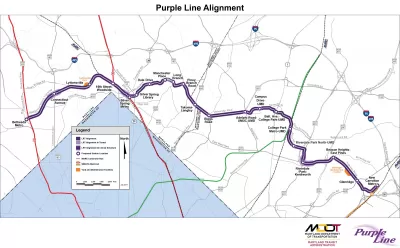
A new tool from the University of Maryland’s National Center for Smart Growth Research and Education (NCSG) "provides easy access to a curated database of plans and regulations" in the Purple Line corridor, the area surrounding Maryland's upcoming Purple Line light rail. Cyrus Chimento, who worked on the project, writes in Greater Greater Washington that while the Purple Line project "presents massive benefits to locals such as increasing transportation access, decreasing pollution, and creating jobs," not all residents will share the benefits. "To combat this potential outcome, the Purple Line Corridor Coalition (PLCC) formed a community development agreement among businesses, nonprofits, government agencies, and community groups to make sure the Purple Line benefits are shared equitably among all residents and workers in the area." The coalition's goals include supporting and growing local businesses, improving access to housing choices, and building a thriving labor market.
The Plans and Regulations Information Tool aims to simplify the navigation of the area's complex regulatory environment. "The real power of the tool is to (very quickly) answer the general question underpinning those mentioned above: 'What plans or regulations apply to this place?' And since the Purple Line corridor spans multiple jurisdictions, we bring all the data together in one place." The tool is designed to assist developers and other interested stakeholders in understanding local regulations, and its designers hope "it can be a piece of the larger effort to make sure the benefits of the Purple Line investment accrue equitably."
Read the full story: This tool helps create equitable development in communities surrounding the Purple Line

DC Metro Is Betting on Buses
The agency plans to significantly expand bus service, which can be added faster and at a lower cost than rail projects.
DC Suburban Light Rail Expansion Prompts Mixed-Use Development
The Purple Line’s expansion into Maryland suburbs in 2027 has spurred TOD along the line.
Coalition Fights Displacement Along Purple Line
Community advocates are warning that Maryland’s new light rail line could cause displacement without concerted efforts to preserve affordable housing and legacy businesses.

Planetizen Federal Action Tracker
A weekly monitor of how Trump’s orders and actions are impacting planners and planning in America.

The state-sanctioned urbicide of Austin
People don’t kill cities. Freeways do.

Colorado’s Largest Data Center Could Rise Next to Homes — Without a Public Hearing
The proposed campus would consume 11 times the power of Denver International Airport; as it has across the country, opposition mounts.

Judges permit Denver to divert 77,000 acre feet from the Colorado River for reservoir expansion
Overuse and climate change have caused the Colorado River’s water levels to plummet.

Amtrak, CN end decades-long dispute with eight-year agreement
The new operating agreement establishes an updated framework for the companies to work together, including processes to resolve disputes.

Raised interest rates may kill financially vulnerable construction projects
The chief economist at ConstructConnect warns that if construction project owners are negatively impacted by the raised rates, it could result in delayed payments to contractors.

FREE Course: Walkable City 1: Why Walkability?
After describing his path towards focusing on walkability as the essence of good planning, Jeff Speck marches through his five principal reasons for making more walkable places.
Reinventing Malls: Planning Alchemy—Turning Gray Fields Into Gold
The course focuses on the opportunities and imperatives that shape reinvention of mall sites.

KFH Group Inc.
Greater Baltimore Committee
Eagle County Government
The Architects Foundation
University of Cincinnati Online
The Pocatello Development Authority
The Urban Renewal Agency of the City of Pocatello