The developer of the 15-home community claims they will produce homes with a tenth of the waste of traditional construction in record time.



Kari Paul reports on a new neighborhood in California's Coachella Valley that will be home to entirely 3D-printed homes. "Through a partnership between two California companies – Palari, a sustainable real estate development group, and Mighty Buildings, a construction technology company – a five acre parcel of land in Rancho Mirage will be transformed into a planned community of 15 3D-printed, eco-friendly homes claiming to be the first of its kind."
Oakland-based Mighty Buildings designs and produces homes with, according to the company, 95% fewer labor hours and ten times less waste than traditional construction techniques. The company can build a 350-sq-ft home in less than 24 hours. "The Rancho Mirage homes will each feature mid-century modern architecture and consist of a three-bedroom, two-bath primary residence of 1,450 sq ft, along with a secondary residence on the property of two bedrooms and one bath." The project comes at a time when California faces a massive housing crisis, with the state projecting a need of "between 1.8m and 3.5m new housing units by 2025 to address the shortage and accommodate projected population growth." Mighty Buildings plans to target the "missing middle housing" market—mid-density multi-family housing that has been largely underrepresented in most cities.
Read the full story: The future of housing': California desert to get America's first 3D-printed neighborhood
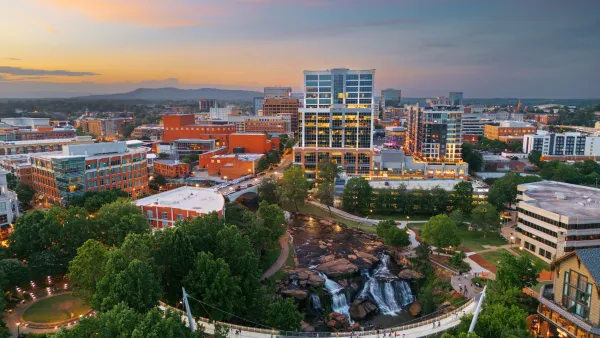
Greenville, SC pushes for missing middle housing
The city recently overhauled its zoning rules to permit more 'low-intensity' housing options.
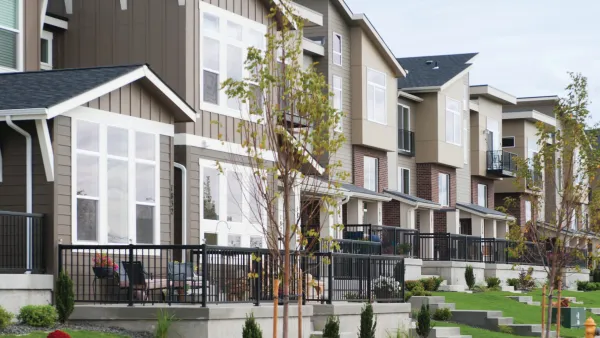
'Missing middle housing' accounted for nearly 20% of Spokane permits in 2025
Recent laws making it easier and less costly to build smaller residential buildings are having their intended effect.
Five simple zoning changes that any city can make to increase housing affordability
Zoning for more affordable housing is not rocket science, says Donald Elliot, author of "An Even Better Way to Zone." Here’s his five-step guide to getting started.

Planetizen Federal Action Tracker
A weekly monitor of how Trump’s orders and actions are impacting planners and planning in America.

California plans to bury El Niño’s downpour
If the state plays its cards right, it may be able to store a billion acre-feet of El Niño’s water in aquifers.

Desperate measures: Advocates weigh draining Lake Powell to fill Colorado River
Draining the reservoir could reduce evaporation losses by a couple hundred thousand acre-feet.

Housing is the top priority of Seattle’s sole new councilmember
Jenks campaigned on building 1,000 new units of affordable housing.

New tax cuts may slash $1.5 billion in funding for Miami transit, public parks
Amendment 3 will save Miami-Dade homeowners $2,700 in 2028.

Arizona, Wisconsin, Pennsylvania hope to finally advance climate goals post-midterms
The three states have spent years under Republican or divided control.

FREE Course: Walkable City 1: Why Walkability?
After describing his path towards focusing on walkability as the essence of good planning, Jeff Speck marches through his five principal reasons for making more walkable places.
Reinventing Malls: Planning Alchemy—Turning Gray Fields Into Gold
The course focuses on the opportunities and imperatives that shape reinvention of mall sites.

City of Rosemead
Rutgers University, Edward J. Bloustein School of Planning and Public Policy
One Hundred Miles
University of Michigan School for Environment and Sustainability (SEAS)
Hunter College, City University of New York (CUNY)
The Architects Foundation
City of Cambridge
Montrose County
The Pocatello Development Authority