Amazon and FedEx are developing bots that would travel on city streets and sidewalks. The companies are also working behind the scenes on legislative efforts that would help them deploy the technology in the future.


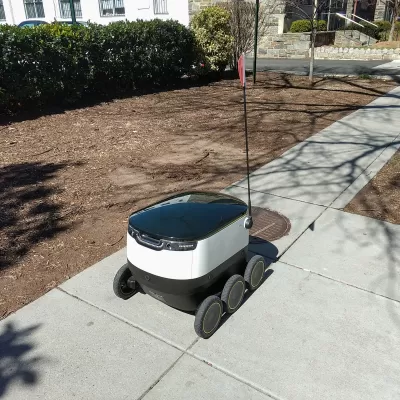
"Both Amazon and FedEx are developing delivery robots. FedEx’s bot, which is called Roxo and looks like a small refrigerator, has completed on-road tests in four cities. Scout, built to deliver Prime packages, also is testing in four cities. The companies present similar visions: A delivery van full of robots would arrive in a neighborhood, and robots would travel the ‘last mile’ to customers’ doorsteps without human aid," writes Aarian Marshall.
The companies are backing bills this year in more than a dozen states that would allow delivery robots on public roads and sidewalks. The legislation is not consistent, with different regulations about where the robots could operate and weight limits. But observers say that shaping legislation early on is a way to establish certainty while the new technologies are developed.
However, concerns about public safety, particularly on sidewalks, and cities' inability to craft their own regulations for the robots have emerged. Lawmakers and lobbyists say that Amazon and FedEx seem open to discussions about changes to the bills. "Scott Mooneyham, of the North Carolina League of Municipalities, contrasts that approach with the early actions of scooter companies, which became notorious for dropping their electric devices on public sidewalks without giving local officials prior warning," says Marshall.
FULL STORY: Amazon and FedEx Push to Put Delivery Robots on Your Sidewalk

How Street Configuration Impacts Equity
With urban pollution and traffic violence disproportionately affecting communities of color, better management of public space and streets could improve equity in cities.
West Hollywood makes delivery robots paying road users
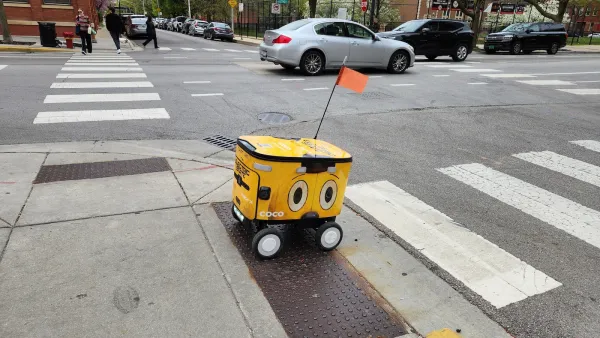
Cities are looking for creative ways to regulate food delivery robots, in some cases putting them to work gathering data for ADA compliance or collecting revenue for sidewalk maintenance.
Delivery Robots are Taking Over Chicago Sidewalks, Alarming Residents
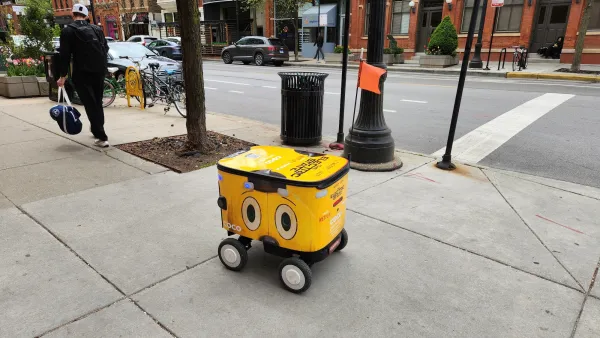
Residents have reported that the food delivery bots have forced people off sidewalks into busy streets and collided with bicyclists.

Planetizen Federal Action Tracker
A weekly monitor of how Trump’s orders and actions are impacting planners and planning in America.

The state-sanctioned urbicide of Austin
People don’t kill cities. Freeways do.

US to reduce Colorado River water deliveries to Mexico
A new Colorado Treaty amendment reduces Mexico’s Colorado River water allocation by 250,000 acre feet.

Mamdani overhauls NYC's Vision Zero plan with 100 new policy goals
The overhaul aims to reduce traffic deaths and make streets safer for pedestrians, cyclists and drivers through lower speed limits, new safety infrastructure and more.

Amtrak not solely to blame for New Jersey commuter rail's unreliability, report finds
A new study from the Garden State Initiative found that NJ Transit’s budget grew 20% across a 4 year period, but reliability declined significantly over the same period.

EPA erases limits on planet-warming pollution from power plants
Under Monday’s plan, power plants would still have some limits on how much mercury, arsenic and other contaminants they can emit.

FREE Course: Walkable City 1: Why Walkability?
After describing his path towards focusing on walkability as the essence of good planning, Jeff Speck marches through his five principal reasons for making more walkable places.
Reinventing Malls: Planning Alchemy—Turning Gray Fields Into Gold
The course focuses on the opportunities and imperatives that shape reinvention of mall sites.

Eagle County Government
Harvard University Graduate School of Design
Nashville Planning Department
The Architects Foundation
University of Cincinnati Online
The Pocatello Development Authority
The Urban Renewal Agency of the City of Pocatello
Journal of the American Planning Association