Honda recently ended the Fit, a small, affordable subcompact car favored by urban dwellers (like the managing editor of Planetizen). The U.S. car market is now completely dislocated from the reality of the rest of the world.


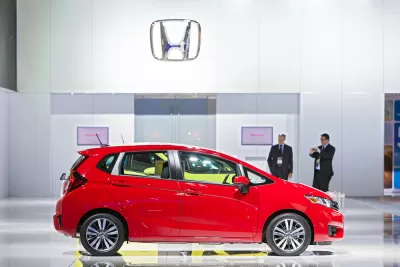
Aaron Gordon builds a larger narrative after a July announcement by Honda that it would no longer sell the Honda Fit in the United States: car companies are fully committing to a traditional neglect of subcompact offerings in the United States.
The subcompact replacement for the Fit in the Honda fleet will be available in overseas markets, but not in the United States. Moreover, the Fit in the United States was always a downgraded substitute for the bells and whistles, and efficiency, of subcompact vehicles in international markets. Gordon explains:
If you ever want to get upset over the boring, terrible, expensive cars on offer in America, go to the UK version of any automaker’s website. Take Honda, for example. Internationally the Fit is known as the Jazz. In the UK, instead of being killed off, the Jazz got an exciting redesign and is a hybrid. As a result, it’s a little more expensive, but would still likely sell for under $20,000 in the US, which would make it the cheapest hybrid on the market (for Honda models that sell in both countries, the US and UK versions have roughly the same prices in their respective currencies; the Jazz hybrid starts at £19,000).
As noted by Gordon, Honda is far from alone in its lack of quality offerings for subcompact cars in the United States. Volkswagen provides another example.
Gordon also notes at the outset that the "subcompact car is basically dead in the US now"--a bold statement that can be supplemented with a few other recent articles, including an article Erik Shilling about the demise of the Fit that includes the car on the scrap heap of subcompact vehicles history in the U.S. market, including the Chevy Sonic, Ford Fiesta, and Toyota Yaris, among other subcompacts likely to mimic the demise of these articles in the near future.
Americans clearly prefer SUVs and large pickup trucks, as proven by a Wall Street Journal by Dan Neil that provoked the large vehicle-loving community on social media, including Senator Ted Cruz, Republican from Texas. Yet another article on the subject, by Nathanial Bullard, makes the case that another approach to automobile design, growing in popularity in Japan and Europe, would be a better choice for U.S. consumers.
Read the full story: Do You Live In the US and Want A Small, Affordable Car? Too Bad.

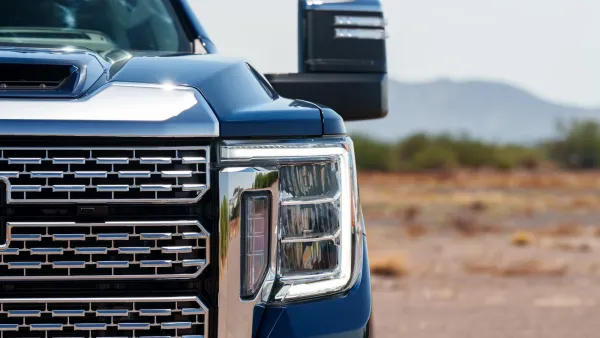
Analysis: Bigger cars are responsible for 10% of increase in pedestrian deaths
The New York Times offers a visual explanation of how larger vehicles make US roads more dangerous.
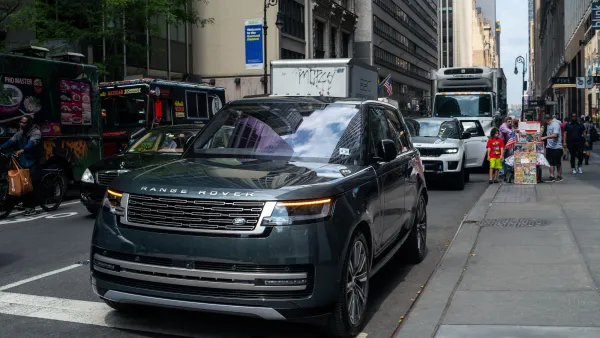
Study: Capping Vehicle Size Could Reduce Global Traffic Deaths by 40%
Limiting cars to 2020 sizes could save consumers up to 22% on gas, according to a new study.

Study: Large SUVs Double Risk of Death for Children Under 10
New research from the United Kingdom reveals the higher risk of larger vehicles for pedestrians and cyclists.

Planetizen Federal Action Tracker
A weekly monitor of how Trump’s orders and actions are impacting planners and planning in America.

California plans to bury El Niño’s downpour
If the state plays its cards right, it may be able to store a billion acre-feet of El Niño’s water in aquifers.

Chicago breaks ground on $3 billion megadevelopment
The new neighborhood, titled Foundry Park, will one day host 3,700 residences.

Satanic place names
From streams and lakes to valleys and canyons, I mapped more than 1,000 places named after the Devil.

California High-Speed Rail Authority CEO resigns after $600,000 scandal
Under Ian Choudri, the authority used taxpayer dollars to fund first class flights and trips to nightclubs.

Want to study the Missouri River? Soon, you may need unanimous approval from 10 states
Legislation would require 10 governors’ permission to study or build projects moving water outside the basin.

FREE Course: Walkable City 1: Why Walkability?
After describing his path towards focusing on walkability as the essence of good planning, Jeff Speck marches through his five principal reasons for making more walkable places.
Reinventing Malls: Planning Alchemy—Turning Gray Fields Into Gold
The course focuses on the opportunities and imperatives that shape reinvention of mall sites.

City of Rosemead
Rutgers University, Edward J. Bloustein School of Planning and Public Policy
One Hundred Miles
Hunter College, City University of New York (CUNY)
The Architects Foundation
University of Cincinnati Online
City of Cambridge
Montrose County
The Pocatello Development Authority