A southwest Ohio city is updating its development code in response to a desire in the community to better protect the city's existing communities.



John Bush reports on the CodePiqua project in Pique, Ohio, which will generate a new development code and transportation plan for the city.
The CodePique effort grows out of Piqua's previous Plan It Piqua Comprehensive Plan, which recommended a code update for the city to better implement the goals set forth in the comprehensive plan.
"The purpose of the project is to put into place development standards that will promote neighborhood qualities that enhance existing developments and create a sense of a place. It also is meant to establish a new transportation plan that includes context sensitive standards for public right-of-way use and improvements," according to Bush.
Piqua Economic Development Director Chris Schmiesing is quoted in the article saying that the city's current development code is too generic to reflect the built environment of the city.
As for the transportation component of CodePiqua, Bush adds the following: "This initiative aims to help resolve many of the conflicts between modes of use, such as vehicles, bicycles and pedestrians. It will also help serve as a basis for future decision making by the Piqua Planning Commission, City Commission and Transportation Committee."
The city contracted Austin-based planning and code consultant Code Studio to work on CodePiqua. More information on the project is available on Code Studio's website.
Read the full story: New community planning project aims to improve economic development in Piqua


Development Code, Future Land Use Map Updates Coming to Dallas
The ForwardDallas initiative is attempting for the Holy Grail of planning: development certainty.

Auburn, Maine Approves New Residential and Commercial Densities Despite Public Outcry
Auburn, Maine offers the latest an example of a small city deciding to increase its capacity for future development in response to housing pressure, even in the face of intense public opposition.
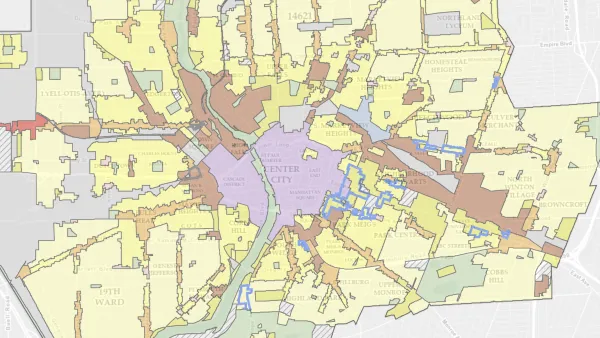
Rochester, New York Drafts a Zoning Map to Match its New Comprehensive Plan
The Rochester 2034 Zoning Alignment Project is implementing the award-winning Rochester 2034 Comprehensive Plan.

Planetizen Federal Action Tracker
A weekly monitor of how Trump’s orders and actions are impacting planners and planning in America.

Northwest rail fans eager for Sept. 30 debut of Amtrak’s Airo fleet
Get ready for that new train smell and more seats. But they won’t go faster or run more frequently on the Cascades route in Washington and Oregon.

Record-breaking wildlife overpass in Colorado brings 91% reduction in animal collisions
Prior to the overpass, vehicles were hitting one deer per day on Colorado’s Interstate 25.

Detroit to transform waterfront with $2.2 billion investment
Developers will convert about 18 acres of unused parking lot space into civic spaces.

‘Going backwards:’ Baltimore mayor, students rally against state's transit funding plan
Maryland's proposed six-year plan provides no funding for Baltimore’s BMORE bus program and reduces its road maintenance funding.

Trump wants to cancel nearly 98% of funding for HUD housing support program
Multiple housing groups are suing the administration in an effort to preserve the funding.

FREE Course: Walkable City 1: Why Walkability?
After describing his path towards focusing on walkability as the essence of good planning, Jeff Speck marches through his five principal reasons for making more walkable places.
Reinventing Malls: Planning Alchemy—Turning Gray Fields Into Gold
The course focuses on the opportunities and imperatives that shape reinvention of mall sites.

City of Thousand Oaks
City of Wisconsin Rapids
Harvard University Graduate School of Design
The Architects Foundation
University of Cincinnati Online
Northern Illinois Transit Authority (NITA)
The Pocatello Development Authority
The Urban Renewal Agency of the City of Pocatello