A step toward an overhaul of the way speed is managed on city streets around the country.


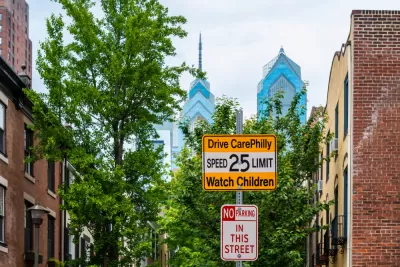
"The National Association of City Transportation Officials (NACTO) [in July] released a guide urging local leaders to rethink how they set speed limits on city streets in a bid to prevent pedestrian deaths," reports Chris Teale.
The "City Limits" guide recommends that cities "[set] default speed limits on many streets at once, designate slow zones in what they deem "sensitive areas" and set speed limits on major corridors by using studies that take into account density and activity level."
NACTO describes this guidance as furthering goals set forth by the National Transportation Safety Board (NTSB) in 2017 to completely overhaul how speed is managed on U.S. streets, including the way that speed limits are set.
Teale cites NACTO Program Manager Jenny O'Connell in stating that NACTO's new guidance would recommend the demise of the 85th percentile rule, "which involves measuring 100 drivers traveling without traffic and setting the speed limit based on the 15th-fastest driver." The 85th percentile rule has been used by some jurisdictions to justify higher speed limits for the sake of enforcement.
Read the full story: NACTO urges shift from 'outdated' speed-limit planning


The Weird Way US Cities Set Speed Limits — and Why it’s Changing
The ‘85% rule’ guides speed limits based on how fast most drivers travel, sometimes prompting cities to raise speed limits.
The 85th Percentile Rule, Explained
A video explainer of the notorious traffic law that explains why some cities have to raise speed limits to enforce traffic safety.

Raising Speed Limits in the Name of Traffic Safety
Business Insider offers a platform for an argument favored by the National Motorists Association and a particularly vocal Michigan state police officer: that speed limits are too slow to be safe.

Planetizen Federal Action Tracker
A weekly monitor of how Trump’s orders and actions are impacting planners and planning in America.

Northwest rail fans eager for Sept. 30 debut of Amtrak’s Airo fleet
Get ready for that new train smell and more seats. But they won’t go faster or run more frequently on the Cascades route in Washington and Oregon.

Trump is considering data centers on 6 states' public land — some state officials say they had no idea
If the administration approves the proposed projects, data center and data center-related developments will cover 17,600 acres of public land.

California may destroy its beaches trying to save homes from El Niño
Boulders and seawalls can protect homes from waves, but ultimately destroy sandy beaches.

California high-speed rail accomplishes only one legislative goal in 2026
The majority of the agency's failed pitches were never developed into written proposals.

Sharp cuts to federal passenger rail, public transit funding arrive today
The American Public Transportation Associations estimates the stopgap bill will result in an over 80% cut to federal passenger rail investment and 20% cut to public transit investment.

FREE Course: Walkable City 1: Why Walkability?
After describing his path towards focusing on walkability as the essence of good planning, Jeff Speck marches through his five principal reasons for making more walkable places.
Reinventing Malls: Planning Alchemy—Turning Gray Fields Into Gold
The course focuses on the opportunities and imperatives that shape reinvention of mall sites.

City of Thousand Oaks
City of Wisconsin Rapids
Harvard University Graduate School of Design
The Architects Foundation
University of Cincinnati Online
Northern Illinois Transit Authority (NITA)
The Pocatello Development Authority
The Urban Renewal Agency of the City of Pocatello