A Portland, Oregon urban planner is pitching the idea of ACUs, or accessory commercial units, as a means of repairing the effects of excluding retails uses from residential neighborhoods.


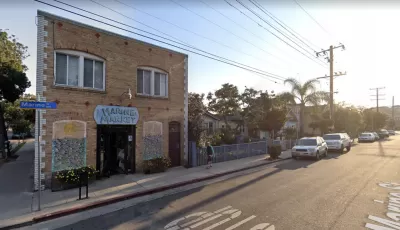
Adele Peters reports on an idea called ACUs, or accessory commercial units, explained thusly: "If backyard cottages (also known as ADUS, or accessory dwelling units) have become an increasingly common way to add new housing to existing neighborhoods, ACUs in the front could help add new businesses."
Peters gives credit for the term to Neil Heller, who runs an urban planning firm called Neighborhood Workshop, who was inspired by the idea while dealing with the pandemic closure of the firm's office. "As many people continue working from home—in the case of some tech workers, indefinitely—Heller considered another possibility," writes Peters. "Could some small businesses relocate to residential neighborhoods?"
This type of space was more common in the past; if you walk around some 1920s-era neighborhoods, it’s not unusual to see a tiny grocery store or even smaller commercial space sitting on an otherwise residential block. Heller hypothesizes that as cars became widespread in cities, some businesses chose to relocate to streets with the most traffic. Zoning laws also changed. “Zoning updates became more exclusively residential, and beyond that, became more exclusively single-family,” he says. “So we sort of just zoned everything out. Most of our cities are just single-family houses only. We’ve become very, very myopic in our scope of what we want to allow in our neighborhoods.”
Like its zoned out cousin, the corner store, allowing ACUs would require zoning changes, and perhaps even entirely new zoning code designations, assuming that most cities don't already have a residential zoning designation that allows for an extra structure on a residential property for the conducting of local serving business (photographic evidence of the existence of such buildings is provided in the source article). Even allowing corner stores on properties in residential neighborhood can prove a challenge, despite efforts at reform from organizations like the Congress for New Urbanism. The effect of allowing ACUs and corner stores in residential neighborhoods, according to the article by peters, would be a huge step toward the 15-minute city, where most trips for services can be completed on foot, of some many U.S. planners' dreams.
FULL STORY: With downtowns staying abandoned, put tiny businesses back into residential neighborhoods


From Paris to Portland: The 15-Minute City Goes Mainstream
Raising the bar on the 20-minute neighborhood model, cities around the world are embracing the appeal of the 15-minute city during the coronavirus pandemic.
Bring Back the Corner Store
‘Accessory commercial units’ were once common across U.S. towns and cities. Now, zoning regulations make them illegal in many places.
Not Just Use: More Zoning Regulations to Unlock Housing Equity
Prohibiting single-family zoning alone won’t accomplish the needed transformation of the built environment in the United States.

The state-sanctioned urbicide of Austin
People don’t kill cities. Freeways do.

US to reduce Colorado River water deliveries to Mexico
A new Colorado Treaty amendment reduces Mexico’s Colorado River water allocation by 250,000 acre feet.

New Jersey’s second-largest city bans standalone data centers
Jersey City will continue to allow co-location facilities, such as those meant for research institutions that store their own data.

Amtrak not solely to blame for New Jersey commuter rail's unreliability, report finds
A new study from the Garden State Initiative found that NJ Transit’s budget grew 20% across a 4 year period, but reliability declined significantly over the same period.

EPA erases limits on planet-warming pollution from power plants
Under Monday’s plan, power plants would still have some limits on how much mercury, arsenic and other contaminants they can emit.

Phoenix announces new on-demand transit service, more frequent RAPID buses
Both new services will launch in October, and are part of Phoenix's Project Effective Access Solutions for Easing Congestion.

FREE Course: Walkable City 1: Why Walkability?
After describing his path towards focusing on walkability as the essence of good planning, Jeff Speck marches through his five principal reasons for making more walkable places.
Reinventing Malls: Planning Alchemy—Turning Gray Fields Into Gold
The course focuses on the opportunities and imperatives that shape reinvention of mall sites.

Eagle County Government
Harvard University Graduate School of Design
Nashville Planning Department
The Architects Foundation
University of Cincinnati Online
The Pocatello Development Authority
The Urban Renewal Agency of the City of Pocatello
Journal of the American Planning Association