London announced another sweeping round of changes to its transportation priority, further cementing the future of active transportation both during and after the pandemic.


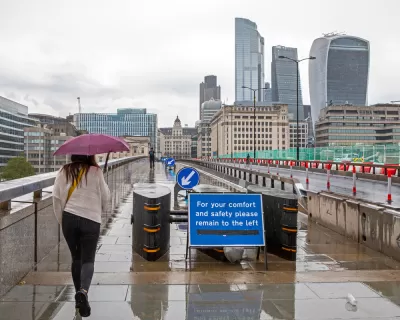
"In addition to a growing number of pop-up cycleways and widened sidewalks installed during the first phase of the [City of London] Corporation’s pandemic transport plan there will be further measures to discourage motor vehicle use, including replacing car parking bays with corrals for securing bicycles," reports Carlton Reid.
Reid provides specifics:
1,900 cycle parking spaces will be installed in the place of car parking bays. Seven kilometres of streets will be made more people friendly in the next phase of the works, including the “reallocation of highway to pedestrians and cyclists on Fleet Street and Moorgate, timed closure of Moorfields to motor vehicles and the closure of Chancery Lane to through traffic,” says the Corporation.
The shift in priority on the streets of London are being presented as an economic recovery program for the transport sector in London. Walking and biking has been up significantly throughout the pandemic.
FULL STORY: City Of London To Convert Car Parking Bays Into Bicycle Corrals

Five Borough Bikeway Plan Released
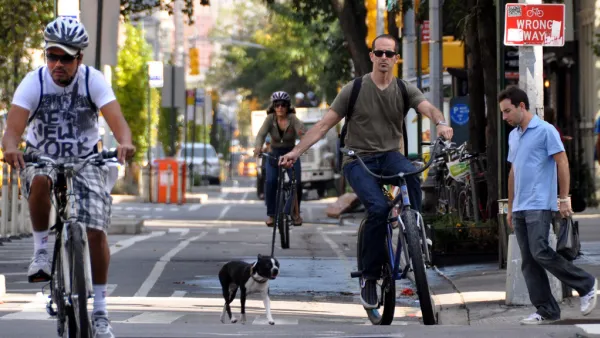
The Regional Plan Association is calling on New York City to implement an ambitious plan to transform the city into a world class city for biking—for the benefit of the public health and economic realities of the pandemic and beyond.
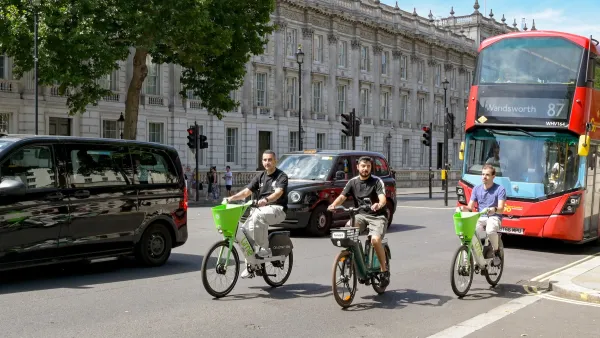
Bike use in London grew by 43% since 2019, but car use remains roughly the same
The city's efforts to reduce car use have stalled despite ambitious programs like congestion pricing and low-traffic neighborhoods.
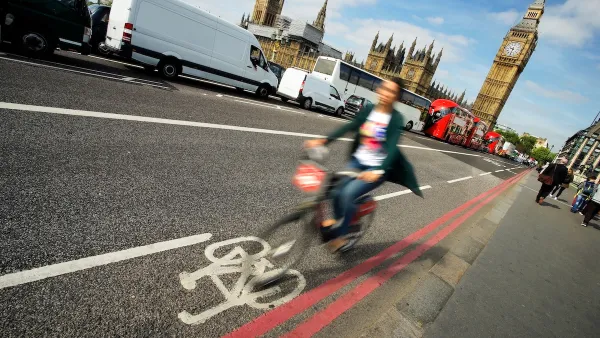
Biking in London Grew by 20 Percent Since 2019
Pandemic-induced changes and improved bike infrastructure have contributed to the impressive growth of cycling as a mode share.

Planetizen Federal Action Tracker
A weekly monitor of how Trump’s orders and actions are impacting planners and planning in America.

The state-sanctioned urbicide of Austin
People don’t kill cities. Freeways do.

US to reduce Colorado River water deliveries to Mexico
A new Colorado Treaty amendment reduces Mexico’s Colorado River water allocation by 250,000 acre feet.

5 New England states march closer to 800 megawatt wind energy project
Securing federal approval for the project may be complicated under the Trump administration, which has historically been hostile towards domestic wind power.

Baltimore to break ground on $50 million Transit Priority Project
The project will bring faster bus trips, safer streets and better bike connections to Baltimore.

Airbnb launches $250 million 'last-dollar financing' housing accelerator, makes first investment in Austin
The company will put $6.4 million towards affordable housing development in Texas’ capital.

FREE Course: Walkable City 1: Why Walkability?
After describing his path towards focusing on walkability as the essence of good planning, Jeff Speck marches through his five principal reasons for making more walkable places.
Reinventing Malls: Planning Alchemy—Turning Gray Fields Into Gold
The course focuses on the opportunities and imperatives that shape reinvention of mall sites.

Eagle County Government
Harvard University Graduate School of Design
Nashville Planning Department
The Architects Foundation
University of Cincinnati Online
The Pocatello Development Authority
The Urban Renewal Agency of the City of Pocatello
Journal of the American Planning Association