With the Trump administration's support, private industry is busy building new broadband infrastructure on public lands. The effect is already obvious in many national parks.


Jimmy Tobias reports on the proliferation of telecommunications infrastructure in public lands, a consequence of policy and philosophy changes enacted by the Trump administration.
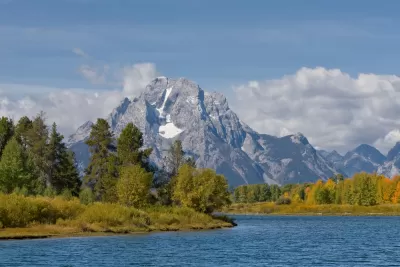
In fact, [the National Park Service] is presently pursuing a massive expansion of cellular and broadband facilities at Grand Teton National Park. Working in tandem with major telecom companies like AT&T and its agents, the agency is planning to permit the installation of more than 60 miles of fiber-optic cable, as well as at least nine new cell tower sites scattered throughout the park. The plan, which is awaiting a final permit, would blanket much of Grand Teton with new and stronger coverage. It is shaping up to be the largest single expansion of telecommunications infrastructure in national park history.
Supporters of expanded cell service in national parks point to the potential support such technology could provide for search and rescue missions, as well as the large demand for cell service among the general public. Others point to the need for places where people can still unplug from technology and social media.
Grand Teton National Park is really just a testing ground, however, for a wider deployment of telecom infrastructure in public lands."The telecom giants — AT&T, Verizon and more — are pushing to build out infrastructure on protected public lands across the country," according to Tobias, "[a]nd they have found a close collaborator in the federal government, which is working alongside industry operatives to open many national parks and other public lands to commercial wireless service."
Specifically, according to Tobias, "President Donald Trump’s Federal Communications Commission has limited the authority of local governments to stop such development." Also, "The administration is also working to 'streamline' environmental reviews and speed up the permitting process that lets companies build telecom facilities on federal land."
FULL STORY: The Park Service is selling out to telecom giants

Opinion: We're Loving Our National Parks to Death
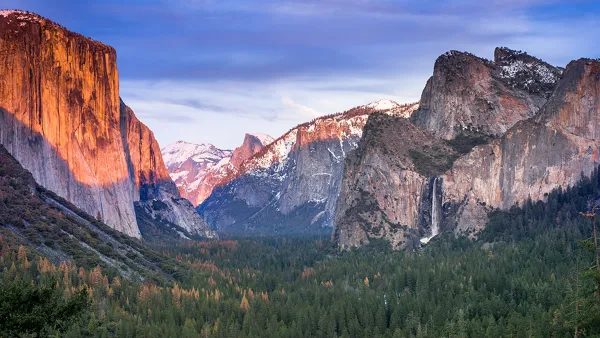
A reservation system could help the struggling national parks system manage crowds and protect our public lands from overuse, according to this article.
Veterans and Gold Star Families Can Now Visit National Parks for Free
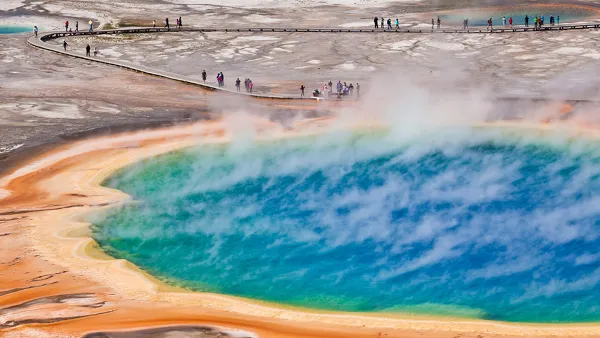
A small token of gratitude to the veterans who fought to protect the freedoms of the United States, and the families who sacrificed everything.
Trump Administration Wants to Remove Conservation From Approved 'Uses' of Public Land
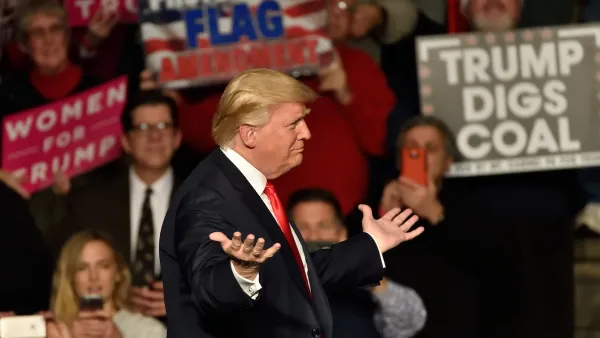
The Department of the Interior moved to officially rescind the Public Lands Rule passed in 2024, which elevates the conservation of public lands to the same level of protection as other uses.

Planetizen Federal Action Tracker
A weekly monitor of how Trump’s orders and actions are impacting planners and planning in America.

The state-sanctioned urbicide of Austin
People don’t kill cities. Freeways do.

US to reduce Colorado River water deliveries to Mexico
A new Colorado Treaty amendment reduces Mexico’s Colorado River water allocation by 250,000 acre feet.

Mamdani overhauls NYC's Vision Zero plan with 100 new policy goals
The overhaul aims to reduce traffic deaths and make streets safer for pedestrians, cyclists and drivers through lower speed limits, new safety infrastructure and more.

Amtrak not solely to blame for New Jersey commuter rail's unreliability, report finds
A new study from the Garden State Initiative found that NJ Transit’s budget grew 20% across a 4 year period, but reliability declined significantly over the same period.

EPA erases limits on planet-warming pollution from power plants
Under Monday’s plan, power plants would still have some limits on how much mercury, arsenic and other contaminants they can emit.

FREE Course: Walkable City 1: Why Walkability?
After describing his path towards focusing on walkability as the essence of good planning, Jeff Speck marches through his five principal reasons for making more walkable places.
Reinventing Malls: Planning Alchemy—Turning Gray Fields Into Gold
The course focuses on the opportunities and imperatives that shape reinvention of mall sites.

Eagle County Government
Harvard University Graduate School of Design
Nashville Planning Department
The Architects Foundation
University of Cincinnati Online
The Pocatello Development Authority
The Urban Renewal Agency of the City of Pocatello
Journal of the American Planning Association