Cities have transformed in profound ways, but more recent changes were the last part of a series of technology waves.



"For many years we've been promised that the marriage of technology and the city, the 'smart city,' would revolutionize urban life. But for a long time the term has essentially been a buzzword attached to different concepts over three distinct generations, accompanied by generous measures of hype and, lately, some serious questions about who's in the driver's seat," writes Aaron M. Renn.
The first generation focused on developing technology solutions to help cities manage operations for services such as water and transit. The second generation involved the promotion of open data to help cities run more smoothly. These first two generations kept cities in control of technology, but they failed to revolutionize urban areas, says Renn.
The third generation did transform cities, but the private sector deployed its technology in urban environments to provide goods and services to consumers and largely left government out of the process. Companies such as Uber, Lyft, and Airbnb often bypassed regulatory structures to change and shape cities.
"In many cases cities are struggling to catch up, sometimes not even knowing what's happening under their noses. This will be a profound challenge not just for governments, but also to our idea of the urban social contract and the division of functions between the public and private sectors," adds Renn.
FULL STORY: How Cities Lost Control of the Urban Tech Revolution

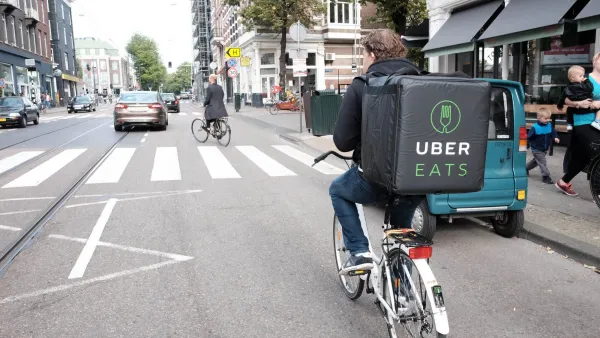
Job Losses Strike a Blow to Gig Economy Darlings
Uber and Airbnb both announced massive layoffs this week, after Lyft did the same last week, as the coronavirus pandemic took a toll on very contemporary corners of the economy.
Tracking the Growth of the 'Gig Economy' in U.S. Cities
The Brookings Institute thinks it has found a way to measure the impact of the expanding 'gig economy'—i.e., freelancing work enabled by online platforms like Airbnb and Uber.

How Cities Are Regulating the Sharing Economy
Compiled from interviews conducted with city officials, this National League of Cities report gives us a regulator's-eye-view of the sharing economy. Among the topics discussed are equity, taxation, and data transparency.

Planetizen Federal Action Tracker
A weekly monitor of how Trump’s orders and actions are impacting planners and planning in America.

The state-sanctioned urbicide of Austin
People don’t kill cities. Freeways do.

US to reduce Colorado River water deliveries to Mexico
A new Colorado Treaty amendment reduces Mexico’s Colorado River water allocation by 250,000 acre feet.

5 New England states march closer to 800 megawatt wind energy project
Securing federal approval for the project may be complicated under the Trump administration, which has historically been hostile towards domestic wind power.

Baltimore to break ground on $50 million Transit Priority Project
The project will bring faster bus trips, safer streets and better bike connections to Baltimore.

Airbnb launches $250 million 'last-dollar financing' housing accelerator, makes first investment in Austin
The company will put $6.4 million towards affordable housing development in Texas’ capital.

FREE Course: Walkable City 1: Why Walkability?
After describing his path towards focusing on walkability as the essence of good planning, Jeff Speck marches through his five principal reasons for making more walkable places.
Reinventing Malls: Planning Alchemy—Turning Gray Fields Into Gold
The course focuses on the opportunities and imperatives that shape reinvention of mall sites.

Eagle County Government
Harvard University Graduate School of Design
Nashville Planning Department
The Architects Foundation
University of Cincinnati Online
The Pocatello Development Authority
The Urban Renewal Agency of the City of Pocatello
Journal of the American Planning Association