To prevent losing funding if the state's interstate highways fall below new federal standards, Pennsylvania is rushing to change its capital investments plans.


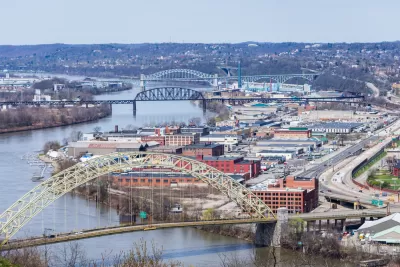
"The Pennsylvania Department of Transportation will shift $3.15 billion from local road projects to improvements on the interstate highways over the next nine years," reports Ed Blazina.
"For years, the state has delayed major maintenance work on the state’s interstate highway system while officials waited for an expected influx of federal funds," to explain the reason for the shift. "But now, with no federal money on the horizon and road conditions reaching the point where federal officials could cut existing federal funds because of the state of road conditions, Pennsylvania decided to shift its emphasis to the interstate system."
"The change, approved by the Federal Highway Administration in June, begins this year by taking $150 million statewide from local projects and earmarking the money for interstate work. That will increase by $50 million a year until 2028, when it reaches $3.15 billion."
The article includes a lot more details about how transportation officials are reacting to the shift, and includes several quotes from officials concerned about the state of local roads. The article also includes the history of planning and funding decisions that led to the current changes.
As for the federal policy that precipitated the change, Blaziina also offers this explanation, by way of information shared by Larry Shifflet, PennDOT’s deputy director for planning:
The Federal Highway Administration developed standards that interstate highways must meet certain standards or states could lose money from its National Highway System funds, which account for about half of $1.8 billion in state highway funds. The state is getting perilously close to not meeting those standards, Mr. Shifflet said.
Read the full story: PennDOT to shift $3.15 billion from local roads to interstate improvements

Report: Caltrans Models, Which Guide Billions in Transportation Funding, are Inaccurate and Outdated
Many of the predictive models used by California’s transportation agency fail to account for post-pandemic travel patterns and induced demand.
Will Voters Fund Transportation Measures in November?
An overview of key transportation-related ballot measures that will be decided in November’s election.

Repositioning Bike and Walking Trails as Essential Infrastructure
Cities and states can access federal transportation funding by including trails in long-range transportation plans.

Planetizen Federal Action Tracker
A weekly monitor of how Trump’s orders and actions are impacting planners and planning in America.

The state-sanctioned urbicide of Austin
People don’t kill cities. Freeways do.

Colorado’s Largest Data Center Could Rise Next to Homes — Without a Public Hearing
The proposed campus would consume 11 times the power of Denver International Airport; as it has across the country, opposition mounts.

Nation's most wind-powered state turns to coal as data centers increase energy demand
For the first time in decades, Iowa has increased its generation of coal power.

NYC cools commuters with city's first rain garden above a bus stop
New York City officials say the plants in the rain garden can absorb 16 gallons of rainwater during heavy storms.

Brightline West’s future may rely on $6 billion federal loan
The company has until Nov. 2 to make a $400 million equity investment into its proposed high-speed rail line.

FREE Course: Walkable City 1: Why Walkability?
After describing his path towards focusing on walkability as the essence of good planning, Jeff Speck marches through his five principal reasons for making more walkable places.
Reinventing Malls: Planning Alchemy—Turning Gray Fields Into Gold
The course focuses on the opportunities and imperatives that shape reinvention of mall sites.

Greater Baltimore Committee
Eagle County Government
Harvard University Graduate School of Design
The Architects Foundation
University of Cincinnati Online
The Pocatello Development Authority
The Urban Renewal Agency of the City of Pocatello
Journal of the American Planning Association