The March ballot in San Diego County will ask voters to make big decisions about planning and development on the fringes of the developed parts of the county.



Scott Lewis and Andrew Keatts report on the politics behind two controversial ballot initiatives that will shape how rural and sprawling developments get approved in San Diego County.
The occasion for the article is a recent decision by the San Diego County Democratic Party to oppose Measure A, an "initiative that would force most housing projects that require special changes to the general plan of the county to get support from voters countywide."
Measure A is portrayed as an anti-sprawl measure, but Will Rodriguez-Kennedy, the party chair, issued a statement that didn't oppose this kind of ballot box planning as a procedural misstep, arguing instead that Measure A would make it harder to build needed housing in San Diego County. "And with that, we saw the head of the Democratic Party seemingly endorse what many of his Democratic counterparts call sprawl," according to the article.
The second ballot initiative, Measure B, would overturn the approval of the 2,135-home Newland Sierra project, to be built north of Escondido. According to the article, the Democratic Party decided to oppose that project, potentially contradicting the party's position on Measure A, according to the article.
Read the full story: Politics Report: Dems Twisted Up on Rural Development

Carbon Offsets for Suburban Developments? The Courts Could Decide
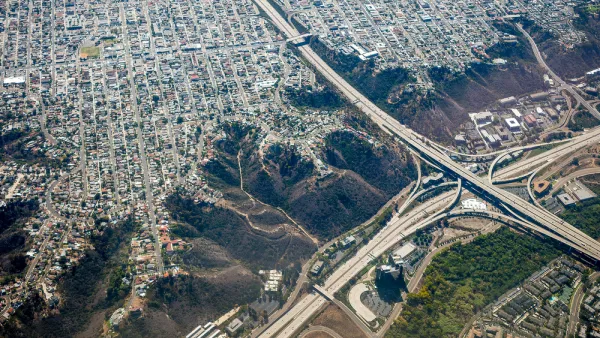
The county of San Diego wants sprawling suburban developments to buy carbon offsets, billing the idea as a fix to the region's housing affordability crisis.
Power Shifts to Cities in San Diego County's Embattled Regional Planning Agency
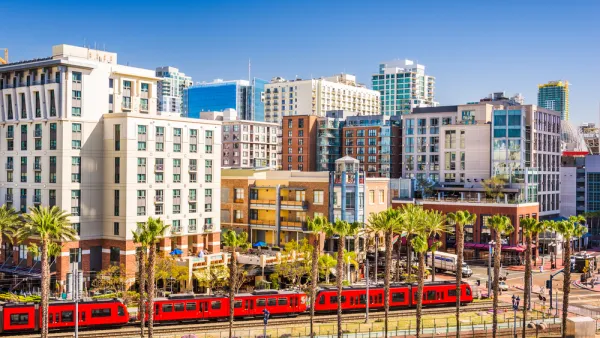
Larger cities in California's second most populous county will be given more power thanks to a bill that reforms the San Diego Association of Governments (SANDAG). One result may be that more public transit measures appear on the ballot.

Nearly a third of US housing is in the wildland-urban interface — and at growing risk of wildfire
As suburbs increasingly mingle with undeveloped land, homes face a higher risk from destructive fires.

Planetizen Federal Action Tracker
A weekly monitor of how Trump’s orders and actions are impacting planners and planning in America.

The state-sanctioned urbicide of Austin
People don’t kill cities. Freeways do.

US to reduce Colorado River water deliveries to Mexico
A new Colorado Treaty amendment reduces Mexico’s Colorado River water allocation by 250,000 acre feet.

Nation's most wind-powered state turns to coal as data centers increase energy demand
For the first time in decades, Iowa has increased its generation of coal power.

NYC cools commuters with city's first rain garden above a bus stop
New York City officials say the plants in the rain garden can absorb 16 gallons of rainwater during heavy storms.

Brightline West’s future may rely on $6 billion federal loan
The company has until Nov. 2 to make a $400 million equity investment into its proposed high-speed rail line.

FREE Course: Walkable City 1: Why Walkability?
After describing his path towards focusing on walkability as the essence of good planning, Jeff Speck marches through his five principal reasons for making more walkable places.
Reinventing Malls: Planning Alchemy—Turning Gray Fields Into Gold
The course focuses on the opportunities and imperatives that shape reinvention of mall sites.

Eagle County Government
Harvard University Graduate School of Design
Nashville Planning Department
The Architects Foundation
University of Cincinnati Online
The Pocatello Development Authority
The Urban Renewal Agency of the City of Pocatello
Journal of the American Planning Association