Over a century ago, the Pacific Electric Railway operated a line between downtown Los Angeles and Long Beach that competed its journey ten minutes faster than LA Metro's Blue Line does. What gives?


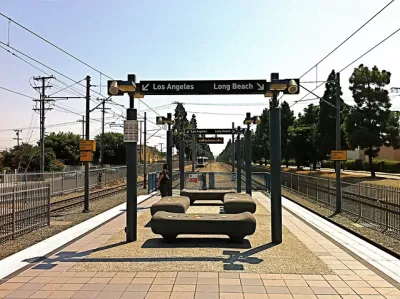
Back in 1916, Brian Addison writes, "the Pacific Electric Railway's Long Beach line, which stretched directly from Downtown Los Angeles to Downtown Long Beach, was nearly ten minutes faster than the current line."
Slow rail transit is arguably better than no rail transit, a deprivation Los Angeles suffered for several decades after the demise of its early 20th century rail transit system. But as Addison points out, "the Long Beach stretch of [the Blue Line] is the only stretch that doesn't have a signal preemption or synchronization system—that is, controllers for the movement of traffic that gives preference to Metro trains rather than street traffic."
That means trains slow to a snail's crawl as they navigate traffic signals, getting bogged down with automobile traffic.
Thankfully, the Los Angeles County Metropolitan Transportation Authority is on the case: the line is currently undergoing rehabilitation to address the issue and will fully reopen on November 2. "Workers have been fine-tuning the systems attached to create priority for the train to save time for commuters," Addison writes. Still, time savings will likely not exceed the ten-minute mark.
Read the full story: Opinion: C’mon, Metro—the LA-to-LB rail line was quicker a century ago than it is now

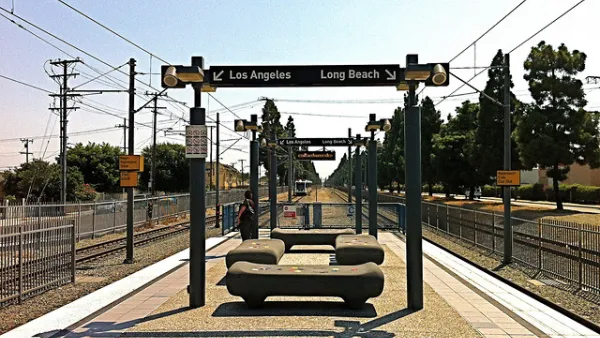
Major Temporary Closures Coming to Los Angeles Metro Rail
Metro will close several stretches of the Blue and Green lines as it completes $350 million worth of upgrades and opens the new Crenshaw Line. More than 100,000 daily riders may be inconvenienced.
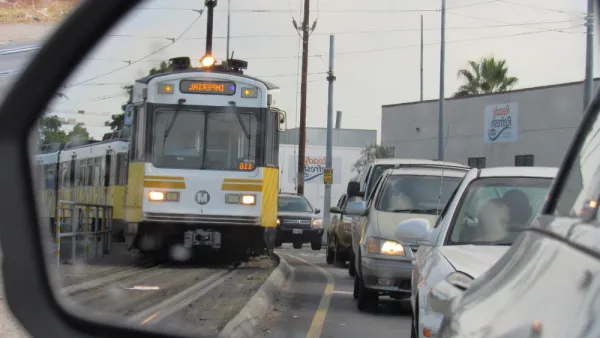
Light Rail Repair Project Falls Short of Promises in Los Angeles
The former Blue Line, now the A Line, with service from Log Beach to Los Angeles, was shut down in segments for ten months (originally scheduled for eight) for repairs. The weeks since the reopening have been marred spotty, slow service.
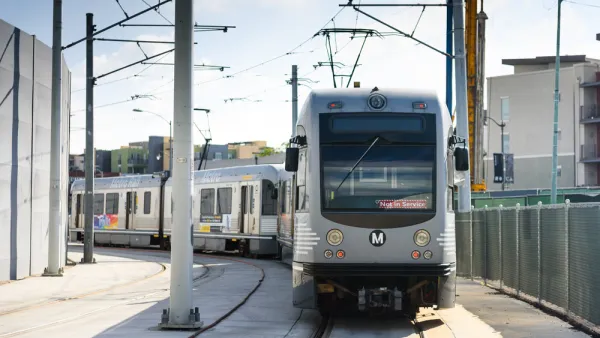
Planned L.A. Crenshaw Line Rollout Prompts Argument
Already delayed, the Crenshaw Line has now sparked debate between stakeholders who favor opposing visions of how the light rail service should link up with the existing Green Line.

Planetizen Federal Action Tracker
A weekly monitor of how Trump’s orders and actions are impacting planners and planning in America.

California plans to bury El Niño’s downpour
If the state plays its cards right, it may be able to store a billion acre-feet of El Niño’s water in aquifers.

Chicago breaks ground on $3 billion megadevelopment
The new neighborhood, titled Foundry Park, will one day host 3,700 residences.

California High-Speed Rail Authority CEO resigns after $600,000 scandal
Under Ian Choudri, the authority used taxpayer dollars to fund first class flights and trips to nightclubs.

Want to study the Missouri River? Soon, you may need unanimous approval from 10 states
Legislation would require 10 governors’ permission to study or build projects moving water outside the basin.

Desperate measures: Advocates weigh draining Lake Powell to fill Colorado River
Draining the reservoir could reduce evaporation losses by a couple hundred thousand acre-feet.

FREE Course: Walkable City 1: Why Walkability?
After describing his path towards focusing on walkability as the essence of good planning, Jeff Speck marches through his five principal reasons for making more walkable places.
Reinventing Malls: Planning Alchemy—Turning Gray Fields Into Gold
The course focuses on the opportunities and imperatives that shape reinvention of mall sites.

City of Rosemead
Rutgers University, Edward J. Bloustein School of Planning and Public Policy
One Hundred Miles
Hunter College, City University of New York (CUNY)
The Architects Foundation
University of Cincinnati Online
City of Cambridge
Montrose County
The Pocatello Development Authority