Automobile traffic to LAX has increased by half in the last decade, and congestion has passed a tipping point.


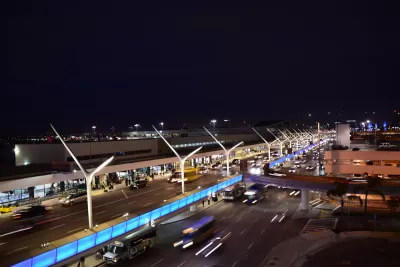
Anyone who has ever dropped off a friend at the Los Angeles International Airport or stepped onto the curb at the arrivals level to wait for a Flyaway (ok, I am talking about myself here) knows the airport's capacity for surpassing the worst nightmares of congestion. A plan to ban ride-hailing companies like Lyft and Uber from making curbside pickups is intended to lesson congestion and free-up road space for more efficient modes of transportation.
Laura J. Nelson and Alex Wigglesworth report on the big changes coming to LAX, as announced by Los Angeles World Airports (the airport authority for the city of Los Angeles) officials on Friday last week.
Starting at the end of October, travelers leaving LAX will be required to board a shuttle or walk to a waiting area east of Terminal 1 to hail an Uber, Lyft or taxi. Drop-off policies, and pickups for family and friends, will not change.
The plan will remain in place until the completion of an elevated airport train, scheduled for 2023. The people-mover will arrive every two minutes and will whisk passengers between the terminals, a car rental facility, a ground transportation hub and a Metro station.
According to the article, Uber and Lyft account for about 27 percent of the 100,000 car trips at LAX in an average day. Blocking the ride-hailing companies from picking up passengers curbside is expected to benefit every other kind of transportation coming in and out of the airport, which have been struggling as car trips to the airport have exploded.
"Meanwhile, ridership plummeted on high-occupancy buses and shuttles, data show. Trips on LAX’s FlyAway buses fell by two-thirds, as did rides on shared vans such as SuperShuttle and Prime Time. Courtesy shuttles to car rental facilities, parking lots and hotels saw a 20% decline," according to the article.
The airport won't just ban ride-hailing pickups and hope for the best: the plan also includes changes to the street design at the arrivals level, where curbside lanes will be converted to bus-only lanes.
Read the full story: Will ending curbside pickups for Uber, Lyft and taxis help LAX’s traffic?
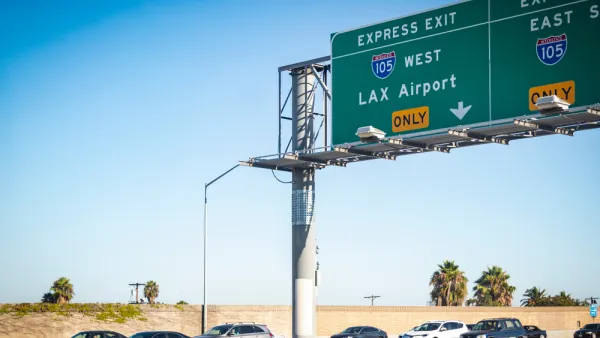
Tinkering With New Ride-Hailing Area Produces Results at LAX
Few planning projects in recent weeks have attracted such scrutiny as the LAX-It ride-hailing pickup area at Los Angeles International Airport.
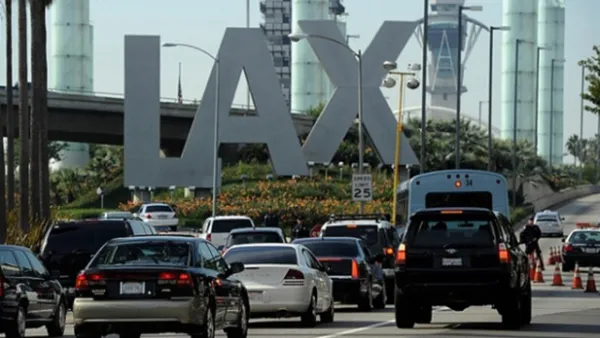
New Ride-Hailing Area at LAX, Called 'LAX-it,' Has Rough Opening Day
The central terminal area at Los Angeles International Airport experienced a sudden onset of calm this Tuesday—the nearby LAX-it waiting area for ride-hailing pick-ups and drop-offs, not so much.
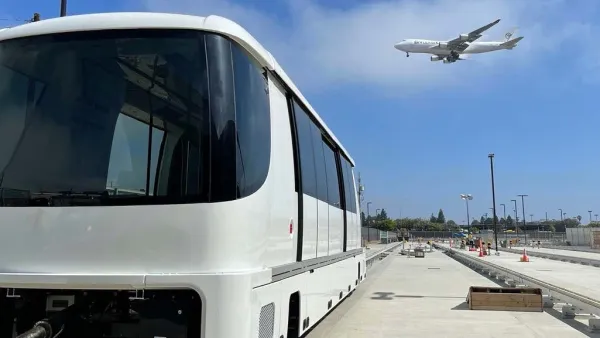
Meet the Hollywood YouTuber who exposed the LAX people mover "fiasco"
Nick Andert uncovered the "brazen and unethical behavior" that has mired the Los Angeles International Airport people mover in years of delays and cost overruns.

Planetizen Federal Action Tracker
A weekly monitor of how Trump’s orders and actions are impacting planners and planning in America.

California plans to bury El Niño’s downpour
If the state plays its cards right, it may be able to store a billion acre-feet of El Niño’s water in aquifers.

Desperate measures: Advocates weigh draining Lake Powell to fill Colorado River
Draining the reservoir could reduce evaporation losses by a couple hundred thousand acre-feet.

Mamdani’s pied-à-terre tax survives legal challenge
A panel of judges found that the plaintiffs failed to demonstrate injury as a result of New York City's implementation of the tax.

Eastern Nebraska is running out of electricity
Data centers and electrification are straining eastern Nebraska’s grid, throttling economic development.

Seattle passes record-breaking transit services expansion
Proposition 1 will double the city’s transit tax to add 95,000 more bus trips and preserve 180,000 bus trips annually.

FREE Course: Walkable City 1: Why Walkability?
After describing his path towards focusing on walkability as the essence of good planning, Jeff Speck marches through his five principal reasons for making more walkable places.
Reinventing Malls: Planning Alchemy—Turning Gray Fields Into Gold
The course focuses on the opportunities and imperatives that shape reinvention of mall sites.

City of Rosemead
Rutgers University, Edward J. Bloustein School of Planning and Public Policy
One Hundred Miles
University of Michigan School for Environment and Sustainability (SEAS)
Hunter College, City University of New York (CUNY)
The Architects Foundation
City of Cambridge
Montrose County
The Pocatello Development Authority