A four-part series explores the shortcomings of transit politics and planning in Wichita, Kansas.



"Wichita is far behind peer cities in the provision and use of public transit," reports Chase M. Billingham.
The sluggish pace of Wichita's transit funding isn't due to car culture, which is also present in other similarly sized cities, notes Billingham. "The true source of divergence is funding. Wichita Transit is severely underfunded, even compared to its peers in nearby car-friendly cities such as Omaha, Oklahoma City and Tulsa."
Data from the U.S. Department of Transportation shows Wichita Transit receiving approximately $4.2 million in local funds in 2017. "By comparison, local agencies that year received $7.4 million in Tulsa, $14.1 million in Oklahoma City, $14.5 million in Omaha, $15.4 million in Des Moines and $70.4 million in Kansas City," according to Billingham.
Local leaders are looking for new sources of revenue to fund transit projects, but a frequently floated idea of implementing a dedicated local sales tax has never been made a reality.
"Transit was one of four priorities that the city identified when it held a referendum on imposing a new 1-cent sales tax in 2014. Amid well-funded opposition and much controversy, that referendum was decisively rejected by voters."
The article is the third in a four-part series of guest commentaries on the subject of transit funding and planning in the city of Wichita.
FULL STORY: Wichita spends far less on public transportation than its peers — that has to change

Excerpt: How Individualism Harms Public Transit
Jarrett Walker calls for a more social approach to transit planning.
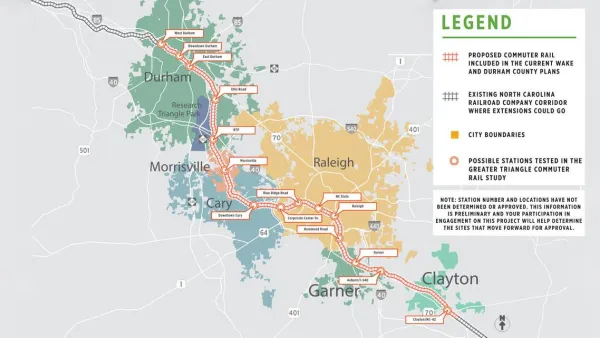
FTA Rejects North Carolina Commuter Rail Funding
As commuter patterns shift, so too do the transit funding preferences of the federal government.
Austin’s Project Connect Transit Plan Drastically Reduced
The details of drastic reductions to the proposed building program for Austin’s Project Connect long-range transit plan are now open for public comment.

The state-sanctioned urbicide of Austin
People don’t kill cities. Freeways do.

US to reduce Colorado River water deliveries to Mexico
A new Colorado Treaty amendment reduces Mexico’s Colorado River water allocation by 250,000 acre feet.

New Jersey’s second-largest city bans standalone data centers
Jersey City will continue to allow co-location facilities, such as those meant for research institutions that store their own data.

Amtrak not solely to blame for New Jersey commuter rail's unreliability, report finds
A new study from the Garden State Initiative found that NJ Transit’s budget grew 20% across a 4 year period, but reliability declined significantly over the same period.

EPA erases limits on planet-warming pollution from power plants
Under Monday’s plan, power plants would still have some limits on how much mercury, arsenic and other contaminants they can emit.

Phoenix announces new on-demand transit service, more frequent RAPID buses
Both new services will launch in October, and are part of Phoenix's Project Effective Access Solutions for Easing Congestion.

FREE Course: Walkable City 1: Why Walkability?
After describing his path towards focusing on walkability as the essence of good planning, Jeff Speck marches through his five principal reasons for making more walkable places.
Reinventing Malls: Planning Alchemy—Turning Gray Fields Into Gold
The course focuses on the opportunities and imperatives that shape reinvention of mall sites.

Eagle County Government
Harvard University Graduate School of Design
Nashville Planning Department
The Architects Foundation
University of Cincinnati Online
The Pocatello Development Authority
The Urban Renewal Agency of the City of Pocatello
Journal of the American Planning Association