Dutch design firm West 8 recently won a competition to rethink an 11-mile stretch of the Baltimore's waterfront, not to be confused with a $5.5 billion project to redevelop Port Covington.


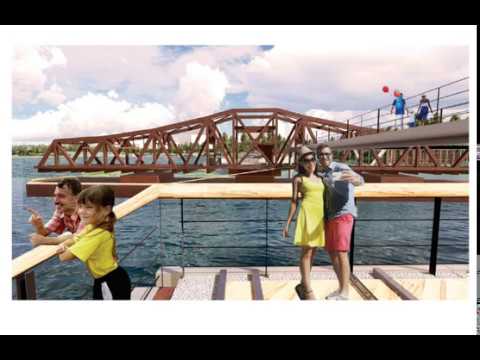
Ethan McLeod reports for Next City on the recently revealed designs to remake the Baltimore waterfront along the Middle Branch of the Patapsco River, a relatively calm stretch of water that feeds into the busier Inner harbor.
The city held a design competition to rethink the area, focusing around Hanover Street Bridge, doomed for removal as it reaches the end of its 103-year lifespan. The city announced Dutch design company West 8 as the winner in July 2019. McLeod provided news coverage as the design competition neared culmination for Baltimore Fishbowl.
The West 8 design "reimagines the Middle Branch as a 'blue green heart' for Baltimore, with an 11-mile loop connecting the shorelines of Westport, Cherry Hill, Riverside, Brooklyn and Port Covington," according to McLeod, in the more recent of the two articles.
"West 8 hopes to upcycle dredged material from the nearby Port of Baltimore as the base for the new marshes and greenery at the water’s edge, similarly to how the firm’s home country of Holland designed new infrastructure like dikes and bridges," according to McLeod. "The design eyes major re-uses as well, like converting an abandoned swing bridge into a pedestrian walkway and fashioning a linear park out of the 103-year-old Hanover Street Bridge."
The Hanover Street Bridge provides commuter access to Port Covington, site of a proposed mega-development spearheaded by Under Armour CEO Kevin Plank and aided by fortuitous mapping of the city's new federal Opportunity Zones. West 8 proposes building a new bridge, to replace the crumbling Hanover Street Bridge, farther down river.
FULL STORY: What Baltimore’s Plan to Redesign 11 Miles of Its Waterfront Means for Existing Communities

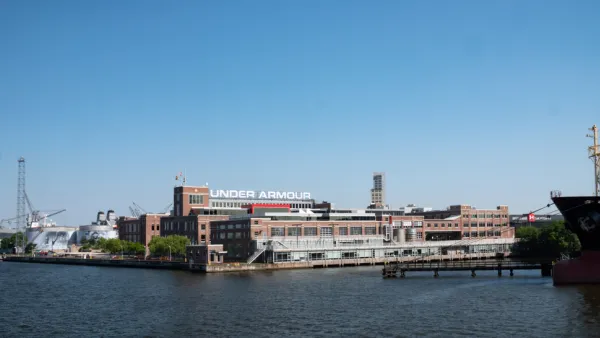
A $5.5 Billion Waterfront Plan for Baltimore Wins Opportunity Zone Status
The Port Covington plan was already in line to receive massive subsidies from the city of Baltimore. Now the plan will be the beneficiary of the new federal Opportunity Zone program as well.
Developers Rebrand Baltimore’s Port Covington Megaproject
The megaproject formerly known as Port Covington is now known as Baltimore Peninsula.

Baltimore to break ground on $50 million Transit Priority Project
The project will bring faster bus trips, safer streets and better bike connections to Baltimore.

Planetizen Federal Action Tracker
A weekly monitor of how Trump’s orders and actions are impacting planners and planning in America.

The state-sanctioned urbicide of Austin
People don’t kill cities. Freeways do.

US to reduce Colorado River water deliveries to Mexico
A new Colorado Treaty amendment reduces Mexico’s Colorado River water allocation by 250,000 acre feet.

5 New England states march closer to 800 megawatt wind energy project
Securing federal approval for the project may be complicated under the Trump administration, which has historically been hostile towards domestic wind power.

Baltimore to break ground on $50 million Transit Priority Project
The project will bring faster bus trips, safer streets and better bike connections to Baltimore.

Airbnb launches $250 million 'last-dollar financing' housing accelerator, makes first investment in Austin
The company will put $6.4 million towards affordable housing development in Texas’ capital.

FREE Course: Walkable City 1: Why Walkability?
After describing his path towards focusing on walkability as the essence of good planning, Jeff Speck marches through his five principal reasons for making more walkable places.
Reinventing Malls: Planning Alchemy—Turning Gray Fields Into Gold
The course focuses on the opportunities and imperatives that shape reinvention of mall sites.

Eagle County Government
Harvard University Graduate School of Design
Nashville Planning Department
The Architects Foundation
University of Cincinnati Online
The Pocatello Development Authority
The Urban Renewal Agency of the City of Pocatello
Journal of the American Planning Association