A new task force is being assembled in Portland to implement new road pricing mechanisms that convinces people to ditch their cars for more efficient modes of travel, while also ensuring low-income communities don't bear too much of the burden.


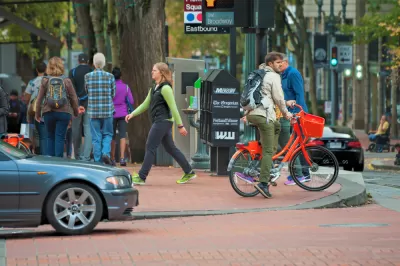
The Portland City Council this week approved a plan "to study short-and-long-term strategies to charge people to use city streets, an effort intended to reduce congestion and curb carbon emissions as the region expects as many as 500,000 new residents by 2040," reports Andrew Theen.
The Pricing for Equitable Mobility task force will be tasked with recommending a pricing scheme from among a number of options: "cordon pricing, a potential fee for Uber and Lyft fares, more demand-based parking pricing, and potentially a local fee to charge drivers based on how many miles they drive."
According to Theen, the city and state have been building momentum for new pricing scheme on roads around Portland for a few years, but substantive progress has been hard to come by. "The Legislature in 2017 also kickstarted a plan to study whether and how to charge drivers on Interstate 5 and 205 in the Portland area. The state has since applied for tolling approval from the federal government," reports Theen.
FULL STORY: Portland to create ‘equitable mobility’ task force to investigate how to charge people to use local roads

Portland Ready to Experiment With New Forms of Road Pricing
A new task force formed in Portland, Oregon will consider ways to make automobile use more expensive, including parking pricing, area and time-based fees, fleet charges, road user charges, cordons, and freeway pricing.
If Road Pricing Is Inherently Unfair and Regressive...
Road pricing has its faults as a revenue measure, but it needs to be compared to ten elements of the current system of paying for transportation, including hidden subsidies, says Joe Cortright, an urban economist with Portland-based City Observatory.
USDOT Revokes Approval for NYC Congestion Pricing
Despite the administration’s stated concern for the “working class,” 85 percent of Manhattan commuters use public transit to enter the city.

The state-sanctioned urbicide of Austin
People don’t kill cities. Freeways do.

US to reduce Colorado River water deliveries to Mexico
A new Colorado Treaty amendment reduces Mexico’s Colorado River water allocation by 250,000 acre feet.

New Jersey’s second-largest city bans standalone data centers
Jersey City will continue to allow co-location facilities, such as those meant for research institutions that store their own data.

Amtrak not solely to blame for New Jersey commuter rail's unreliability, report finds
A new study from the Garden State Initiative found that NJ Transit’s budget grew 20% across a 4 year period, but reliability declined significantly over the same period.

EPA erases limits on planet-warming pollution from power plants
Under Monday’s plan, power plants would still have some limits on how much mercury, arsenic and other contaminants they can emit.

Phoenix announces new on-demand transit service, more frequent RAPID buses
Both new services will launch in October, and are part of Phoenix's Project Effective Access Solutions for Easing Congestion.

FREE Course: Walkable City 1: Why Walkability?
After describing his path towards focusing on walkability as the essence of good planning, Jeff Speck marches through his five principal reasons for making more walkable places.
Reinventing Malls: Planning Alchemy—Turning Gray Fields Into Gold
The course focuses on the opportunities and imperatives that shape reinvention of mall sites.

Eagle County Government
Harvard University Graduate School of Design
Nashville Planning Department
The Architects Foundation
University of Cincinnati Online
The Pocatello Development Authority
The Urban Renewal Agency of the City of Pocatello
Journal of the American Planning Association