The Oregon Climate Action Program, which would have priced carbon emissions by establishing a cap-and-trade program similar to the one in California, was defeated on Saturday, the penultimate day of the 2019 legislative session.


The Oregon legislature made history this session, which ended Sunday, by outlawing single-family zoning and making life easier for bicyclists by allowing them to treat stop signs like yield signs, but was unable to pass a critical climate bill despite having supermajority control of both chambers.
"This was the year for Oregon to enact the nation’s second economy-wide cap on greenhouse gases and reclaim her national environmental bona fides. Even Republicans acknowledged the inevitability," writes Ted Sickinger, an investigative reporter who has been chronicling the effort for The Oregonian, on June 30.
Democrats had a [three-fifths] supermajority in both houses. The governor, House Speaker and Senate President were all on board.
While that margin exceeded the supermajority requirement for bills that raise taxes, it was not clear whether that threshold was needed. In the end, it wouldn't matter when the bill reached the Senate.
"House Bill 2020 [which establishes the Oregon Climate Action Program] is one of the most complex and sprawling pieces of legislation ever to come before Oregon lawmakers, wrote Sickinger on June 17 after the bill passed the House on a 36-to-24 vote.
It envisions a wholesale reduction in Oregonians’ use of fossil fuels, and an associated decrease in greenhouse gas emissions equivalent to 80 percent below 1990 levels by 2050.
Republican walkout
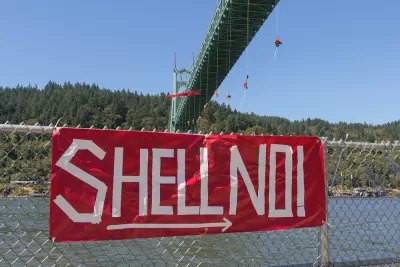
The national media was captivated when Democratic Gov. Kate Brown authorized the Oregon State Police on June 20 "to retrieve the [11] Senate Republicans, who fled the Capitol in order to deprive the Senate of a quorum and block the likely passage of the carbon-reduction legislation," as reported by Nigel Jaquiss of Willamette Week.
However, Senate President Peter Courtney conceded on June 25 that there was disunity within Democratic ranks that would prevent the bill's passage, which led to the return of most of the Republican senators on Saturday after being on the lam for nine days.
"When Courtney banged down his gavel on the 17-10 vote [on Saturday], the biggest controversy of the 2019 session was over," reported Jaquiss on June 29. House Bill 2020 had died, and with it the opportunity for Oregon to join California, Quebec and Nova Scotia in the Western Climate Initiative.
What went wrong
"Democrats needed support from 16 of the 18 members of their Senate caucus in order to pass it," reported Sickinger and his colleagues on June 26 after Sen. Courtney divulged the bad news for supporters. Three Democrats were holdouts, some representing "districts where major employers were particularly opposed to the climate bill." Another issue that concerned lawmakers – the effect of the bill on gas and diesel prices.
Sickinger goes on to do an extensive political postmortem on the "complex 180-page bill, one that eventually had more than 100 proposed amendments."
Rewriting it to incorporate the first major round of changes – including deals Democrats cut with specific industries and interest groups -- took weeks. And in the end, the bill didn’t land for a final vote in the Senate until 11 days [June 19] before the constitutionally mandated close of the session.
A major point Sickinger makes is the urban-rural divide on climate policy, particularly when it comes to carbon pricing. A map of the districts of the 11 senators who walked-out makes that divide very clear, as its the overwhelming majority of the state, geographically speaking. [Scroll down to the image below "Republican senators’ districts" in the June 26 Oregonian article].
But outside the metro area, the concerns are real, rooted in past experience and the feeling that urban architects of the policy don’t truly care about the consequences on their way of life.
The coalition of supporters [including Renew Oregon] never had an effective spokesperson to counter that. It certainly wasn’t Gov. Kate Brown, who is not popular in rural reaches of the state. And not a single Republican lawmaker representing those districts took up the mantle.
However, the political divide between Republicans and Democrats exceeds the urban-rural split, according to a researcher cited by Sickinger.
Additional reading: "Cap and trade: What could Oregon’s carbon policy cost you?" June 19: Sickinger explains how the program would hike prices, particularly on transportation fuel.
“The bill makes the urban-rural divide stronger than ever because the biggest polluters are in Oregon’s large cities,” said Senate Republican Leader Herman Baertschiger, Jr., R-Grants Pass. “It is fundamentally inequitable to put the responsibility of cleaning up their pollution on the backs of rural Oregonians.”
Update from Associated Press, July 1: Gov. Kate Brown indicated she's prepared to use her executive power to have Oregon initiate the carbon cap-and-trade program by directing her staff to work with opponents in the rural parts of the state who were key to defeating the bill in the Senate, reports Sarah Zimmerman.
"Working on legislation is my preferred approach," she told reporters. "However, given the uncertainty that now permeates Oregon's political system, I am also directing my staff and agencies to explore alternative paths."
Related in Planetizen:
-
California Looks North for a Climate Partner, June 18, 2019
- Oregon Democrats Unveil Cap-and-Trade Bill, February 12, 2019
- Advocates for Oregon's Carbon Pricing Plan Proceed Cautiously, December 12, 2018
-
No West Coast Climate Bloc, November 7, 2018
FULL STORY: How Oregon’s climate-change bill ran out of gas


Déjà Vu: Republican Legislators Flee From Capitol to Stall Climate Bill
Republican state lawmakers repeated a tactic they successfully deployed last summer to prevent the passage of a bill that would have made Oregon the second state, after California, to place a price on carbon emissions from most economic sectors.
California Looks North for a Climate Partner
California has been lonely for the last seven years as the only state that prices carbon emissions from most sources. Oregon is expected to decide this month whether to join them.
Oregon Democrats Unveil Cap-and-Trade Bill
A new bill in the Oregon Legislature, technically called a "legislative concept," would set up a California-style cap-and-trade program, calling for steep greenhouse gas emission reductions by 2035 and 2050.

The state-sanctioned urbicide of Austin
People don’t kill cities. Freeways do.

US to reduce Colorado River water deliveries to Mexico
A new Colorado Treaty amendment reduces Mexico’s Colorado River water allocation by 250,000 acre feet.

New Jersey’s second-largest city bans standalone data centers
Jersey City will continue to allow co-location facilities, such as those meant for research institutions that store their own data.

Amtrak not solely to blame for New Jersey commuter rail's unreliability, report finds
A new study from the Garden State Initiative found that NJ Transit’s budget grew 20% across a 4 year period, but reliability declined significantly over the same period.

EPA erases limits on planet-warming pollution from power plants
Under Monday’s plan, power plants would still have some limits on how much mercury, arsenic and other contaminants they can emit.

Phoenix announces new on-demand transit service, more frequent RAPID buses
Both new services will launch in October, and are part of Phoenix's Project Effective Access Solutions for Easing Congestion.

FREE Course: Walkable City 1: Why Walkability?
After describing his path towards focusing on walkability as the essence of good planning, Jeff Speck marches through his five principal reasons for making more walkable places.
Reinventing Malls: Planning Alchemy—Turning Gray Fields Into Gold
The course focuses on the opportunities and imperatives that shape reinvention of mall sites.

Eagle County Government
Harvard University Graduate School of Design
Nashville Planning Department
The Architects Foundation
University of Cincinnati Online
The Pocatello Development Authority
The Urban Renewal Agency of the City of Pocatello
Journal of the American Planning Association