One Dalton Street, the third tallest building in Boston, is almost complete.


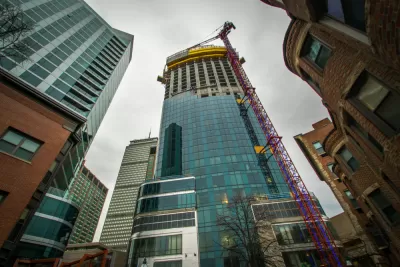
Robert Campbell, architecture critic for the Boston Globe, writes a column describing Boston's newest skyscraper as a design success.
The building, One Dalton Street, achieves this success despite having "no particular reason to exist," writes Campbell. "With a posh Four Seasons hotel occupying its lower floors and luxury condos in its upper levels — one penthouse has reportedly been sold for $40 million — it’s a place for people who choose to experience the life of a busy urban world while living far above it."
Still, the building is in full command of its details, according to Campbell, to the point of a military comparison. The real magic of the building, according to Campbell, is the building's "powerful sculptural form in play with its surroundings."
The senior architect on the project, Henry Cobb, "studied historic railway lines and street maps of this part of Boston" before realizing that "the land had always been organized as a loose arrangement of triangles." Those triangles are manifested in the floor plans of every level in the building above the fifth.
Read the full story: One Dalton, Boston’s commanding new skyscraper, conjures architectural magic

From the Golden Age of Skyscrapers, an Eyesore No More
Anthony Paletta takes a look at a new book by Elihu Rubin, chronicling the intriguing political history behind the construction of Boston's Prudential Center in the mid-1950s.
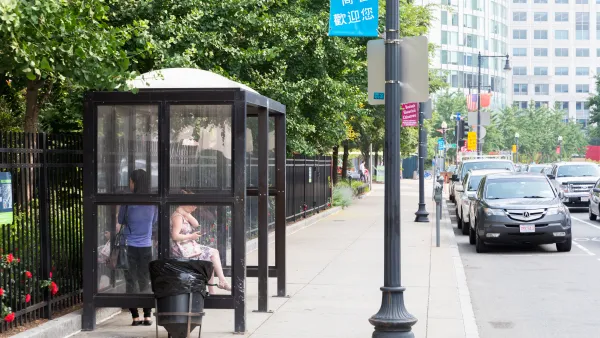
Boston requests proposals for new street furniture program
The city is looking to expand its network of bus shelters, wayfinding kiosks and other infrastructure.

Does every planner need an AI policy?
From a hundred-person agency to a one-person consultancy, the answer is yes. The difference is what “policy" means.

Planetizen Federal Action Tracker
A weekly monitor of how Trump’s orders and actions are impacting planners and planning in America.

Amtrak, CN end decades-long dispute with eight-year agreement
The new operating agreement establishes an updated framework for the companies to work together, including processes to resolve disputes.

Judges permit Denver to divert 77,000 acre feet from the Colorado River for reservoir expansion
Overuse and climate change have caused the Colorado River’s water levels to plummet.

Idaho may see an 18% drop in federal surface transit funding — the largest estimated cut in the US
Transit systems in rural communities are much more reliant on federal funding to provide their services.

How ‘post-disaster gentrification’ alters neighborhoods after natural calamities
After hurricanes, fires or other calamities, the original residents of a community are often replaced by younger, wealthier residents.

Maryland local governments examine if they should have more power to raise property taxes
Maryland’s housing market is out of reach for the majority of moderate-income residents.

FREE Course: Walkable City 1: Why Walkability?
After describing his path towards focusing on walkability as the essence of good planning, Jeff Speck marches through his five principal reasons for making more walkable places.
Reinventing Malls: Planning Alchemy—Turning Gray Fields Into Gold
The course focuses on the opportunities and imperatives that shape reinvention of mall sites.

Harvard University Graduate School of Design
KFH Group Inc.
Greater Baltimore Committee
The Architects Foundation
University of Cincinnati Online
The Pocatello Development Authority
The Urban Renewal Agency of the City of Pocatello