The St. Paul 2040 Comprehensive Plan aims for missing middle density at 56 "Neighborhood Nodes" around the city.


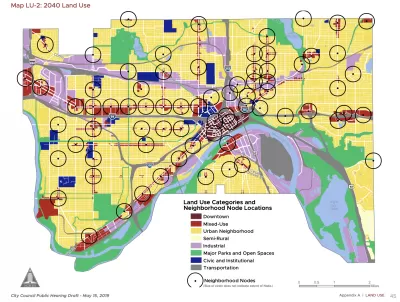
Frederick Melo reports on the details of the new 20-year comprehensive plan for St. Paul, under consideration at a series of public meetings this month and expected for a City Council by January.
According to Melo, the "St. Paul for All 2040 Comprehensive Plan" focuses growth around "Neighborhood Nodes":
St. Paul wants and needs to grow, and to do that, city planners have pinpointed 56 intersections where denser new housing, retail, transit stops and other important services could happily co-exist. That may mean lifting zoning and density restrictions, or taking advantage of zoning that already exists, to incorporate these future “neighborhood nodes” into local planning.
The entire comprehensive plan is split into six chapters, on land use, transportation, parks and open space, housing, water resources, and historic preservation, according to Melo's explanation. "The chapters touch on six themes — urban design, economic development, resiliency in the face of intense environmental changes, public health, helping residents remain in their neighborhoods as they age, and reducing racial disparities through equitable distribution of city services."
Read the full story: St. Paul’s 20-year plan calls for more development at 56 neighborhood intersections
Charlotte's New, Controversial Comprehensive Plan to End Single-Family Zoning
A tight vote after months of controversy has produced a major zoning reform effort that differs significantly from recent examples on the West Coast and in Minneapolis.
D.C. Comprehensive Plan Amendments Approved
New amendments to the D.C. Comprehensive Plan set goals for new housing development and fewer cars on the road.
Rapid Growth and a Small Town Recall Effort
A group of organizers in the small town of Elizabeth, Colorado (population 1,700) wants to recall its entire City Council as an act of defiance in the face of rapid change and growth.

Planetizen Federal Action Tracker
A weekly monitor of how Trump’s orders and actions are impacting planners and planning in America.

California plans to bury El Niño’s downpour
If the state plays its cards right, it may be able to store a billion acre-feet of El Niño’s water in aquifers.

Desperate measures: Advocates weigh draining Lake Powell to fill Colorado River
Draining the reservoir could reduce evaporation losses by a couple hundred thousand acre-feet.

Mamdani’s pied-à-terre tax survives legal challenge
A panel of judges found that the plaintiffs failed to demonstrate injury as a result of New York City's implementation of the tax.

Eastern Nebraska is running out of electricity
Data centers and electrification are straining eastern Nebraska’s grid, throttling economic development.

Seattle passes record-breaking transit services expansion
Proposition 1 will double the city’s transit tax to add 95,000 more bus trips and preserve 180,000 bus trips annually.

FREE Course: Walkable City 1: Why Walkability?
After describing his path towards focusing on walkability as the essence of good planning, Jeff Speck marches through his five principal reasons for making more walkable places.
Reinventing Malls: Planning Alchemy—Turning Gray Fields Into Gold
The course focuses on the opportunities and imperatives that shape reinvention of mall sites.

City of Rosemead
Rutgers University, Edward J. Bloustein School of Planning and Public Policy
One Hundred Miles
University of Michigan School for Environment and Sustainability (SEAS)
Hunter College, City University of New York (CUNY)
The Architects Foundation
City of Cambridge
Montrose County
The Pocatello Development Authority