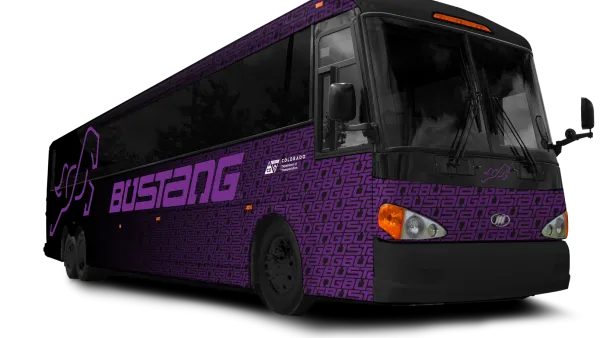
Bustang, the interregional bus service launched by the Colorado Department of Transportation in 2015, will have a station in the middle of Interstate 25 as part of a $350 million plan to add toll lanes between Johnstown and Fort Collins.


Miles Blumhardt of the Fort Collins Coloradoan interviewed Jared Fiel, spokesperson for the Colorado Department of Transportation (CDOT) about the I-25 North Express Lanes Project which runs from Fort Collins, the state's fourth-largest city, about 14.5 miles south to the Town of Johnstown.
The $350 million project broke ground in Loveland last September and is expected to be completed in 2021. [Can you spot the two statewide elected politicians with shovels in hand who are running for president in this Loveland Reporter-Herald photo?]
The focus of the interview was why the additional lane would be an express (aka toll) lane rather than a general purpose or carpool lane. As with CDOT's sister project on Interstate 25: I-25 South Gap, having to pay to drive on the freeway as a solo motorist is not popular in the Centennial State. More on that aspect of the project is discussed below.
Bustang park-and-ride
Not mentioned in the article is a unique aspect of the project, the construction of Colorado's first middle-of-interstate bus stop near Loveland for Bustang, an interregional express bus service operated by CDOT that began service in July 2015.
"Riders can park at a new park-and-ride at Kendall Parkway, then walk under the interstate to access the bus station," reported Nicole Brady for The Denver Channel in October.
"This will be a first for Colorado," CDOT spokesperson Fiel said. He added that this could reduce the commute on the Bustang from Fort Collins to Denver by 15 minutes. [The current schedule indicates the trip takes 1 hour and 40 minutes.]
The time-savings comes from the ability of the buses to remain "in the future express lanes, rather than crossing the two other lanes as it pulls off the road," said CDOT construction manager Chris Boespflug, reported Julia Rentsch for the Reporter-Herald last June. He added that very few of these types of freeway express bus stops have been constructed in the U.S. that enable time-savings over more conventional design.
Why a toll lane?
Blumhardt's article is in the form of a Q & A by with CDOT spokesperson Fiel of CDOT. There are two reasons for charging tolls on the new lane: more effective lane management and better financing.
"Essentially, if we put up another general purpose or free lane, that would just become congested," explains Fiel.
"The express lane allows drivers a choice of using HOV, tolls or Bustang or riding in the free lanes. What we have seen by adding express lanes elsewhere is reduced congestion in the other general purpose lanes because a certain percentage will use the express lanes, including buses."
The toll will be variable, based on the level of congestion, i.e., congestion pricing will be applied.
Question: Did this approach speed up the project getting completed?
Answer: Yes, in addition to other municipalities helping fund the project. This project wasn’t expected to get done until 2035, and now it is scheduled to be completed in 2021. We took out a $50 million loan from anticipated toll revenue (CDOT expects $50 million in tolls over 20 years, which will pay back the loan and help with lane maintenance) to help us do the big package instead of doing it bridge by bridge.
Not mentioned by Fiel is that the project was awarded a $15 million Transportation Investment Generating Economic Recovery (TIGER) grant that was likely influenced by the application of congestion pricing to the project.
And the universal question, it would seem, asked by motorists on highway widening projects built by public agencies:
Question: We are paying state and federal gas taxes to pay for roads and bridges, so why now are we being asked to pay again in the form of tolls for the third lanes?
The assumption in the question that motorist user fees pay for all the costs of road building, maintenance, and enforcement, so tolling amounts to a form of "double taxation."
Answer: We would be waiting until 2035 for the funds for this, if we waited to use just regular gas tax. The 22-cent-per-gallon tax in Colorado has not increased since 1991, and the 18.4-cent-per-gallon federal rate has been in place since 1993, and cars have become more fuel-efficient, there are electric vehicles and more people using the roads. Look at it this way: Imagine paying your mortgage with the same paycheck you received in 1991.
Fiel's answer suggests there may be a silver lining to not increasing fuel taxes - that tolling will be considered. As Fiel explained in his first answer, tolling not only brings in revenue, but enables better road management due to pricing.
Related in Planetizen:
-
Demand Begets Supply of Long-Haul Buses in Colorado, December 29, 2017
-
Strong Opposition to Toll Lane Additions Expressed in Colorado, December 11, 2017
-
Commuting to Denver from Colorado Springs Gets Easier, January 4, 2016
-
Does Exhausting the Highway Trust Fund Have a Silver Lining? April 6, 2014,
FULL STORY: Why are we adding a toll lane on Interstate 25 when we already pay taxes for roads?

Commuting to Denver from Colorado Springs Gets Easier
Thanks to Bustang, an interregional bus service that began July 13, commuters can relax in reclining, high-back chairs or choose to plug their devices into outlets and utilize wifi for the 69-mile trip between Colorado's two largest cities.
Atlanta-Bound Bus Commuters Benefit from New Express Lanes
More evidence that express (toll) lanes benefit public transit when buses operate in the corridor. Riders on Georgia's Xpress buses, which use the Northwest Corridor Express Lanes, saw trip times reduced by 15 minutes.
Express Lanes Toll Revenue Benefits Bus Riders, Carpoolers, and Bike Riders
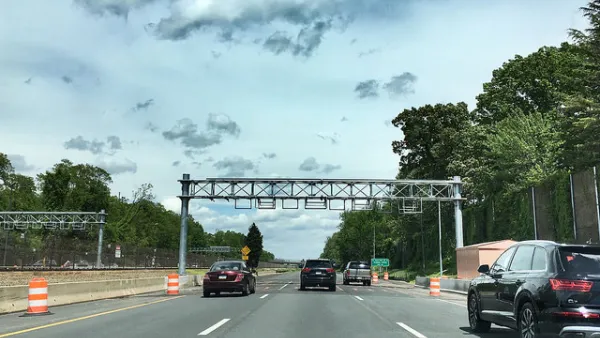
The new 66 Express Lanes Inside the Beltway made headlines when one-way tolls topped $40. Max Smith of WTOP News reports how revenues are used in Northern Virginia. Bus transit and shuttles to park-and-ride lots are two of the biggest beneficiaries.

The state-sanctioned urbicide of Austin
People don’t kill cities. Freeways do.

US to reduce Colorado River water deliveries to Mexico
A new Colorado Treaty amendment reduces Mexico’s Colorado River water allocation by 250,000 acre feet.

New Jersey’s second-largest city bans standalone data centers
Jersey City will continue to allow co-location facilities, such as those meant for research institutions that store their own data.

Amtrak not solely to blame for New Jersey commuter rail's unreliability, report finds
A new study from the Garden State Initiative found that NJ Transit’s budget grew 20% across a 4 year period, but reliability declined significantly over the same period.

EPA erases limits on planet-warming pollution from power plants
Under Monday’s plan, power plants would still have some limits on how much mercury, arsenic and other contaminants they can emit.

Phoenix announces new on-demand transit service, more frequent RAPID buses
Both new services will launch in October, and are part of Phoenix's Project Effective Access Solutions for Easing Congestion.

FREE Course: Walkable City 1: Why Walkability?
After describing his path towards focusing on walkability as the essence of good planning, Jeff Speck marches through his five principal reasons for making more walkable places.
Reinventing Malls: Planning Alchemy—Turning Gray Fields Into Gold
The course focuses on the opportunities and imperatives that shape reinvention of mall sites.

Eagle County Government
Harvard University Graduate School of Design
Nashville Planning Department
The Architects Foundation
University of Cincinnati Online
The Pocatello Development Authority
The Urban Renewal Agency of the City of Pocatello
Journal of the American Planning Association