Another buzzy tech company with roots in the real estate market has designs on the "smart cities" revolution.



"The company behind the WeWork real-estate empire is starting a 'future cities' initiative and has hired former Waze and Google executive Di-Ann Eisnor to run it," reports Simone Stolzoff.
"According to the We Company, Eisnor and [a] team of engineers, architects, data scientists, biologists, and economists will create products and partner with local groups around the world to help address problems spurred by globalization, urbanization, and climate change," according to Stolzoff.
According to the article, the goals and potential outcomes of the project, as announced, remain a bit abstract. However, "[t]he move to launch a smart cities program, though, is in line with one of the company’s non-spiritual missions: to compile the world’s largest data set on how people work and live." That goal is reminiscent of Facebook's ongoing mission to map the entire world's built environment to measure population density using artificial intelligence.
WeWork's foray into the "smart" or "future" cities realm also follows in the footsteps of Sidewalk Labs, a company owned by Google parent company Alphabet, which has been granted an entire neighborhood in Toronto, and potentially more, to treat as a "smart city" experiment.
FULL STORY: The We Company is launching a “smart cities” project and hired a Google executive to lead it

A 20-Year To-Do List for Cities
Predicting the future of challenges facing cities isn't very hard when the future is already staring cities right in the face.
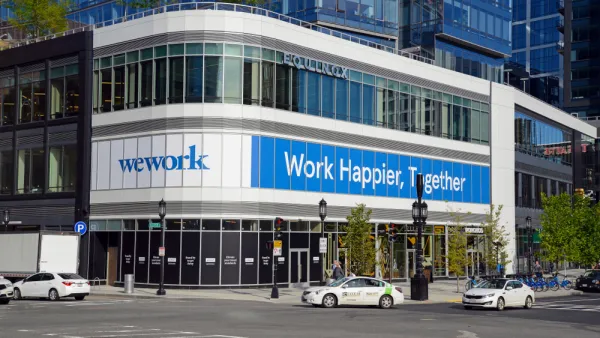
Which Tech Giant is Best Suited to Understand Cities?
The company that best understands what drives city residents’ decisions is best suited to untangle persistent urban problems.
Salt Lake City debuts new bus rapid transit line
The third BRT line in the Utah Transit Authority system connects destinations from Taylorsville to the West Valley.

Planetizen Federal Action Tracker
A weekly monitor of how Trump’s orders and actions are impacting planners and planning in America.

The state-sanctioned urbicide of Austin
People don’t kill cities. Freeways do.

US to reduce Colorado River water deliveries to Mexico
A new Colorado Treaty amendment reduces Mexico’s Colorado River water allocation by 250,000 acre feet.

Mamdani overhauls NYC's Vision Zero plan with 100 new policy goals
The overhaul aims to reduce traffic deaths and make streets safer for pedestrians, cyclists and drivers through lower speed limits, new safety infrastructure and more.

Amtrak not solely to blame for New Jersey commuter rail's unreliability, report finds
A new study from the Garden State Initiative found that NJ Transit’s budget grew 20% across a 4 year period, but reliability declined significantly over the same period.

EPA erases limits on planet-warming pollution from power plants
Under Monday’s plan, power plants would still have some limits on how much mercury, arsenic and other contaminants they can emit.

FREE Course: Walkable City 1: Why Walkability?
After describing his path towards focusing on walkability as the essence of good planning, Jeff Speck marches through his five principal reasons for making more walkable places.
Reinventing Malls: Planning Alchemy—Turning Gray Fields Into Gold
The course focuses on the opportunities and imperatives that shape reinvention of mall sites.

Eagle County Government
Harvard University Graduate School of Design
Nashville Planning Department
The Architects Foundation
University of Cincinnati Online
The Pocatello Development Authority
The Urban Renewal Agency of the City of Pocatello
Journal of the American Planning Association