The Congress for New Urbanism has once again released on if its signature efforts: the Freeways Without Futures report that assumes urban freeways were a mistake of 20th century planning and engineering and advocates for a new approach.


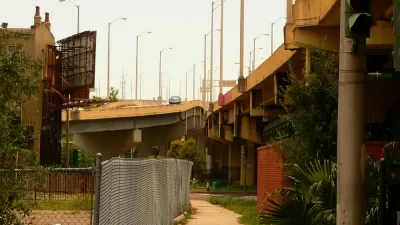
The Congress for New Urbanism released its 2019 Freeways Without Futures report this week, listing ten freeways around the country that could provide new examples of how cities "can save money while boosting their economies and improving the lives of citizens by not repeating the mistakes of the 20th Century."
- Claiborne Expressway (I-10), New Orleans, Louisiana
- I-275, Tampa, Florida
- I-345, Dallas, Texas
- I-35, Austin, Texas
- I-5, Portland, Oregon
- I-64, Louisville, Kentucky
- I-70, Denver, Colorado
- I-81, Syracuse, New York
- I-980, Oakland, California
- Kensington and Scajaquada Expressways, Buffalo, New York
According to the website promoting the report and providing detail on each of the ten freeways listed, the report addresses fundamental questions: "Do we continue to funnel billions of taxpayer dollars into an aging system that pollutes cities, divides neighborhoods, and occupies valuable land that could instead be used for homes and businesses? Or is there an alternative solution that creates stronger cities and communities?"
Claire Tran shared the news about the new Freeways Without Futures report for CityLab.
Read the full story: Freeways Without Futures
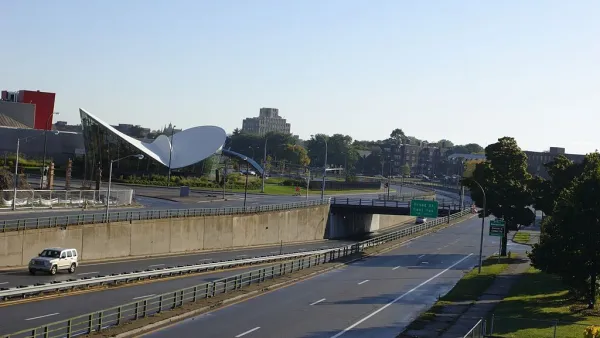
The End of a Urban Freeway—and an Era of Planning—in Rochester, New York
A project to fill-in the Inner Loop in Rochester, New York is underway. It took a lot of contemporary planning to undo this mistake of mid-century planning.
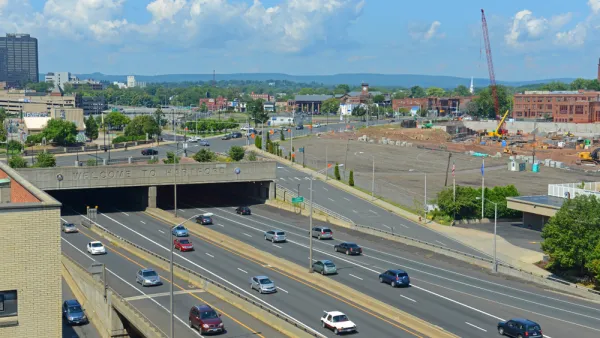
Undoing the Destructive Legacy of Hartford's Interstates
A new plan would spend an estimated $17 billion to remove a huge chunk of the Interstate Highway System's footprint in Hartford, Connecticut.
Economic Justice Includes Highway Removals
A $435 billion "economic justice" bill proposed by Democrats in the U.S. Senate includes $10 billion for projects that remove highways and build community-oriented assets in their place.

Planetizen Federal Action Tracker
A weekly monitor of how Trump’s orders and actions are impacting planners and planning in America.

California plans to bury El Niño’s downpour
If the state plays its cards right, it may be able to store a billion acre-feet of El Niño’s water in aquifers.

Desperate measures: Advocates weigh draining Lake Powell to fill Colorado River
Draining the reservoir could reduce evaporation losses by a couple hundred thousand acre-feet.

In Texas, data centers are swallowing promised parkland
Residents who moved to Taylor, Texas for a rural community now have to contend with three data centers in their backyard.

How a Chicago-sized wind farm beat the odds and powered on
The project spanned five presidential administrations and a standoff with a U.S. military base.

MTA gives itself 30 days to transform pit into basketball court
The site has been under construction since 2022; the city originally estimated it would finish the court in 2024.

FREE Course: Walkable City 1: Why Walkability?
After describing his path towards focusing on walkability as the essence of good planning, Jeff Speck marches through his five principal reasons for making more walkable places.
Reinventing Malls: Planning Alchemy—Turning Gray Fields Into Gold
The course focuses on the opportunities and imperatives that shape reinvention of mall sites.

City of Rosemead
Rutgers University, Edward J. Bloustein School of Planning and Public Policy
One Hundred Miles
Hunter College, City University of New York (CUNY)
The Architects Foundation
University of Cincinnati Online
City of Cambridge
Montrose County
The Pocatello Development Authority