"The Gap: A Shortage of Affordable Rental Homes" illustrates the depth of the nation's rental housing affordability crisis.


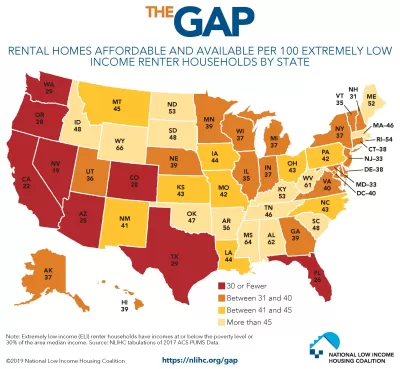
The National Low-Income Housing Coalition (NLIHC) released its annual report on the state of the nation's housing today, and the picture is bleak.
"Today, more than 8 million Americans spend more than half their income on housing, meaning that these severely rent-burdened households have little left every month to pay for food, transportation, and healthcare," writes Patrick Sisson to share the news about the report. "No state or city in the entire country has an adequate supply of housing for extremely low-income housing population; California alone is short one million units."
It isn't just California getting a bad wrap with the findings of the report. As noted in local coverage for the Houston Chronicle by reporter Sarah Smith, "Houston is the least-affordable city in Texas for extremely low income renters..."
"Texas has fewer affordable units per 100 households for people of extremely low income than the country as a whole, per the report, coming out ahead of only six states. The national average is 37 homes per 100 extremely low income renters; Houston, however, only has 19 homes for that demographic," adds Smith.
Returning again to Sisson's coverage of the report, the current presidential administration and the upcoming presidential election also feature prominently in the narrative about the state of the nation's housing market.
The Trump administration completely fails to address the affordable housing crisis, or propose any new policies or programs that could help alleviate the strain. "The Trump administration, in its latest budget proposal, suggests slashing funding for the Department of Housing and Urban Development (HUD) by more than 16 percent, with those cuts affecting public housing and the maintenance and improvement of public housing buildings, and wants to add work requirements to existing programs," according to Sisson.
On a press call to promote the new report, Diane Yentel, president and CEO of the NLIHC, contrasted those proposals with those of Democratic presidential hopefuls Kamala Harris and Elizabeth Warren. According to Yentel, the housing programs proposed by senators Elizabeth Warren and Kamala Harris, "offer bold solutions, 'the likes of which, in scale and scope, we haven’t seen in decades.'"
Read the full story: As affordable housing crisis worsens, Trump proposes more cuts

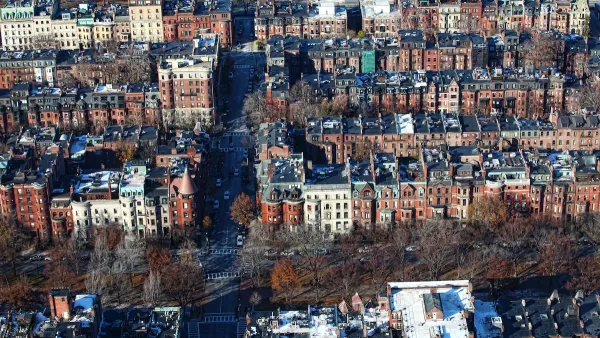
Boston Affordable Housing Program Meets 1,000-Unit Goal
The program offers zero-interest loans to developers that keep rental units affordable for at least 50 years.

Experts Express Pessimism Over Housing Costs
Although the current housing crisis has been compared with the housing crash of the late 2000s, experts caution that affordability issues could plague the U.S. housing market for years to come.
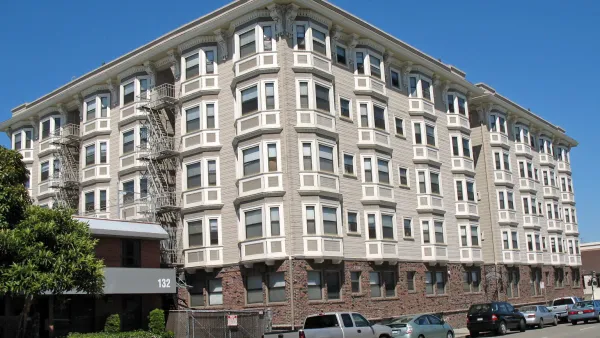
New California Bond Program Promotes Affordability for Middle-Income Renters
The California Statewide Communities Development Authority hopes that a new program, which helps cities purchase rental properties with no upfront cost, will lead to an increase in affordable middle-income housing.

Planetizen Federal Action Tracker
A weekly monitor of how Trump’s orders and actions are impacting planners and planning in America.

California plans to bury El Niño’s downpour
If the state plays its cards right, it may be able to store a billion acre-feet of El Niño’s water in aquifers.

Desperate measures: Advocates weigh draining Lake Powell to fill Colorado River
Draining the reservoir could reduce evaporation losses by a couple hundred thousand acre-feet.

California city breaks ground on transit connector
The project includes three mobility hubs and a pedestrian bridge.

After public outcry, Massachusetts city releases housing development tracker
Cambridge’s tracker currently shows 250 housing projects in various stages of development.

40 years after approval, Chicago breaks ground on new park
The park honors Jean Baptiste Point du Sable, the city’s first permanent non-native settler.

FREE Course: Walkable City 1: Why Walkability?
After describing his path towards focusing on walkability as the essence of good planning, Jeff Speck marches through his five principal reasons for making more walkable places.
Reinventing Malls: Planning Alchemy—Turning Gray Fields Into Gold
The course focuses on the opportunities and imperatives that shape reinvention of mall sites.

City of Rosemead
Rutgers University, Edward J. Bloustein School of Planning and Public Policy
One Hundred Miles
Hunter College, City University of New York (CUNY)
The Architects Foundation
University of Cincinnati Online
City of Cambridge
Montrose County
The Pocatello Development Authority