With Democrats rising to power in the U.S. House of Representatives and the government recently reopened (temporarily at least), it's time to plot the legislative ambitions of the coming session in Congress.


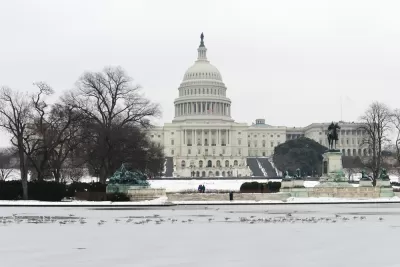
Rep. Peter DeFazio (D-OR) sat down for an interview with Angie Schmitt to lay out expectations for transportation policy as a result of new Democratic leadership in the House of Representatives.
Rep. DeFazio is the chair of the House Transportation Committee, and is thus "perhaps the most powerful person to shape federal transportation policy," according to Schmitt. Rep. DeFazio's track record in Congress, serving since 1987, includes leadership "on issues such as holding designers accountable for unsafe streets and promoting increased protection for women on public transit," according to Schmitt.
The interview ranges from major policy pushes, funding for alternative transportation, the Highway Trust Fund, a potential federal infrastructure bill, and pedestrian safety. Rep. DeFazio opens the interview with a bold statement about the need to move beyond fossil fuels in transportation.
Read the full story: New House Transportation Chair: ‘We Need to Move Beyond Fossil Fuel’


Pedestrian Safety Still Not a Priority in the United States
Dangerous by Design 2021 quantifies the transportation sector's ongoing neglect of the health and safety of people performing that basic human action of taking a walk.

California Transportation Commission Reluctant to Incorporate Complete Streets Guidelines
The agency plans to update its road design guidelines by the end of the year — before a new law that prioritizes pedestrian and cyclist safety takes effect.

DC’s Traffic Cameras Are Working, but Not a Panacea
Automated enforcement is reducing speeding, but bigger changes to street design and the built environment are needed to make the District’s streets safer and more pleasant for people walking.

Planetizen Federal Action Tracker
A weekly monitor of how Trump’s orders and actions are impacting planners and planning in America.

California plans to bury El Niño’s downpour
If the state plays its cards right, it may be able to store a billion acre-feet of El Niño’s water in aquifers.

Chicago breaks ground on $3 billion megadevelopment
The new neighborhood, titled Foundry Park, will one day host 3,700 residences.

California High-Speed Rail Authority CEO resigns after $600,000 scandal
Under Ian Choudri, the authority used taxpayer dollars to fund first class flights and trips to nightclubs.

Want to study the Missouri River? Soon, you may need unanimous approval from 10 states
Legislation would require 10 governors’ permission to study or build projects moving water outside the basin.

Desperate measures: Advocates weigh draining Lake Powell to fill Colorado River
Draining the reservoir could reduce evaporation losses by a couple hundred thousand acre-feet.

FREE Course: Walkable City 1: Why Walkability?
After describing his path towards focusing on walkability as the essence of good planning, Jeff Speck marches through his five principal reasons for making more walkable places.
Reinventing Malls: Planning Alchemy—Turning Gray Fields Into Gold
The course focuses on the opportunities and imperatives that shape reinvention of mall sites.

City of Rosemead
Rutgers University, Edward J. Bloustein School of Planning and Public Policy
One Hundred Miles
Hunter College, City University of New York (CUNY)
The Architects Foundation
University of Cincinnati Online
City of Cambridge
Montrose County
The Pocatello Development Authority