A new report proposes changes to the New York City Department of Design and Construction in the hopes of limiting extreme cost overruns and delays.


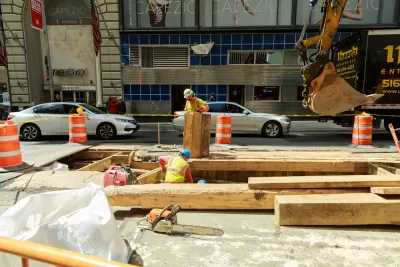
"The de Blasio administration plans to unveil major changes Thursday to curb the eye-popping cost overruns and delays that have wasted millions of taxpayer dollars on municipal projects, such as a 400-square-foot park bathroom that took eight years to build," according to an article by Joe Anuta.
The Department of Design and Construction, which acts as the city's contractor for most projects, has "drafted a report [pdf] that lays out a path to bring projects in on time and on budget and make dealing with government less of a headache for vendors—which would increase competition and attract more bidders, including minority- and women-owned businesses."
"The department's report proposed a more streamlined process up front with fewer layers of approval and less room to alter designs midstream," adds Anuta.
The new rules would also "create a dedicated pot of funding for change orders, a dreaded term in the contracting business that describes project alterations during construction," according to Anuta.
Read the full story: City unveils major overhaul to stop wasteful projects

2021 Opening Expected for San Francisco's Central Subway
Mark your calendars (but maybe use pencil).

The Consultants Behind the CA High-Speed Rail Debacle
The state's high-speed rail project is billions of dollars over budget and years behind schedule. A major problem is that consultants have been running the show from the start, say critics.
Activating Artists as an Urban Resource
Planning and art don't traditionally mix, but that's changing. Embedded at NYC's Department of Design and Construction, artist Mary Miss envisions public art as an infrastructural aid.

Planetizen Federal Action Tracker
A weekly monitor of how Trump’s orders and actions are impacting planners and planning in America.

California plans to bury El Niño’s downpour
If the state plays its cards right, it may be able to store a billion acre-feet of El Niño’s water in aquifers.

Chicago breaks ground on $3 billion megadevelopment
The new neighborhood, titled Foundry Park, will one day host 3,700 residences.

Satanic Place Names
From streams and lakes to valleys and canyons, I mapped more than 1,000 places named after the Devil.

California High-Speed Rail Authority CEO resigns after $600,000 scandal
Under Ian Choudri, the authority used taxpayer dollars to fund first class flights and trips to nightclubs.

Want to study the Missouri River? Soon, you may need unanimous approval from 10 states
Legislation would require 10 governors’ permission to study or build projects moving water outside the basin.

FREE Course: Walkable City 1: Why Walkability?
After describing his path towards focusing on walkability as the essence of good planning, Jeff Speck marches through his five principal reasons for making more walkable places.
Reinventing Malls: Planning Alchemy—Turning Gray Fields Into Gold
The course focuses on the opportunities and imperatives that shape reinvention of mall sites.

City of Rosemead
Rutgers University, Edward J. Bloustein School of Planning and Public Policy
One Hundred Miles
Hunter College, City University of New York (CUNY)
The Architects Foundation
University of Cincinnati Online
City of Cambridge
Montrose County
The Pocatello Development Authority