Planning and art don't traditionally mix, but that's changing. Embedded at NYC's Department of Design and Construction, artist Mary Miss envisions public art as an infrastructural aid.


Long-time public artist Mary Miss serves as the first artist-in-residence at New York City’s Department of Design and Construction (DDC), with a mandate "to change the culture of an agency known for its sometimes difficult relationships with architects."
Jen Kinney writes, "In the past 30 years, just 337 percent-for-art projects have been installed in the city, while thousands of construction and infrastructure projects have been undertaken in that same time."
In her DDC position, as well as through her nonprofit City as Living Laboratory, Miss sees ways to integrate public art into cities' infrastructural needs. For example, in Milwaukee, she proposes to "light the water treatment plant's stack so that it glows blue most of the time, but turns red the night before it's forecasted to rain. Through education, residents will understand this as encouragement not to run their dishwashers or washing machines or take baths until the storm has passed."
"When it comes to integrating artists at DDC, Miss offers three potential pathways: Artists could be hired as liaisons between a construction project and local residents, before, during and after construction; they could be brought on as a member of the design team; or they could apply to DDC as fellows."
Read the full story: How to Bring More Artists Into City Planning

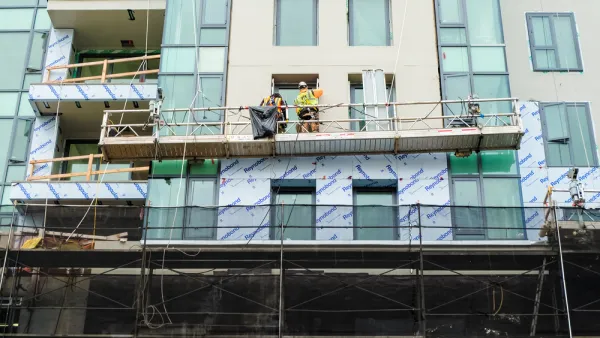
Art May Be Coming to New York City Sidewalk Sheds
Scaffolding and sidewalk sheds being a fixture of life in NYC, the city has decided to let artists do their thing with all that blank canvas.
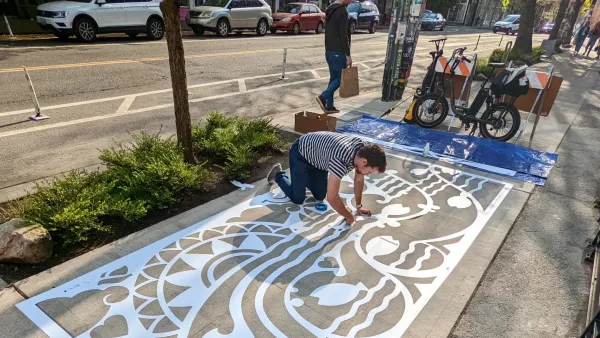
This Seattle sidewalk art only appears when it rains
Prompted to find a silver lining to the gloom of rainy Pacific Northwest days, an artist hit upon a novel solution: water-activated sidewalk paint.
NYC has Lost 4% of its Resident Artists Since 2019
Advocates argue the city should build more affordable housing reserved for artists, who are being increasingly priced out.

Planetizen Federal Action Tracker
A weekly monitor of how Trump’s orders and actions are impacting planners and planning in America.

Northwest rail fans eager for Sept. 30 debut of Amtrak’s Airo fleet
Get ready for that new train smell and more seats. But they won’t go faster or run more frequently on the Cascades route in Washington and Oregon.
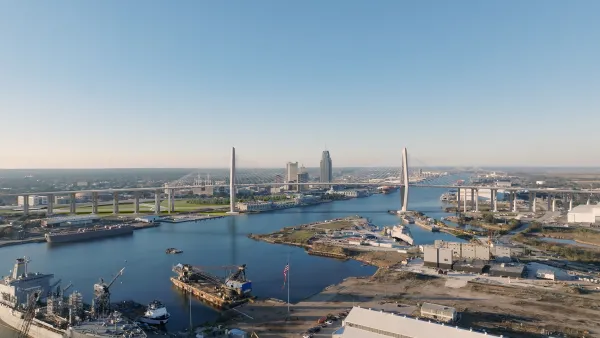
Alabama scores up to $2.5 billion federal loan for largest infrastructure project in state’s history
The Mobile River Bridge and Bayway Project aims to ease congestion at Alabama’s worst bottleneck.

Novel study finds extreme state-by-state disparity in housing construction timelines
The first comprehensive working paper on U.S. construction timelines also found that the permitting process for multi-family projects has slowed nationwide.

California may destroy its beaches trying to save homes from El Niño
Boulders and seawalls can protect homes from waves, but ultimately destroy sandy beaches.

California high-speed rail accomplishes only one legislative goal in 2026
The majority of the agency's failed pitches were never developed into written proposals.

FREE Course: Walkable City 1: Why Walkability?
After describing his path towards focusing on walkability as the essence of good planning, Jeff Speck marches through his five principal reasons for making more walkable places.
Reinventing Malls: Planning Alchemy—Turning Gray Fields Into Gold
The course focuses on the opportunities and imperatives that shape reinvention of mall sites.

City of Thousand Oaks
City of Wisconsin Rapids
Harvard University Graduate School of Design
The Architects Foundation
University of Cincinnati Online
Northern Illinois Transit Authority (NITA)
The Pocatello Development Authority
The Urban Renewal Agency of the City of Pocatello