Pedestrians are often blamed first for accidents, but they have few choices when the infrastructure is lacking, a new study shows.


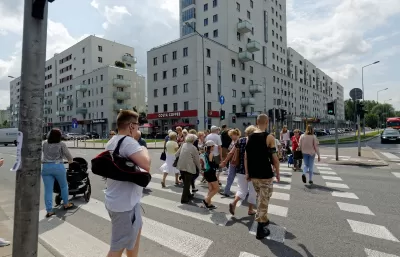
Michael Smith, a University of Illinois graduate student, collected video at intersections on a road in Rockford, Illinois, to understand better how pedestrians interact with the built environment. Often pedestrians are blamed for accidents, with the assumption being that they were jaywalking or not paying attention to their surroundings.
"But Smith’s videos found pedestrians’ behavior is influenced a lot by the environment: They’re more likely engage in risky behavior — like walking or rolling in the street or crossing mid-block — when the pedestrian infrastructure is incomplete or lacking," reports Angie Schmitt.
At one intersection, Smith repeatedly saw examples of people backtracking and going into the street because there was not an ADA-compliant ramp at the corner, even though the location was near a housing development for older people. He also noticed that people waiting for buses at a stop without a bench or shelter would wait on the other side of the street at a shopping center and then dart across when the bus came.
"People were adapting their behavior to the conditions, often in ways that put them at risk," notes Schmitt. Smith’s recommendations include a decrease in the speed limit, enhanced crosswalks, and leading pedestrian intervals at signaled intersections.
Read the full story: Research Explains Why Pedestrians ‘Break the Rules’

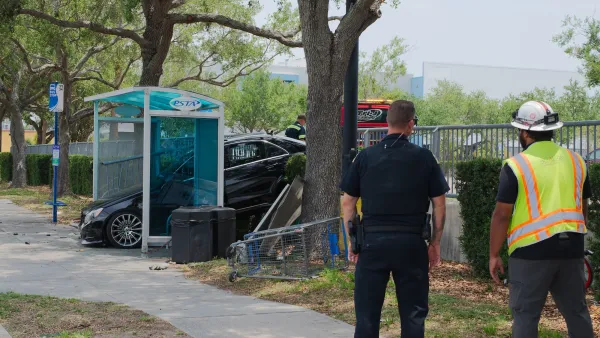
Buses are very safe. The walk to and from stations, not so much.
A disproportionate number of crashes involving pedestrians happen near transit stops.
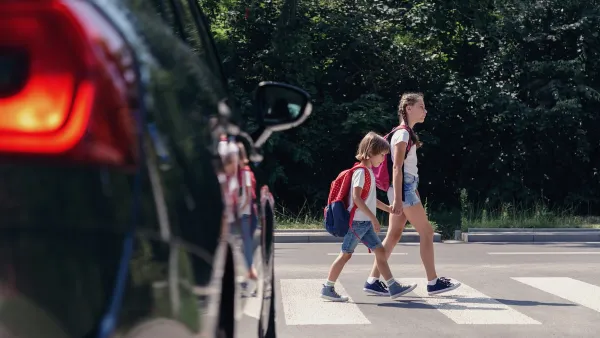
US Street Design Manual Inches Toward Safer Roads
The guiding document for U.S. road design is starting to recognize the needs of people walking and biking, but safe streets advocates say more significant changes are needed to reduce the high number of pedestrian deaths and improve connectivity for all road users.
Traffic Safety Efforts Chug Ahead — Too Slowly for Some
Around the United States, traffic deaths are growing or plateauing, yet efforts to make roads safer still face political opposition.

Planetizen Federal Action Tracker
A weekly monitor of how Trump’s orders and actions are impacting planners and planning in America.

The state-sanctioned urbicide of Austin
People don’t kill cities. Freeways do.

US to reduce Colorado River water deliveries to Mexico
A new Colorado Treaty amendment reduces Mexico’s Colorado River water allocation by 250,000 acre feet.

Brightline West’s future may rely on $6 billion federal loan
The company has until Nov. 2 to make a $400 million equity investment into its proposed high-speed rail line.

LA Metro’s ultimatum: no extra buses for LA28 if federal funding isn’t imminently secured
If Metro does not provide additional buses, LA28 organizers will have to find a new way to manage Olympic traffic. LA28’s budget does not include a line item for transit.

Colorado’s Largest Data Center Could Rise Next to Homes — Without a Public Hearing
The proposed campus would consume 11 times the power of Denver International Airport; as it has across the country, opposition mounts.

FREE Course: Walkable City 1: Why Walkability?
After describing his path towards focusing on walkability as the essence of good planning, Jeff Speck marches through his five principal reasons for making more walkable places.
Reinventing Malls: Planning Alchemy—Turning Gray Fields Into Gold
The course focuses on the opportunities and imperatives that shape reinvention of mall sites.

Eagle County Government
Harvard University Graduate School of Design
Nashville Planning Department
The Architects Foundation
University of Cincinnati Online
The Pocatello Development Authority
The Urban Renewal Agency of the City of Pocatello
Journal of the American Planning Association