With world population to grow by about 2 billion by 2050, and with more people eating higher on the food chain as nations develop economically, can world agriculture reduce its carbon footprint? A new World Resources Institute report shows how.


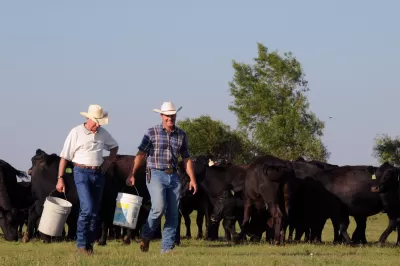
“Food is the mother of all sustainability challenges,” says Janet Ranganathan, vice president for science and research at the World Resources Institute (WRI), a global research organization. “We can’t get below 2 degrees Celsius without major changes to this system.”
She says that’s why the group’s report, Creating A Sustainable Food Future, released Dec. 5, 2018, is “one of the most important...that we’ve ever published," reports Jenny Splitter for Forbes.
Its authors set out to answer the most critical question facing the global food system today: how to feed the nearly 10 billion people expected to populate the earth by 2050 [up from almost 7.7 billion people today] in a way that doesn’t completely wreck the planet.
"Agriculture already occupies roughly 40 percent of the world’s land and is responsible for about a quarter of humanity’s greenhouse gas emissions," adds Brad Plumer for The New York Times's climate team in his piece on the WRI report.
"Increasing the amount of food produced per hectare was the most critical step, the experts said, followed by cutting meat-eating and putting a stop to the wasting of one-third of food produced," reports Damian Carrington, the Guardian's environment editor.
Chicken is not meat, or at least not "ruminant meat"
Restricting meat-eating need not mean becoming a vegetarian, though Carrington did pen a column on Dec. 22, "Why I’m looking forward to my first vegan Christmas."
“We could imagine a significant shift from beef to chicken, and that by itself goes a long way," said lead author Timothy D. Searchinger of Princeton University. “Poultry production has about one-eighth the climate impact of beef production," adds Plumer.
"According to Searchinger, WRI is recommending 'that two million heavy consumers of meat, lamb and goat in 2050 in the U.S., Russia, Europe, and Brazil, limit their consumption to 1.5 servings per person per week,' so the world can meet its overall reduction goals while, at the same time, acknowledging that 'the world’s poor people are entitled to consume at least a little more',” adds Splitter.
"Ruminant livestock (cattle, sheep, and goats) use two-thirds of global agricultural land and contribute roughly half of agriculture’s production-related emissions," states the executive summary [pdf]. "Ruminant meat demand is projected to grow by 88 percent between 2010 and 2050."
"Avoiding meat and dairy is ‘single biggest way’ to reduce your impact on Earth," reported Carrington of the Guardian on a study published in Science on June 1 that corroborated the outsized impacts of ruminants.
Not by efficiency alone
While efficiency—producing more food on less land, was the report's most critical finding, it recommended tying it to conservation, notes Splitter.
In order to protect natural resources even as farms become more efficient, Searchinger says “governments need to explicitly link...yield gains to protection of forests and other natural lands.” Through government regulation, natural ecosystems can be protected and agricultural expansion, when necessary, can be limited to avoid sacrificing resource-rich lands like tropical rainforests."
The report also looked at human population growth to reduce food demand "by reducing fertility levels, voluntarily, through 'improving education for girls, reducing child mortality and providing access to reproductive health services'," adds Splitter. Presumably this recommendation would be applicable to developing nations in Africa which have the world's highest fertility rates, unlike many economically developed nations where they have fallen below replacement levels.
FULL STORY: How To Feed The World Sustainably? Grow More With Less, New Study Finds

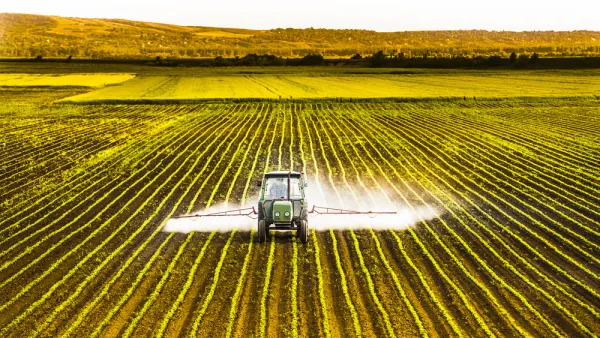
Land Use the Subject of Latest IPCC Report
Not urban land use, but in the literal sense: land used to produce food, graze livestock, supply drinking water, grow trees, and sequester carbon. As the climate warms and the population grows, crop yields will decrease and land will be degraded.
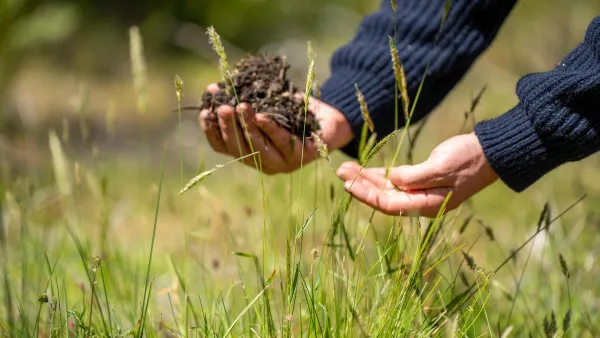
New Documentary Highlights Regenerative Agriculture and Climate Change
Common Ground is a recently released documentary which urges viewers to rethink our relationship with soil and approach to agriculture and food production.
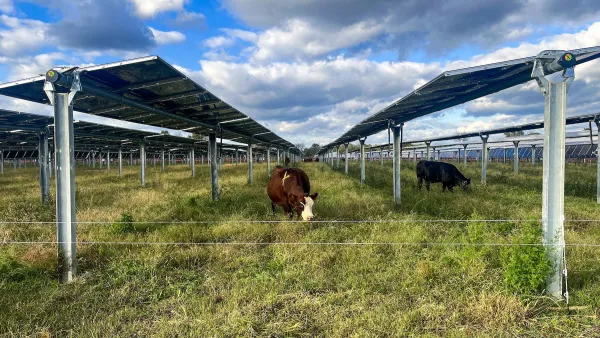
Cows at Tennessee's 'Silicon Ranch' graze under solar panels
The project aims to prove that agriculture and solar energy production can work in tandem.

The state-sanctioned urbicide of Austin
People don’t kill cities. Freeways do.

US to reduce Colorado River water deliveries to Mexico
A new Colorado Treaty amendment reduces Mexico’s Colorado River water allocation by 250,000 acre feet.

New Jersey’s second-largest city bans standalone data centers
Jersey City will continue to allow co-location facilities, such as those meant for research institutions that store their own data.

Amtrak not solely to blame for New Jersey commuter rail's unreliability, report finds
A new study from the Garden State Initiative found that NJ Transit’s budget grew 20% across a 4 year period, but reliability declined significantly over the same period.

EPA erases limits on planet-warming pollution from power plants
Under Monday’s plan, power plants would still have some limits on how much mercury, arsenic and other contaminants they can emit.

Phoenix announces new on-demand transit service, more frequent RAPID buses
Both new services will launch in October, and are part of Phoenix's Project Effective Access Solutions for Easing Congestion.

FREE Course: Walkable City 1: Why Walkability?
After describing his path towards focusing on walkability as the essence of good planning, Jeff Speck marches through his five principal reasons for making more walkable places.
Reinventing Malls: Planning Alchemy—Turning Gray Fields Into Gold
The course focuses on the opportunities and imperatives that shape reinvention of mall sites.

Eagle County Government
Harvard University Graduate School of Design
Nashville Planning Department
The Architects Foundation
University of Cincinnati Online
The Pocatello Development Authority
The Urban Renewal Agency of the City of Pocatello
Journal of the American Planning Association