With several stipulations, Seattle City Council has signed off on the university's plans for up to 6 million square feet of new construction, including high-rises.


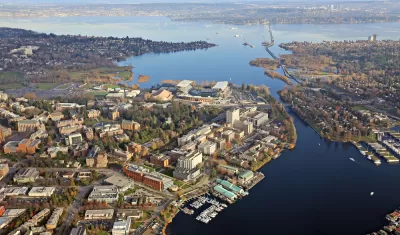
A ten-year vision to accommodate another 7,000 students and staff, the UW's expansion plans call for 6 million square feet of new construction. Seattle City Council has approved the plan this month, Daniel Beekman writes, after preliminary approval in September.
The plan includes an "innovation district" made up of "high rises there where students and researchers can partner with companies, governments and nonprofits to start new projects and businesses." Towers as tall as 17 stories may rise in the vicinity of the medical center.
City Council approval came with a stipulation that "the university must have no more than 12 percent of students and employees commute by driving alone by 2028," strengthening the university original proposal of 15 percent.
Another condition previously required the university to build at least 450 units of affordable housing for low-wage employees. The UW subsequently agreed to do so as long as the construction was treated as voluntary. One councilmember, Kshama Sawant, approved the plan but called 450 units a "paltry number when you consider the actual need."
Read the full story: Seattle City Council approves plan for UW to build 6 million square feet, add high-rise district


Capital Gains Tax Under Consideration in Seattle
A proposed capital gains tax would invest $37 million per year in solving affordable housing and homelessness crises in Seattle.

The Cost of Solving Homelessness in Seattle: $400 Million
It’s "dramatically higher" than any number under discussion, and not even close to what the city will raise with its new tax on large businesses.

Seattle church complex includes 87 affordable homes
The Columbia City Church of Hope deeded part of its property to an affordable housing developer after limiting in-person congregation during the pandemic.

Planetizen Federal Action Tracker
A weekly monitor of how Trump’s orders and actions are impacting planners and planning in America.

California plans to bury El Niño’s downpour
If the state plays its cards right, it may be able to store a billion acre-feet of El Niño’s water in aquifers.

Chicago breaks ground on $3 billion megadevelopment
The new neighborhood, titled Foundry Park, will one day host 3,700 residences.

California High-Speed Rail Authority CEO resigns after $600,000 scandal
Under Ian Choudri, the authority used taxpayer dollars to fund first class flights and trips to nightclubs.

Want to study the Missouri River? Soon, you may need unanimous approval from 10 states
Legislation would require 10 governors’ permission to study or build projects moving water outside the basin.

Desperate measures: Advocates weigh draining Lake Powell to fill Colorado River
Draining the reservoir could reduce evaporation losses by a couple hundred thousand acre-feet.

FREE Course: Walkable City 1: Why Walkability?
After describing his path towards focusing on walkability as the essence of good planning, Jeff Speck marches through his five principal reasons for making more walkable places.
Reinventing Malls: Planning Alchemy—Turning Gray Fields Into Gold
The course focuses on the opportunities and imperatives that shape reinvention of mall sites.

City of Rosemead
Rutgers University, Edward J. Bloustein School of Planning and Public Policy
One Hundred Miles
Hunter College, City University of New York (CUNY)
The Architects Foundation
University of Cincinnati Online
City of Cambridge
Montrose County
The Pocatello Development Authority