Despite statements to the contrary just a week ago, Macron reversed position and caved to the demonstrators' demands that upcoming fuel tax hikes be suspended.


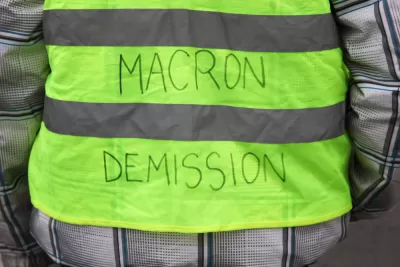
"On Tuesday, French Prime Minister Édouard Philippe announced that he will suspend plans [for six months] to raise taxes on gasoline and diesel, which were scheduled to increase next month," reports Feargus O'Sullivan, a contributing writer to CityLab, covering Europe.
The demonstrators, who don the yellow vests that French motorists are required to keep in their vehicles in the event of a traffic incident, have taken to the streets since mid-November, protesting against modest fuel tax increases planned for January 1, part of a green agenda espoused by French President Emmanuel Macron. They have come to be called Yellow Vest, or Gilet Jaune, demonstrators.
Just last Tuesday, Nov. 27, "Macron said he sympathizes with the protesters and offered some conciliatory gestures, but stood firm on the tax that prompted the anger," reported Camila Domonoske for NPR. One conciliation was the suspension of cordon area congestion pricing that would have been permitted by willing cities.
Demonstrations rooted in inequality
The demonstrations proved too big, too powerful to ignore. "PM Philippe said anyone would have 'to be deaf or blind' not to hear or see the anger," reports the BBC, which notes that "[t]he government will also immediately freeze prices on electricity and home heating fuel."
"The Gilets Jaunes have grown as a popular movement filled with many groups who feel they have been overlooked and stigmatized by Parisian elites," explains O'Sullivan.
As in all Western countries, France’s inequality gap has widened, leaving many people struggling, including groups such as the lower middle class, who previously enjoyed far more secure prosperity. Many have seen their living standards fall or stagnate, including people with jobs who now find that their wages barely stretch to cover necessities.
While an American looking in on France might see a relatively strong welfare safety net intended to protect such struggling citizens, French people accustomed to it are more likely to see, and experience, the growing size of the net’s holes.
O'Sullivan describes at length what appear to be President Macron's shortcomings as an egalitarian leader. "The issue of fuel taxes has thus been a catalyst for the expression of a slow-building resentment."
Urban-rural divide?
Another aspect of the gap is observed occasionally in Planetizen posts: the urban-rural divide. The demonstrators largely hail from "rural and forgotten France," reported Adam Nossiter, Paris correspondent for The New York Times, on Nov. 24. However, O'Sullivan questions this aspect of inequality.
The Gilets Jaunes have presented themselves as the voice of France’s neglected regions. American media outlets have thus presented the crisis as an urban-rural standoff—a framing that is partly right, but still somewhat off the mark.
O'Sullivan maps out where the demonstrations have taken place, and explains how political power is largely centralized in France, unlike among the states in the U.S. To some extent, this explains a phenomenon that occurred on Election Day in the U.S., when the nation's second highest fuel-taxed state chose to retain a recent 12-cent gas tax hike, while the nation's second lowest gas-taxed state rejected a 10-cent gas tax hike.
Populism
O'Sullivan sees a connection with past populist movements in France that mobilized to protest taxes, namely Poujadism in the 1950s, and even the Tea Party movement that began following Barack Obama's first presidential inauguration in January 2009. He ends his piece on an ominous note:
The car burnings and roadblocks may be over for today, but the energy and anger behind the Gilets Jaunes are likely not going anywhere.
Suspension vs. termination
That sentiment was enforced by Nossiter of The New York Times, who reported on Dec. 4:
The government’s announcement of merely a six-month suspension of the gas tax increase — not a scuttling of it — left those who have emerged as Yellow Vest spokesmen wary, at the very least.
“There’s no guarantee it won’t be back in six months,” said Lionel Cucchi, a spokesman in Marseille of the gas tax. “There will be more demonstrations. We remain mobilized.”
Time to rethink green taxes?
In an interesting Guardian article, "Macron’s U-turn on eco-tax rise gives green lobby fuel for thought," Jonathan Watts writes that Maron's reversal on the "eco-tax" could be seen as "a painful lesson for environmental policymakers at this week’s UN climate talks in Katowice [Poland]."
Dozens of countries and cities have introduced or drawn up plans for carbon taxes to speed the transition from fossil fuels that are warming the planet to increasingly dangerous levels. They are rarely easy to implement. There have also been protests and political backwards steps in Belgium, Tunisia, Algeria and Canada.
But while policy wonks across the world agree on the principle of “polluter pays”, Macron has clearly found it hard to convince the French public on two key questions: what they are supposed to be paying for and whether the burden is being fairly shared.
The Yellow Vest movement, while rooted in income inequality, may be one of the most visible illustrations of why the gas tax is called "regressive," although one should also consider the frequency of hiking fuel taxes. In the U.S, it's been well over two decades since the federal government and many states have increased fuel excise taxes.
Related in Planetizen:
Read the full story: France Gives In to ‘Yellow Vest’ Protesters’ Demands

Fuel Tax Hike Revolt Threatens French President Macron's Leadership
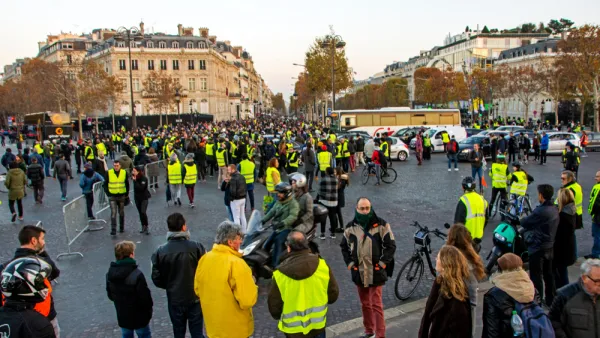
Anger at fuel tax increases planned for January, part of a pro-Green agenda espoused by President Emmanuel Macron, has sparked a populous movement involving hundreds of thousands of protestors that have taken to the streets, erupting into violence.
France Drops Road Tolling Plans Amid Fuel Tax Protests
Controversial London-style congestion pricing won't be coming to French cities due to concerns sparked by the 'Yellow Vest' protests over an upcoming fuel tax hike, but President Macron stated the fuel tax increases will go forward in January.
Progressive Carbon Pricing Policy Should Address Social Equity
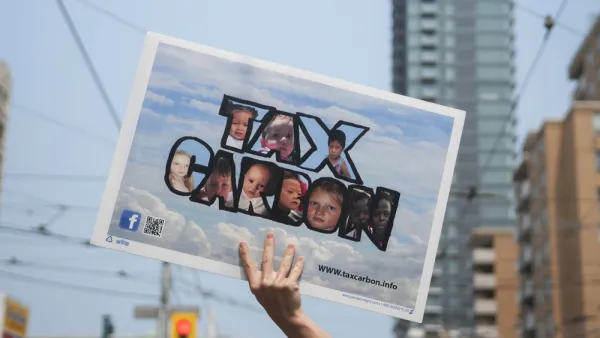
Putting a price on carbon emissions is widely viewed as an effective tool to reduce emissions. It can also be applied to help those who stand to lose the most from climate change, thus enabling a socially just transition to a low carbon economy.

Planetizen Federal Action Tracker
A weekly monitor of how Trump’s orders and actions are impacting planners and planning in America.

California plans to bury El Niño’s downpour
If the state plays its cards right, it may be able to store a billion acre-feet of El Niño’s water in aquifers.

Chicago breaks ground on $3 billion megadevelopment
The new neighborhood, titled Foundry Park, will one day host 3,700 residences.

Satanic Place Names
From streams and lakes to valleys and canyons, I mapped more than 1,000 places named after the Devil.

California High-Speed Rail Authority CEO resigns after $600,000 scandal
Under Ian Choudri, the authority used taxpayer dollars to fund first class flights and trips to nightclubs.

Want to study the Missouri River? Soon, you may need unanimous approval from 10 states
Legislation would require 10 governors’ permission to study or build projects moving water outside the basin.

FREE Course: Walkable City 1: Why Walkability?
After describing his path towards focusing on walkability as the essence of good planning, Jeff Speck marches through his five principal reasons for making more walkable places.
Reinventing Malls: Planning Alchemy—Turning Gray Fields Into Gold
The course focuses on the opportunities and imperatives that shape reinvention of mall sites.

City of Rosemead
Rutgers University, Edward J. Bloustein School of Planning and Public Policy
One Hundred Miles
Hunter College, City University of New York (CUNY)
The Architects Foundation
University of Cincinnati Online
City of Cambridge
Montrose County
The Pocatello Development Authority