Tolls were not on state ballots like gas taxes and transportation sales taxes on Nov. 6, but surrogates for and against truck-only tolling participated in two gubernatorial elections in New England, and the results will give no joy to truckers.


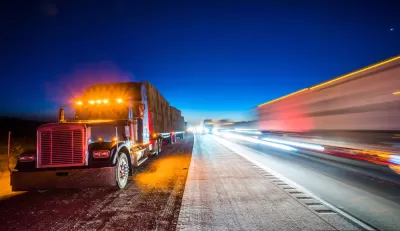
Earlier this month, voters determined the outcome of state gas tax measures in Missouri, Utah, California, and on state sales tax and bond measures to fund road projects in Colorado.
In Rhode Island, a controversial, first-of-its-kind transportation user fee known as truck-only tolls was indirectly on the ballot in the state's gubernatorial race.
"Incumbent Governor Gina Raimondo [D] handily won reelection," writes Pete Garino, president of Advanced Management Consulting LLC and the former Chief Operating Officer of the Rhode Island Department of Transportation, in a column for the International Bridge, Tunnel and Turnpike Association.
Raimondo is a fierce supporter of truck-only tolling, a key element of her RhodeWorks program, which passed the state legislature in 2016.
She fended off a challenge by an opponent who was supported by the Rhode Island Trucking Association and vowed to take down the truck toll gantries that were activated earlier this year. During the campaign, Raimondo indicated to the Cranston Herald that RhodeWorks was “perhaps the best policy decision of her administration thus far."
As noted in a September post on the truck-only tolling program, American Trucking Associations, of which the state association is a member, and three truck carriers filed a lawsuit July 10 contesting the constitutionality of the tolling program. The lawsuit [pdf] maintains that truck tolls discriminate against interstate commerce.
"In neighboring Connecticut, [Democratic] gubernatorial candidate Ned Lamont took notice, made truck-only tolling a centerpiece of his campaign, and prevailed in a hard-fought campaign," adds Garino.
Lamont was just as assertive about tolling in the Connecticut gubernatorial race, asserting that “I’m going to make it a priority from day one.”
During the campaign, Lamont said he expected truck-only tolling would collect $250 million in annual revenue, significantly more than the $45 million Rhode Island expects to see each year when its system is fully deployed.
Legislative support in Connecticut
"At the time of the election, Democrats and Republicans each held 18 [state Senate] seats, with Democrats controlling the chamber through the lieutenant governor's tie-breaking vote," according to Ballotpedia. The Democrats picked up at least four seats on Election Day, as well as expanding their majority in the Connecticut House of Representatives.
"Democratic leaders in the Connecticut House and Senate said they are open to Lamont’s campaign pledge to install truck tolls on the state’s highways and major routes," reports Bill Cummings for the Connecticut Post on Nov. 12.
"I’m sure he will introduce [truck tolls] and I will support that," said Senate President Martin Looney, D-New Haven. "If the governor wants to begin with that as an incremental step, I would support that."
House Majority Leader Matt Ritter, D-Hartford, said he expects truck tolls will come before lawmakers next year.
"The governor-elect thought out the idea of truck tolls," Ritter said. "That seemed to have widespread support. [Trucks] do a lot of damage to the roads, no doubt about that."
Yes, trucks do a lot of damage
The difference between the wear and tear caused by heavy trucks and passenger vehicles damage to roads and bridges is exponential, though the exact amount depends on the study.
- According to a 2009 GAO study, "Excessive Truck Weight: An Expensive Burden We Can No Longer Afford [pdf]," road damage from one 18-wheeler is equivalent to 9,600 cars
- "Engineers estimate that a fully loaded truck--a five-axle rig weighing 80,000 pounds, the interstate maximum--causes more damage to a highway than 5,000 cars," according to Governing.
- A May 2016 post places the ratio at "410 average sized cars traveling on a road to equal the level of damage caused by one 18,000 pounds big rig truck."
"It’s not clear how far lawmakers will go — stop at truck tolls or toll all vehicles — and whether Lamont is willing to expand his modest proposal," adds Cummings.
Related in media:
- Commercial Carrier Journal: Incoming Connecticut governor eyes truck tolls to fix state’s budget woes, November 15, 2018
Prior posts:
-
Nation's First Truck-Only Toll Program Off to Auspicious Start, September 26, 2018
-
Rhode Island's Unique Funding Option to Repair Roads and Bridges Approved, February 13, 2016
FULL STORY: Truck Tolls A Winning Issue At The Polls

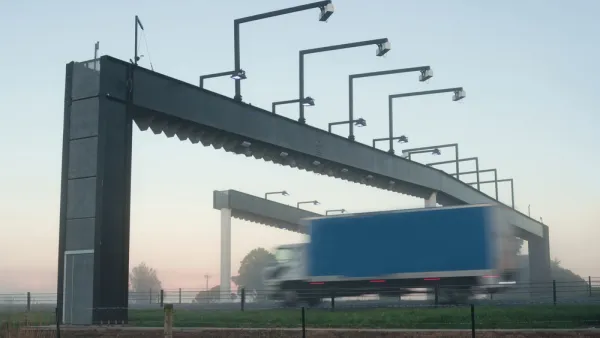
Nation's First Truck-Only Toll Program Off to Auspicious Start
After the Rhode Island General Assembly passed controversial legislation in February 2016 spearheaded by Gov. Gina Raimondo (D), the first two of what will be 13 truck-only toll gantries became operational on June 11. Results are looking good.
Learning the Wrong Lessons From France's Yellow Vest Movement
The widespread Yellow Vests protests, which initially involved hundreds of thousands of protestors in November, are wrongly being interpreted as a movement against carbon taxes and climate action, rather than a revolt against social inequities.
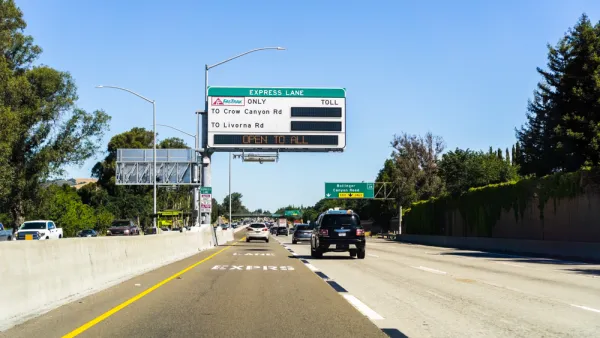
Toll Lane Expansion in Inland Empire Begins After Voters Reject Gas Tax Repeal
The day after California voters soundly rejected a repeal of a one-year old 12-cents gas tax increase and new annual vehicle registration fees. the Riverside County Transportation Commission launched a study to extend toll lanes on Interstate 15.

Planetizen Federal Action Tracker
A weekly monitor of how Trump’s orders and actions are impacting planners and planning in America.

The state-sanctioned urbicide of Austin
People don’t kill cities. Freeways do.

US to reduce Colorado River water deliveries to Mexico
A new Colorado Treaty amendment reduces Mexico’s Colorado River water allocation by 250,000 acre feet.

5 New England states march closer to 800 megawatt wind energy project
Securing federal approval for the project may be complicated under the Trump administration, which has historically been hostile towards domestic wind power.

Baltimore to break ground on $50 million Transit Priority Project
The project will bring faster bus trips, safer streets and better bike connections to Baltimore.

Airbnb launches $250 million 'last-dollar financing' housing accelerator, makes first investment in Austin
The company will put $6.4 million towards affordable housing development in Texas’ capital.

FREE Course: Walkable City 1: Why Walkability?
After describing his path towards focusing on walkability as the essence of good planning, Jeff Speck marches through his five principal reasons for making more walkable places.
Reinventing Malls: Planning Alchemy—Turning Gray Fields Into Gold
The course focuses on the opportunities and imperatives that shape reinvention of mall sites.

Eagle County Government
Harvard University Graduate School of Design
Nashville Planning Department
The Architects Foundation
University of Cincinnati Online
The Pocatello Development Authority
The Urban Renewal Agency of the City of Pocatello
Journal of the American Planning Association