Just two years after killing what would be the world's largest methanol plant at the Port of Tacoma, the project has reemerged at the Port of Kalama. According to the EIS for the plant, global CO2 emissions will be reduced, though increased locally.


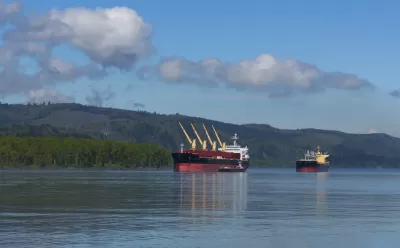
It was only two and one-half years ago when Pacific Northwest environmentalists celebrated after halting a proposal for what would have been the world's largest methanol plant. Methanol, refined from coal, natural gas, or renewable sources, can be used a petrochemical to make plastics or as a transportation fuel.
However, the Tacoma facility was but one of three methanol plants that Northwest Innovation Works [NWIW], a subsidiary of the Chinese Academy of Sciences Holdings, an arm of China’s government, hopes to build.
The other two are in Kalama, Washington in Cowlitz County in the southwestern part of the state, and Clatskanie (Columbia County), Oregon at the Port of St. Helens.
Katie Fairbanks of The Daily News in Longview, Wash., reports on the Nov. 13 release of the draft supplemental environmental impact statement (EIS) for the Kalama Manufacturing and Marine Export Facility, located along the Columbia River.
"The project would receive natural gas through a new 3.1-mile-long pipeline and convert the natural gas to methanol for shipment by marine vessel to global markets, primarily in Asia," according to the EIS.
The largest part of the 241-page document is a greenhouse gas analysis prepared by Bay Area-based Life Cycle Associates which specializes in “cradle-to-grave” analysis for fuel pathway carbon intensities for the California Low Carbon Fuel Standard.
"The draft [EIS]...supports what [NWIW] contended all along: That the plant, which would convert natural gas to methanol, would displace coal-based methanol plants that produce far greater volumes of carbon dioxide, one of the main greenhouse gases linked to global climate change," reports Fairbanks.
Given the worldwide demand for methanol, failing to build the plant would mean other, dirtier [coal-based] projects would be built.
Our technology is so superior,” Kent Caputo, general counsel and chief commercial officer for NWIW, told The Daily News in a briefing about the study Monday [Nov. 12] afternoon. The project “would have a gigantic displacement effect” on carbon sources elsewhere, Caputo added.
A slide in the article suggests that the Ultra Low Emission (ULE) technology would be similar to that used by a Coogee Chemical methanol plant in Melbourne, Australia. The Australian Financial Review reported in March 2017 that due to a lack of natural gas, the facility could be shipped to the U.S. where a gas surplus exists.
Opposition
Columbia Riverkeeper Executive Director Brett VandenHeuvel, perhap's the project's most outspoken opponent, took issue with the study's findings, calling it "speculative" that the displacement would occur. A white paper [pdf] prepared by the nonprofit group, whose mission is to protect and restore the Columbia River, asserts:
[T]he promised carbon reductions rely on a very big assumption: that the Kalama Methanol Refinery would replace coal-based forms of production. No one has supplied any evidence showing that this is true. So the Kalama refinery may simply add to global supplies of petrochemicals—and global greenhouse gas pollution—without actually replacing dirtier methanol production.
According to project partner Port of Kalama, "[t]hrough the use of natural gas and implementation of ULE technology, the Kalama facility will reduce carbon emissions by 90% compared to coal-to-methanol facilities."
Environmental NIMBYism?
Assuming that the Kalama plant will, in fact, displace coal-based methanol plants, which the project opponents contest, the net reduction on a global perspective in carbon emissions is huge, but there will local emissions of 1.1 million tons of carbon dioxide equivalent annually. However, when taking into account emissions from coal-based plants, there will be net reductions of 9.7 to 12.6 (million tonneCO2e/annum) according to the greenhouse gas analysis [see executive summary, pg. 83/241 of the EIS (pdf)].
"In addition, NWIW also announced it would voluntarily work to reduce or compensate for all its carbon releases within the state," adds Fairbanks.
The program would include purchasing verified carbon credits or paying a comparable amount to a greenhouse gas mitigation fund.
State Environmental Policy Act
The environmental review is being done in accordance with the State Environmental Policy Act under the state Department of Ecology with the Port of Kalama and Cowlitz County as co-lead agencies.
A public hearing on the study will be held at 6 p.m. Dec. 13 at the Cowlitz Expo Center in Longview. The public comment period for the study is open until Dec. 28.
- Columbia Riverkeeper press release, Nov. 13: Methanol Company Downplays Climate Impact Of Refinery
- Pacific Standard, Nov 7: Taxpayers May Soon Be On The Hook For A $2 Billion Fracked Gas Refinery
- Sightline Institute, Feb. 12: How Northwest Methanol Is Likely Intended For China’s Gas Tanks
- Seattle Business Magazine, September 2014: Chinese Investors Propose to Build Three Methanol Plants in the Region
Related in Planetizen:
-
Plans for World's Largest Methanol Plant Die in Tacoma, April 21, 2016The massive and controversial Tideflats methanol plant proposal will no longer trouble environmentalists in the Pacific Northwest.
FULL STORY: Study: Kalama methanol project would help fight climate change

How the Environmental Review Process Privileges Highway Construction Over Transit
U.S. transit projects have a much harder time getting environmental approval than road projects, perpetuating the dominance of cars in U.S. transportation policy.
Judge Halts Sales of New Coal Mining Leases on Federal Lands
Once again, the president's efforts to undo his predecessor's environmental legacy were thwarted by a court ruling. In this case, the Interior Department's failure to conduct an environmental review of a Trump executive order ran afoul of NEPA.
Global Coal Consumption Grows After Three Years of Decline
The rise is attributed to Asian nations, particularly India and China, where coal-power plants are newer than in the West. It shows a growing disconnect between energy and climate goals, warned the International Energy Agency.

Planetizen Federal Action Tracker
A weekly monitor of how Trump’s orders and actions are impacting planners and planning in America.

The state-sanctioned urbicide of Austin
People don’t kill cities. Freeways do.

US to reduce Colorado River water deliveries to Mexico
A new Colorado Treaty amendment reduces Mexico’s Colorado River water allocation by 250,000 acre feet.

Mamdani overhauls NYC's Vision Zero plan with 100 new policy goals
The overhaul aims to reduce traffic deaths and make streets safer for pedestrians, cyclists and drivers through lower speed limits, new safety infrastructure and more.

Amtrak not solely to blame for New Jersey commuter rail's unreliability, report finds
A new study from the Garden State Initiative found that NJ Transit’s budget grew 20% across a 4 year period, but reliability declined significantly over the same period.

EPA erases limits on planet-warming pollution from power plants
Under Monday’s plan, power plants would still have some limits on how much mercury, arsenic and other contaminants they can emit.

FREE Course: Walkable City 1: Why Walkability?
After describing his path towards focusing on walkability as the essence of good planning, Jeff Speck marches through his five principal reasons for making more walkable places.
Reinventing Malls: Planning Alchemy—Turning Gray Fields Into Gold
The course focuses on the opportunities and imperatives that shape reinvention of mall sites.

Eagle County Government
Harvard University Graduate School of Design
Nashville Planning Department
The Architects Foundation
University of Cincinnati Online
The Pocatello Development Authority
The Urban Renewal Agency of the City of Pocatello
Journal of the American Planning Association