Since its passage 40 years ago, the controversial legislation has remained consistently popular with Californians.



Matt Levin takes a closer look at how support for Proposition 13 in California has fared over the years. While there has been no shortage of criticism about the legislation and its impacts, a recent survey by the Public Policy Institute of California shows robust support for Prop. 13, with 65 percent of likely voters reporting they think it has been “mostly a good thing.”
While there have been some dips in support over time, this is the same percentage of voters who approved of Prop. 13 when it passed in 1978. Even housing prices have surprisingly not helped move the gauge much, reports Levin. And while the survey found some differences by party affiliation, age, income, and status as a renter or homeowner, a majority held strong across all groups.
In addition, a proposal that would change how Prop. 13 operates has lost support. A "split-roll" property tax system, which would tax commercial properties at current market value, will possibly be on the ballot in 2020. Levin reports that 60 percent of respondents supported this initiative in 2012, but this year that number has dropped to 46 percent.
FULL STORY: Californians still really like Prop. 13—except for the big parts they don’t like


Signatures Submitted for Initiative to Reform California Proposition 13
A coalition of groups advocating for more funding for local communities and schools want to reform the landmark tax-cutting initiative by treating commercial and industrial properties different than residential, creating the so-called "split roll."

California's 'Split Roll' Property Tax Reform, Explained
California voters will consider a landmark reform of its infamous property tax system this November. Prop. 15 would remove property tax caps on commercial properties established by Prop. 13 in 1978.
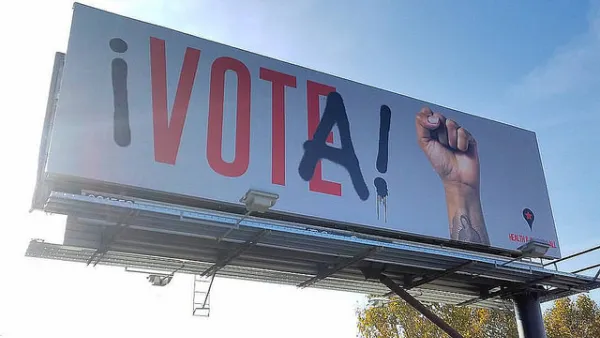
Prop 13 on the Ballot in California—Just Not the Prop 13 Everyone's Worried About
A case of mistaken identity has embroiled California in election controversy, as claims of bias and misinformation swirl around Prop 13 (2020), Prop 13 (1978), and an anticipated "split roll" initiative.

The state-sanctioned urbicide of Austin
People don’t kill cities. Freeways do.

US to reduce Colorado River water deliveries to Mexico
A new Colorado Treaty amendment reduces Mexico’s Colorado River water allocation by 250,000 acre feet.

New Jersey’s second-largest city bans standalone data centers
Jersey City will continue to allow co-location facilities, such as those meant for research institutions that store their own data.

Amtrak not solely to blame for New Jersey commuter rail's unreliability, report finds
A new study from the Garden State Initiative found that NJ Transit’s budget grew 20% across a 4 year period, but reliability declined significantly over the same period.

EPA erases limits on planet-warming pollution from power plants
Under Monday’s plan, power plants would still have some limits on how much mercury, arsenic and other contaminants they can emit.

Phoenix announces new on-demand transit service, more frequent RAPID buses
Both new services will launch in October, and are part of Phoenix's Project Effective Access Solutions for Easing Congestion.

FREE Course: Walkable City 1: Why Walkability?
After describing his path towards focusing on walkability as the essence of good planning, Jeff Speck marches through his five principal reasons for making more walkable places.
Reinventing Malls: Planning Alchemy—Turning Gray Fields Into Gold
The course focuses on the opportunities and imperatives that shape reinvention of mall sites.

.jpg)
Eagle County Government
Harvard University Graduate School of Design
Nashville Planning Department
The Architects Foundation
University of Cincinnati Online
The Pocatello Development Authority
The Urban Renewal Agency of the City of Pocatello
Journal of the American Planning Association