Two downtown-adjacent neighborhoods would no longer require parking for new developments under a proposal under consideration in the city of Houston.


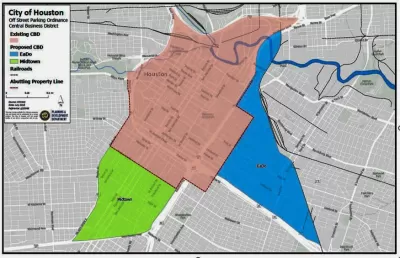
"[Houston's] latest proposal to eliminate off-street parking requirements in Midtown and East Downtown got a vote of confidence from the management districts of both neighborhoods when staff members presented it to them [recently]," according to scoop on the Swamplot website.
"There’s still a ways to go before the map becomes more than a pretty picture: A 30-day public comment period will culminate in a recap next month. Then city council gets its final say on things at a meeting proponents hope will take place before the end of the year."
Angie Schmitt provides additional perspective and information on the potential changes to Houston's parking requirements:
Midtown and East Downtown (EaDo) have been proposed as extensions of the downtown area that would allow new developments to be built without requiring a large amount of off-street parking, or any off-street parking at all. The two neighborhoods currently have about 10,000 residents, with strong transit access and plenty of room to grow.
Schmitt notes that despite its reputation as a city relatively free of land use regulations, Houston has relatively high parking requirements compared to national averages. The changes have the potential to make these large corners of Houston much more walkable, according to Schmitt.
FULL STORY: Houston May Eliminate Some Mandatory Parking — A Big Step Toward a Transit Friendly City


Houston Lacks Zoning—Or Does It? The State Supreme Court Will Decide
A lawsuit argues that Houston's Historic Preservation Ordinance is a form of de facto land use control, equivalent to zoning, which isn't allowed by state and local laws.
Citing Lack of ADU Development, Ann Arbor to Refine its ADU Ordinance
After legalizing accessory dwelling units in 2016, the city of Ann Arbor hasn't added many accessory dwelling units. Some regulations designed to limit the number of ADUs developed have made the building type impossibly cost prohibitive.
On Houston's Unique Land Use Regulations (Just Don't Call Them Zoning)
Houston's famous lack of zoning codes might be more semantic than legal.

Planetizen Federal Action Tracker
A weekly monitor of how Trump’s orders and actions are impacting planners and planning in America.

The state-sanctioned urbicide of Austin
People don’t kill cities. Freeways do.

US to reduce Colorado River water deliveries to Mexico
A new Colorado Treaty amendment reduces Mexico’s Colorado River water allocation by 250,000 acre feet.

5 New England states march closer to 800 megawatt wind energy project
Securing federal approval for the project may be complicated under the Trump administration, which has historically been hostile towards domestic wind power.

Baltimore to break ground on $50 million Transit Priority Project
The project will bring faster bus trips, safer streets and better bike connections to Baltimore.

Airbnb launches $250 million 'last-dollar financing' housing accelerator, makes first investment in Austin
The company will put $6.4 million towards affordable housing development in Texas’ capital.

FREE Course: Walkable City 1: Why Walkability?
After describing his path towards focusing on walkability as the essence of good planning, Jeff Speck marches through his five principal reasons for making more walkable places.
Reinventing Malls: Planning Alchemy—Turning Gray Fields Into Gold
The course focuses on the opportunities and imperatives that shape reinvention of mall sites.

Eagle County Government
Harvard University Graduate School of Design
Nashville Planning Department
The Architects Foundation
University of Cincinnati Online
The Pocatello Development Authority
The Urban Renewal Agency of the City of Pocatello
Journal of the American Planning Association