On Tuesday, EPA released its new rule to regulate emissions from existing power plants, essentially leaving it to the states to determine appropriate emissions levels rather than setting actual standards each state has to meet like the current rule.


There may be a new leader at the helm of the U.S. Environmental Protection Agency, but the goal of erasing the environmental legacy of President Obama continues without interruption. Rather than focusing on reducing greenhouse gas (GHG) and criteria pollutant emissions and protecting public health and the environment, the EPA's press release reads like it came from the Department of Energy as its two priorities appear to be the affordability and reliability of energy.
This proposal, entitled the Affordable Clean Energy (ACE) Rule, establishes emission guidelines for states to use when developing plans to limit GHGs at their power plants. The ACE Rule replaced the prior administration’s overly prescriptive and burdensome Clean Power Plan (CPP) and instead empowers states, promotes energy independence, and facilitates economic growth and job creation.
The emphasis on affordability resembles another landmark regulation rollback announced this month by the Environmental Protection Agency and the U.S. Department of Transportation: the proposed Safer Affordable Fuel-Efficient (SAFE) Vehicles Rule that freezes greenhouse gas emission and fuel economy standards for model years 2021 to 2026.
"The new proposal ... seeks to make minor on-site efficiency improvements at individual plants and would also let states relax pollution rules for power plants that need upgrades, keeping them active longer," report Lisa Friedman and Coral Davenport for The New York Times. By weakening the regulation of existing coal-fired power plants, Andrew Wheeler, the acting administrator of the Environmental Protection Agency and former coal lobbyist, advances "a proposal that the coal industry has hailed as an end to burdensome regulation and environmentalists have criticized as a retreat in the battle to address climate change."
“Today’s proposal provides the states and regulated community the certainty they need to continue environmental progress while fulfilling President Trump’s goal of energy dominance,” stated Wheeler on Tuesday.
In a separate piece on the ACE proposal published Tuesday, Friedman reports that "the hundreds of pages of technical analysis [pdf] that accompany the new proposal indicate that emissions would grow under the plan" and "lead to up to 1,400 premature deaths annually."
Friedman points to "Chapter 4: Estimated Forgone Climate Benefits And Forgone Human Health Co-Benefits" [pdf].
That is, instead of listing the health gains of the Trump plan — preventing premature deaths, for example, or avoiding a certain number of increased emergency room visits from asthma attacks — it is instead describing the effect of the Trump plan as benefits lost.
The increased mortality in the ACE rule result not from increased carbon or other greenhouse gas emissions but "because of increased rates of microscopic airborne particulates known as PM 2.5, which are dangerous because of their link to heart and lung disease as well as their ability to trigger chronic problems like asthma and bronchitis."
By contrast, the Obama administration’s central argument for its Clean Power Plan was that the measure protected human health as well as the climate. Specifically, it said, the plan would help avoid between 1,500 and 3,600 premature deaths annually by 2030.
It should be noted, though, that the Clean Power Plan rule never was implemented after the Supreme Court ruled 5-4 in February 2016 to stay the rule, agreeing with 29 states and state agencies which claimed that the plan was an overreach of the president's use of executive authority.
Additional posts on the existing rule, finalized just over three years ago, and its proposed rollback, initially targeted in February 2017, can be found under tags, Clean Power Plan and Clean Power Plan Rule.
Hat tip to CityLab Daily.
FULL STORY: New E.P.A. Rollback of Coal Pollution Regulations Takes a Major Step Forward

It's Official: Obama's Clean Power Plan Has Been Replaced by the Trump Administration
It took less than a year for the EPA to finalize the Affordable Clean Energy rule, which will allow older coal-burning plants to continue operating, in the Trump administration's most consequential environmental rollback accomplished to date.
The Far-Reaching Consequences of Remaking the Mercury Emissions Rule
The EPA intends to review the rulemaking process behind the mercury rule, the subject of a landmark Supreme Court ruling in 2015, to place more value on a rule's compliance cost to industry and less to its beneficial impact on human health.
Making Older Coal Power Plants More Efficient Without Making Them Cleaner
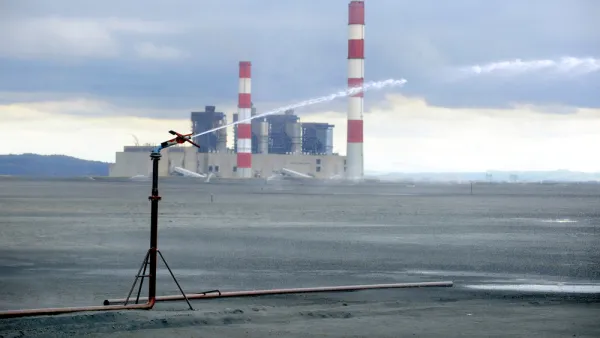
At the center of the EPA's newly proposed Affordable Clean Energy rule is doing away with a permitting process known as New Source Review that requires coal power plants to add scrubbers and other expensive pollution control equipment when upgraded.

Planetizen Federal Action Tracker
A weekly monitor of how Trump’s orders and actions are impacting planners and planning in America.

The state-sanctioned urbicide of Austin
People don’t kill cities. Freeways do.

US to reduce Colorado River water deliveries to Mexico
A new Colorado Treaty amendment reduces Mexico’s Colorado River water allocation by 250,000 acre feet.

5 New England states march closer to 800 megawatt wind energy project
Securing federal approval for the project may be complicated under the Trump administration, which has historically been hostile towards domestic wind power.

Baltimore to break ground on $50 million Transit Priority Project
The project will bring faster bus trips, safer streets and better bike connections to Baltimore.

Airbnb launches $250 million 'last-dollar financing' housing accelerator, makes first investment in Austin
The company will put $6.4 million towards affordable housing development in Texas’ capital.

FREE Course: Walkable City 1: Why Walkability?
After describing his path towards focusing on walkability as the essence of good planning, Jeff Speck marches through his five principal reasons for making more walkable places.
Reinventing Malls: Planning Alchemy—Turning Gray Fields Into Gold
The course focuses on the opportunities and imperatives that shape reinvention of mall sites.

Eagle County Government
Harvard University Graduate School of Design
Nashville Planning Department
The Architects Foundation
University of Cincinnati Online
The Pocatello Development Authority
The Urban Renewal Agency of the City of Pocatello
Journal of the American Planning Association