The city is piloting plastic, modular bike lane separators that buffer cyclists from the adjacent vehicle lane.


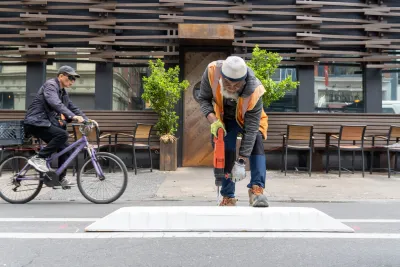
Philadelphia has added new bike infrastructure to a busy section of 13th Street in Center City, adding delineator posts, paint and modular plastic curbs to the bike lane, reports Molly McVety for PhillyVoice. "13th Street is one of the most busiest corridors for cyclists. Its intersection with Pine Street averaged 255 cyclists per hour in 2025 — one of the highest bike counts in the city, according to data from the Bicycle Coalition of Greater Philadelphia."
According to Center City District President and CEO Prema Katari Gupta, "It's a low-cost way to create a safer, more accessible downtown that works for cyclists and businesses alike." CCD sponsored the cost of the curbs. McVety adds, "Cycling advocates have called for similar measures to be permanently installed on other corridors, including Spruce and Pine streets, which have attracted increased focus since the death of Barbara Friedes, the Children's Hospital of Philadelphia doctor who was fatally struck by a drunk driver while cycling on Spruce Street in 2024."
Read the full story: New protections for bicyclists added to 13th Street in Center City

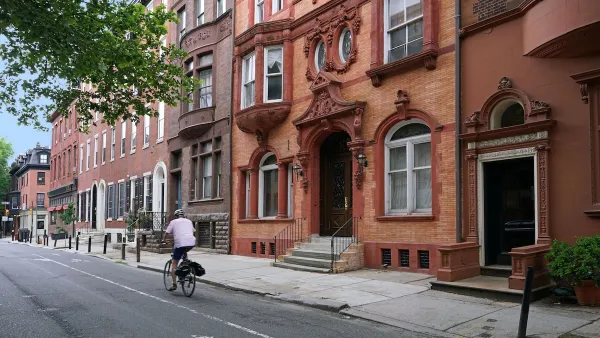
Philly Council Wants to Crack Down on Bike Lane Parking
The city council passed a bill that would raise penalties and eliminate a grace period for drivers who stop in bike lanes.
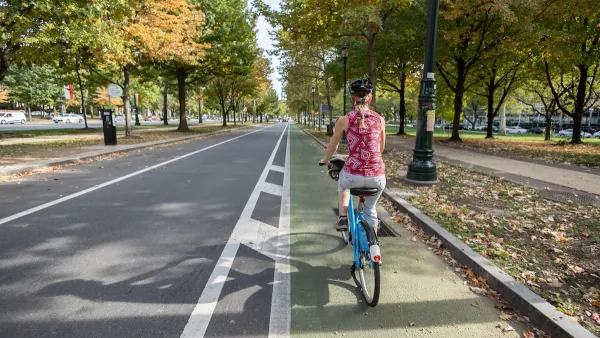
Philadelphia Could Start Citing Drivers for Blocking Bike Lanes
City officials will consider several road safety bills that include higher penalties for stopping in bike lanes and an assessment of the city’s Vision Zero funding.

The 5 Safest Cities for Cyclists in America — and What They Have in Common
Cities with low fatality rates for people on bikes have made strong commitments to building safe, protected bike networks and supporting Complete Streets.

Planetizen Federal Action Tracker
A weekly monitor of how Trump’s orders and actions are impacting planners and planning in America.

California plans to bury El Niño’s downpour
If the state plays its cards right, it may be able to store a billion acre-feet of El Niño’s water in aquifers.

Chicago breaks ground on $3 billion megadevelopment
The new neighborhood, titled Foundry Park, will one day host 3,700 residences.

California High-Speed Rail Authority CEO resigns after $600,000 scandal
Under Ian Choudri, the authority used taxpayer dollars to fund first class flights and trips to nightclubs.

Want to study the Missouri River? Soon, you may need unanimous approval from 10 states
Legislation would require 10 governors’ permission to study or build projects moving water outside the basin.

Desperate measures: Advocates weigh draining Lake Powell to fill Colorado River
Draining the reservoir could reduce evaporation losses by a couple hundred thousand acre-feet.

FREE Course: Walkable City 1: Why Walkability?
After describing his path towards focusing on walkability as the essence of good planning, Jeff Speck marches through his five principal reasons for making more walkable places.
Reinventing Malls: Planning Alchemy—Turning Gray Fields Into Gold
The course focuses on the opportunities and imperatives that shape reinvention of mall sites.

City of Rosemead
Rutgers University, Edward J. Bloustein School of Planning and Public Policy
One Hundred Miles
Hunter College, City University of New York (CUNY)
The Architects Foundation
University of Cincinnati Online
City of Cambridge
Montrose County
The Pocatello Development Authority