City officials say the warehouse-style centers don’t support the Beltline overlay district’s goal to foster pedestrian-oriented development.


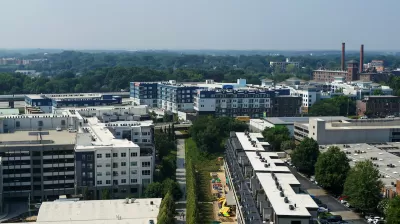
The Atlanta City Council is considering banning data centers along the Beltline corridor and near rapid transit stops based on concerns that the massive facilities disrupt the walkability of the multiuse trail and guzzle too much electricity. “The legislation mirrors similar bans on new storage facilities, gas stations and drive-thru restaurants within the Beltline overlay district, which city leaders said should foster pedestrian-focused developments,” Zachary Hansen explains in Governing.
The proposed legislation would not affect existing centers, but it could prevent them from expanding. “The legislation was also influenced by Georgia Power’s recent request for regulators to approve huge amounts of new electricity-generating capacity — mostly powered by fossil fuels — mainly due to the vast number of data center projects across the state. Georgia Power executives have said data centers are responsible for roughly 80 percent of the demand crunch it says it is facing.”
FULL STORY: Atlanta Considers Banning Data Centers from Beltline, Transit Stops


Atlanta launches autonomous Beltline shuttle
The ATL Spoke service connects the Beltline to a MARTA rail station.

Atlanta could add dedicated bike lane to Beltline
A city councilmember says a dedicated lane would prevent conflicts between cyclists and pedestrians, but others worry it would impede efforts to build transit along the Beltline.

Atlanta's Beltline hits 79% of its affordable housing goal
The walking, biking, and transit corridor set a goal to create 5,600 affordable housing units in the area by 2030.

Planetizen Federal Action Tracker
A weekly monitor of how Trump’s orders and actions are impacting planners and planning in America.

The state-sanctioned urbicide of Austin
People don’t kill cities. Freeways do.

US to reduce Colorado River water deliveries to Mexico
A new Colorado Treaty amendment reduces Mexico’s Colorado River water allocation by 250,000 acre feet.

5 New England states march closer to 800 megawatt wind energy project
Securing federal approval for the project may be complicated under the Trump administration, which has historically been hostile towards domestic wind power.

Baltimore to break ground on $50 million Transit Priority Project
The project will bring faster bus trips, safer streets and better bike connections to Baltimore.

Airbnb launches $250 million 'last-dollar financing' housing accelerator, makes first investment in Austin
The company will put $6.4 million towards affordable housing development in Texas’ capital.

FREE Course: Walkable City 1: Why Walkability?
After describing his path towards focusing on walkability as the essence of good planning, Jeff Speck marches through his five principal reasons for making more walkable places.
Reinventing Malls: Planning Alchemy—Turning Gray Fields Into Gold
The course focuses on the opportunities and imperatives that shape reinvention of mall sites.

Eagle County Government
Harvard University Graduate School of Design
Nashville Planning Department
The Architects Foundation
University of Cincinnati Online
The Pocatello Development Authority
The Urban Renewal Agency of the City of Pocatello
Journal of the American Planning Association