The newest plan for the 710 corridor claims it will not displace any residents.



The Los Angeles Metro Board Planning Committee approved a plan to widen the 710 freeway, citing “no known displacements” of residents or businesses.
As Joe Linton explains in Streetsblog LA, a prior plan, which would have widened the freeway significantly and displaced local residents, caused significant concern among environmental justice advocates and community members. That plan was scrapped after it was found in violation of the federal Clean Air Act.
“Though it has many details still to be fleshed out, the resulting CMIP is definitely multimodal. More than a third of the remaining $743M project budget would go to facilities for transit, bicycling, and/or minimizing goods movement emissions.” The new plan adds about four miles of new auxiliary traffic lanes and other improvements that will expand car capacity, Linton notes. “That plan includes a lot of wiggle language, including citing ‘minimal or no displacement’ and ‘no known displacement’ numerous times, plus pledges to ‘avoid significant displacement.’”
FULL STORY: Metro Committee Approves 710 Freeway Plan with Reduced Widening and “No Known Displacements”

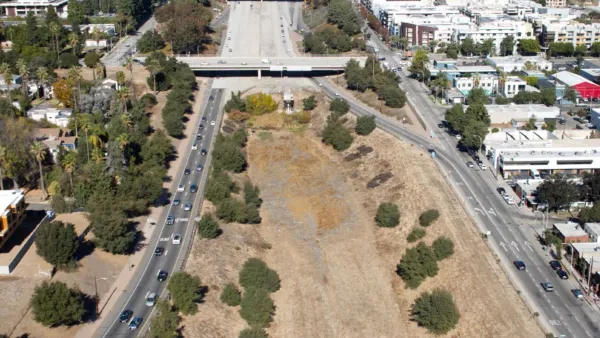
Pasadena approves plan for 710 Stub but tables Restorative Justice elements
A never-built freeway that displaced hundreds of residents in the 1970s has left a 50-acre scar that may finally see redevelopment.
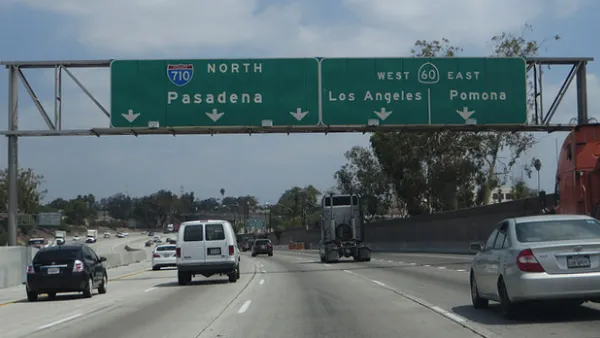
L.A. Metro Denounces—but Doesn't Scrap—710 Freeway Expansion Plan
The agency's board members spoke out forcefully against air pollution and displacement, but stopped short of completely rejecting the project, looking instead to cleaner vehicles and regulations that mitigate community concerns.

Caltrans Chief Wants an 'Absolute Pause' on 710 Freeway Expansion
Communities along the corridor have fought expansion for decades, citing air quality and displacement concerns. Now, the agency says it's time to rethink the project.

The state-sanctioned urbicide of Austin
People don’t kill cities. Freeways do.

US to reduce Colorado River water deliveries to Mexico
A new Colorado Treaty amendment reduces Mexico’s Colorado River water allocation by 250,000 acre feet.

New Jersey’s second-largest city bans standalone data centers
Jersey City will continue to allow co-location facilities, such as those meant for research institutions that store their own data.

Amtrak not solely to blame for New Jersey commuter rail's unreliability, report finds
A new study from the Garden State Initiative found that NJ Transit’s budget grew 20% across a 4 year period, but reliability declined significantly over the same period.

EPA erases limits on planet-warming pollution from power plants
Under Monday’s plan, power plants would still have some limits on how much mercury, arsenic and other contaminants they can emit.

Phoenix announces new on-demand transit service, more frequent RAPID buses
Both new services will launch in October, and are part of Phoenix's Project Effective Access Solutions for Easing Congestion.

FREE Course: Walkable City 1: Why Walkability?
After describing his path towards focusing on walkability as the essence of good planning, Jeff Speck marches through his five principal reasons for making more walkable places.
Reinventing Malls: Planning Alchemy—Turning Gray Fields Into Gold
The course focuses on the opportunities and imperatives that shape reinvention of mall sites.


Eagle County Government
Harvard University Graduate School of Design
Nashville Planning Department
The Architects Foundation
University of Cincinnati Online
The Pocatello Development Authority
The Urban Renewal Agency of the City of Pocatello
Journal of the American Planning Association