The long-awaited changes include road design elements and signage aimed at improving safety for pedestrians and cyclists while planning for autonomous vehicles.


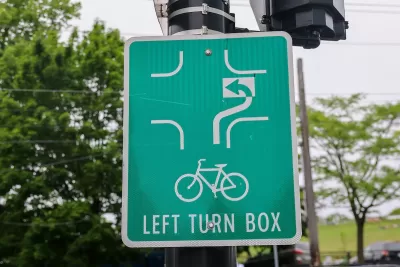
The Federal Highway Administration announced an important update to the Manual on Uniform Traffic Control Devices for Streets and Highways, known as the MUTCD. The update marks a victory for safe streets advocates who have long called for changes aimed at reducing risks to all road users.
According to an article by Dan Zukowski in Smart Cities Dive, “The new regulations include improvements for vulnerable road users — including pedestrians and bicyclists — such as rapid-flashing beacons that pedestrians can activate at marked crosswalks and green-colored pavement for bicycle lanes.” Other measures include bike turn boxes at intersections and specialized traffic signals for bikes, as well as elements that prepare for autonomous vehicles
The FHWA acknowledged a need to update the manual more frequently than in the past as technology and transportation change more rapidly. “The new standards also include signage for electric vehicle charging stations and ways to prepare roadways for autonomous vehicles.”
FULL STORY: Rules of the Road Get a Long-Awaited Update in the US


US Street Design Manual Inches Toward Safer Roads
The guiding document for U.S. road design is starting to recognize the needs of people walking and biking, but safe streets advocates say more significant changes are needed to reduce the high number of pedestrian deaths and improve connectivity for all road users.

Has Progress on Travel Safety Run Off the Road?
Changing technology and rebuilding infrastructure to improve road safety are long-term strategies. How can enforcement and interventions that influence driver behavior make a difference in reducing traffic deaths sooner?
Reforms Are Coming to American Road Design
The federal manual governing road design is getting an update. Will it encourage real progress toward road safety?

Planetizen Federal Action Tracker
A weekly monitor of how Trump’s orders and actions are impacting planners and planning in America.

The state-sanctioned urbicide of Austin
People don’t kill cities. Freeways do.

US to reduce Colorado River water deliveries to Mexico
A new Colorado Treaty amendment reduces Mexico’s Colorado River water allocation by 250,000 acre feet.

5 New England states march closer to 800 megawatt wind energy project
Securing federal approval for the project may be complicated under the Trump administration, which has historically been hostile towards domestic wind power.

Baltimore to break ground on $50 million Transit Priority Project
The project will bring faster bus trips, safer streets and better bike connections to Baltimore.

Airbnb launches $250 million 'last-dollar financing' housing accelerator, makes first investment in Austin
The company will put $6.4 million towards affordable housing development in Texas’ capital.

FREE Course: Walkable City 1: Why Walkability?
After describing his path towards focusing on walkability as the essence of good planning, Jeff Speck marches through his five principal reasons for making more walkable places.
Reinventing Malls: Planning Alchemy—Turning Gray Fields Into Gold
The course focuses on the opportunities and imperatives that shape reinvention of mall sites.

Eagle County Government
Harvard University Graduate School of Design
Nashville Planning Department
The Architects Foundation
University of Cincinnati Online
The Pocatello Development Authority
The Urban Renewal Agency of the City of Pocatello
Journal of the American Planning Association