A former Sears store has a new life as a housing complex.


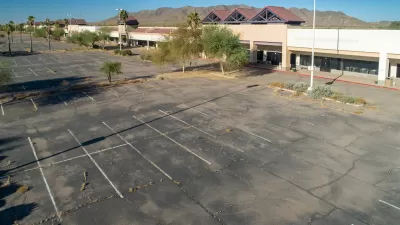
In an example of productive adaptive reuse, a former Sears store in Rochester, New York is now a 73-unit affordable housing project for seniors. Adele Peters describes the project in Fast Company, adding that underused malls present a convenient opportunity to build more housing.
According to Peters, “A new report from the nonprofit Enterprise Community Partners estimates that nationwide, repurposing 10% of strip mall space could create more than 700,000 new apartments”—a small but not insignificant contribution to the estimated 3.8 million housing units needed.
As Peters explains, strip malls are easier to convert to housing than office buildings. “At the former Sears store outside of Rochester, developers were able to repurpose the building by adding windows to the facade, as well as three interior courtyards so that there’s natural light in each apartment. Adding another apartment building in the parking lot meant that the project had enough units to make sense economically.”
In California, where several similar projects are underway, recent changes to state law made it easier to acquire permits for commercial-to-housing conversion projects. One estimate calculated the potential for as many as 1.37 million homes in the Bay Area alone.
FULL STORY: This old Sears store is now an apartment building

Paper Series Sheds Light On Adaptive Reuse
A series of reports from Berkeley's Terner Center assess the potential of commercial-to-residential conversions to help ease the housing crisis.
Vacant downtown LA office building will be transformed into 512 affordable homes
The World Trade Center will create hundreds of new apartments with rents starting as low as $937.
Church-to-housing trend grows in Southern California
Many faith leaders are eager to support housing construction on church land.

Planetizen Federal Action Tracker
A weekly monitor of how Trump’s orders and actions are impacting planners and planning in America.

The state-sanctioned urbicide of Austin
People don’t kill cities. Freeways do.

US to reduce Colorado River water deliveries to Mexico
A new Colorado Treaty amendment reduces Mexico’s Colorado River water allocation by 250,000 acre feet.

5 New England states march closer to 800 megawatt wind energy project
Securing federal approval for the project may be complicated under the Trump administration, which has historically been hostile towards domestic wind power.

Baltimore to break ground on $50 million Transit Priority Project
The project will bring faster bus trips, safer streets and better bike connections to Baltimore.

Airbnb launches $250 million 'last-dollar financing' housing accelerator, makes first investment in Austin
The company will put $6.4 million towards affordable housing development in Texas’ capital.

FREE Course: Walkable City 1: Why Walkability?
After describing his path towards focusing on walkability as the essence of good planning, Jeff Speck marches through his five principal reasons for making more walkable places.
Reinventing Malls: Planning Alchemy—Turning Gray Fields Into Gold
The course focuses on the opportunities and imperatives that shape reinvention of mall sites.

Eagle County Government
Harvard University Graduate School of Design
Nashville Planning Department
The Architects Foundation
University of Cincinnati Online
The Pocatello Development Authority
The Urban Renewal Agency of the City of Pocatello
Journal of the American Planning Association