A new public space project offers an ambitious vision—so why is the city implementing it at such a small scale?


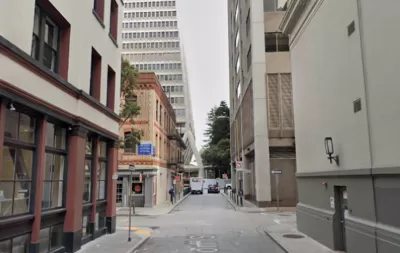
A redevelopment project in San Francisco is being touted by local boosters as “a bellwether for the resurgence of a struggling downtown,” writes Patrick Sisson in Fast Company. An alleyway now called the Landing at Leidesdorff, designed by SITELAB, “will feature removable street seating, murals recalling the area’s maritime history as a former wharf, and a village-like atmosphere in the center of downtown, complete with events and programming.”
The project is one effort to revitalize languishing public spaces around office buildings with vacancy rates of up to 31 percent. For Sisson and others, like SITELAB’s Laura Crescimano, the small scale of the project falls short of its grand vision. “Despite a year of work to make it happen, despite the wealth of historic architecture, support from the Mayor’s office and $385,000 in city investment, San Francisco will only pedestrianized a single alleyway as a pilot project (it will be car-free for 16 hours a day).”
But changing the shape of public space in downtowns can be tough. “Cities have traditionally over-indexed on offices because it was a way to make money on property taxes without having to provide the public services, like schooling, that residential neighborhoods demand.” Now, it will take effort to “restore a more diverse ecosystem.”
Read the full story: The solution to cities’ downtown doom loop is simpler than you think

Analysis of Downtown Recoveries Reveals Post-Pandemic Winners and Losers
The recovery of U.S. downtowns is happening at widely different paces depending on which city you consider.
Downtown San Francisco Still Looking for a Post-Pandemic Comeback
“Downtown on the Brink” reads the headline of a recent San Francisco Chronicle feature.

With Zero Office Conversions in Four Years, San Francisco Pins Hopes on New Special Financing District
City leaders hope the new incentive will spur the redevelopment of some of the city’s 30,000 square feet of vacant office space into housing.

Planetizen Federal Action Tracker
A weekly monitor of how Trump’s orders and actions are impacting planners and planning in America.

California plans to bury El Niño’s downpour
If the state plays its cards right, it may be able to store a billion acre-feet of El Niño’s water in aquifers.

Chicago breaks ground on $3 billion megadevelopment
The new neighborhood, titled Foundry Park, will one day host 3,700 residences.

California High-Speed Rail Authority CEO resigns after $600,000 scandal
Under Ian Choudri, the authority used taxpayer dollars to fund first class flights and trips to nightclubs.

Want to study the Missouri River? Soon, you may need unanimous approval from 10 states
Legislation would require 10 governors’ permission to study or build projects moving water outside the basin.

Desperate measures: Advocates weigh draining Lake Powell to fill Colorado River
Draining the reservoir could reduce evaporation losses by a couple hundred thousand acre-feet.

FREE Course: Walkable City 1: Why Walkability?
After describing his path towards focusing on walkability as the essence of good planning, Jeff Speck marches through his five principal reasons for making more walkable places.
Reinventing Malls: Planning Alchemy—Turning Gray Fields Into Gold
The course focuses on the opportunities and imperatives that shape reinvention of mall sites.

City of Rosemead
Rutgers University, Edward J. Bloustein School of Planning and Public Policy
One Hundred Miles
Hunter College, City University of New York (CUNY)
The Architects Foundation
University of Cincinnati Online
City of Cambridge
Montrose County
The Pocatello Development Authority