The community of Wilson is testing the efficiency of using a publicly subsidized on-demand van service in lieu of traditional buses.


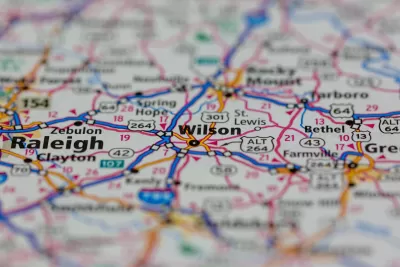
The small town of Wilson, North Carolina is experimenting with completely replacing its bus system with a publicly subsidized, on-demand microtransit van service. As Jeff McMurray reports in SourceOne, the service provides door-to-door service for $2.50 per ride.
According to the article, “Wilson landed federal and state infrastructure grants to support the shared, public rides residents summon — usually within 15 minutes — through a service operating like Uber and Lyft, but at a fraction of the cost to riders.”
In many rural areas, microtransit has “emerged as a great equalizer in the battle for infrastructure dollars that has traditionally pit the bus, train and subway needs of urban areas against the road construction projects sought by rural communities.”
In Wilson, the new service provides a crucial lifeline to local jobs. “More than half the rides are for residents using the vans to ‘maintain or get employment,’ said Rodger Lentz, Wilson’s assistant city manager who pushed for the switch.”
The service, known as RIDE, was developed through a partnership with microtransit company Via, which operates similar programs in many U.S. cities and communities. Kai Monast, associate director of the Institute for Transportation Research and Education at North Carolina State University, predicts that “although Wilson will remain committed to microtransit, the community eventually will return in part to a fixed-route system, adjusted heavily from the data gathered through years of on-demand van rides.”
FULL STORY: What if public transit was like Uber? A small city ended its bus service to find out

West Memphis to launch new transit system
The city across the Mississippi River from Memphis, Tennessee will soon begin service on its own, on-demand transit system.

El Paso launches improved bus network, new microtransit service
Sun Metro is eliminating some bus lines in favor of more frequent service, estimating that only 1% of riders will have to walk farther to reach a station.
South Florida Microtransit Nears 1.5 Million Rides
Fort Lauderdale’s LauderGO! shuttle service reported 700,000 rides.

Planetizen Federal Action Tracker
A weekly monitor of how Trump’s orders and actions are impacting planners and planning in America.

The state-sanctioned urbicide of Austin
People don’t kill cities. Freeways do.

US to reduce Colorado River water deliveries to Mexico
A new Colorado Treaty amendment reduces Mexico’s Colorado River water allocation by 250,000 acre feet.

Guerilla urbanists are building DIY bus stop benches in Chicago
A before-and-after of one of the bus stops with a new bench. The new benches are not officially sanctioned or permitted, but the residents who placed them hope they will be the start of a network of DIY benches across the city.

Mamdani overhauls NYC's Vision Zero plan with 100 new policy goals
The overhaul aims to reduce traffic deaths and make streets safer for pedestrians, cyclists and drivers through lower speed limits, new safety infrastructure and more.

Amtrak not solely to blame for New Jersey commuter rail's unreliability, report finds
A new study from the Garden State Initiative found that NJ Transit’s budget grew 20% across a 4 year period, but reliability declined significantly over the same period.

FREE Course: Walkable City 1: Why Walkability?
After describing his path towards focusing on walkability as the essence of good planning, Jeff Speck marches through his five principal reasons for making more walkable places.
Reinventing Malls: Planning Alchemy—Turning Gray Fields Into Gold
The course focuses on the opportunities and imperatives that shape reinvention of mall sites.

Eagle County Government
Harvard University Graduate School of Design
Nashville Planning Department
The Architects Foundation
University of Cincinnati Online
The Pocatello Development Authority
The Urban Renewal Agency of the City of Pocatello
Journal of the American Planning Association