City staff were asked to evaluate the potential for reducing parking and eliminating or altering minimum parking requirements.


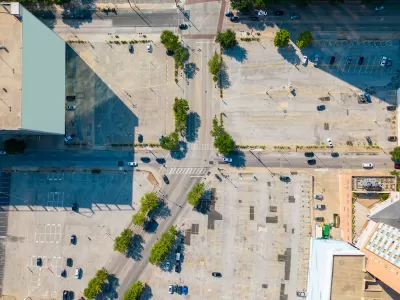
A memo initially meant to support a PARK(ing) Day event in Dallas went further than expected when it “also called on Dallas City Manager T.C. Broadnax to reduce parking in the city, brief city officials on the status of that goal and look into the “elimination of minimum parking requirements in the city” — a major overhaul to the city’s decades old parking code.”
According to an article by Nathan Collins for KERA News, the memo, written by Council Member Chad West, was submitted in early August. Cities around the country are removing minimum parking requirements as part of their efforts to make housing more affordable and limit sprawl and the need for car use.
Collins notes that under the city’s current parking policy, developers are required to build an off-street parking spot for each bedroom in a residential unit, raising the cost of housing construction. “City staff also says the code poses a barrier to redevelopment of existing buildings, disproportionately burdens small business and could delay environmental and walkability goals the city has adopted.”
Some city councilmembers say their districts are ‘underparked,’ while others point to the many surface parking lots in the city that could be more efficiently used. Andreea Udrea, assistant director of the city’s planning and urban design department, said during a council briefing that the management of existing parking spaces is the city’s biggest problem. “The supply is not managed. Meaning, if it overspills, there’s no tools to deal with that, there’s no tools for design.”
Any proposed amendments to the zoning code will likely reach the City Council in late 2023 or early 2024.
Read the full story: Elimination of minimum parking requirements' being discussed by Dallas officials

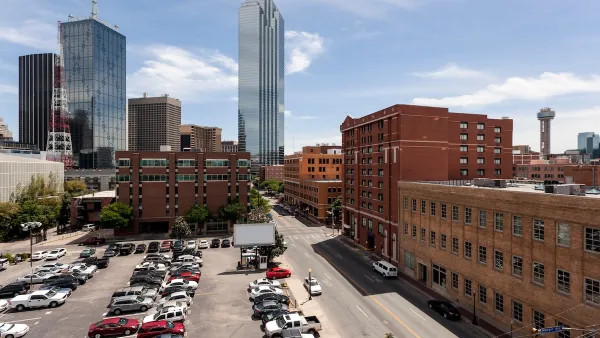
Dallas Ditches Parking Minimums in 14-1 Vote
The sweeping city council decision removes set parking requirements from developments downtown, near transit, small businesses and more.
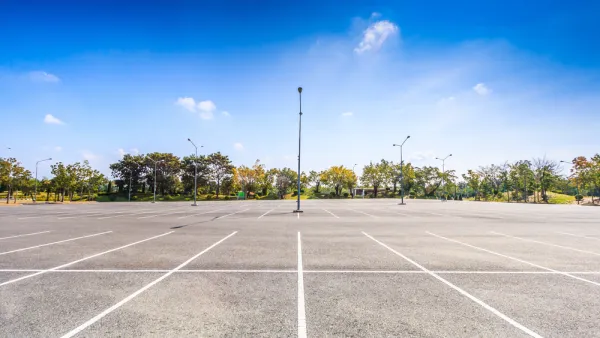
Dallas Considers Nixing Parking Requirements
According to one local official, Dallas projects routinely build 20 to 30 percent more parking than they need, driving up the cost of housing and leading to unsustainable land use patterns.
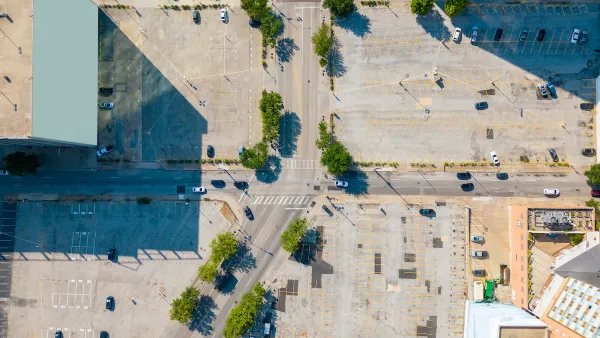
Dallas Could Eliminate Parking Requirements
Supporters of the measure say it would contribute to economic development and make local development more affordable.

Planetizen Federal Action Tracker
A weekly monitor of how Trump’s orders and actions are impacting planners and planning in America.

The state-sanctioned urbicide of Austin
People don’t kill cities. Freeways do.

US to reduce Colorado River water deliveries to Mexico
A new Colorado Treaty amendment reduces Mexico’s Colorado River water allocation by 250,000 acre feet.

NYC cools commuters with city's first rain garden above a bus stop
New York City officials say the plants in the rain garden can absorb 16 gallons of rainwater during heavy storms.

Brightline West’s future may rely on $6 billion federal loan
The company has until Nov. 2 to make a $400 million equity investment into its proposed high-speed rail line.

LA Metro’s ultimatum: no extra buses for LA28 if federal funding isn’t imminently secured
If Metro does not provide additional buses, LA28 organizers will have to find a new way to manage Olympic traffic. LA28’s budget does not include a line item for transit.

FREE Course: Walkable City 1: Why Walkability?
After describing his path towards focusing on walkability as the essence of good planning, Jeff Speck marches through his five principal reasons for making more walkable places.
Reinventing Malls: Planning Alchemy—Turning Gray Fields Into Gold
The course focuses on the opportunities and imperatives that shape reinvention of mall sites.

Eagle County Government
Harvard University Graduate School of Design
Nashville Planning Department
The Architects Foundation
University of Cincinnati Online
The Pocatello Development Authority
The Urban Renewal Agency of the City of Pocatello
Journal of the American Planning Association