‘Commonsense’ urbanism projects are being painted by opponents as sinister plots to limit movement and erode property rights.


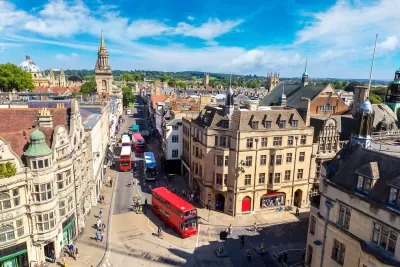
The conspiracy mindset fueling many of today’s “culture wars” has finally come for urban planning ideas, writes Skip Descant in Governing.
Alex Roy, co-founder of mobility consultancy Johnson & Roy and a host on the Autonocast podcast, calls out a “concerted effort against new mobility,” conducted largely on Twitter, that has attacked seemingly innocuous concepts like the 15-minute city and new mobility.
For Roy, “That mobility in cities should become politicized in America should come as no huge surprise.” In fact, Roy says “In the history of mobility, ‘every mode that arrived became politicized. It became the darling of the left, or the right.’”
Descant acknowledges it’s “easy to dismiss the chatter on Twitter and conservative media as simply white noise,” but the belief in dark global conspiracies that seek to gut property rights and limit movement is dangerous to advancing solutions to urban problems. “Given the many challenges facing cities, ranging from changing commuter patterns brought on by the COVID-19 pandemic, shifts in how we shop, and how we work, the problems facing cities are real and will require solutions rather than growing political divisions.”
Read the full story: ‘Culture Wars’ Break Out Over Public Transit, Urbanist Ideas

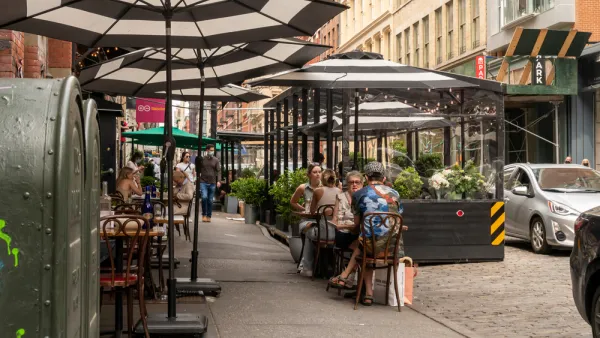
The Slow Retreat of Pandemic-Era Outdoor Dining Programs Continues
It’s been almost three years since the political dynamics of outdoor dining in the United States shifted, suddenly and overwhelmingly. Increasingly, the status quo is being restored.

Conspiracy Theorists Discover the 15-Minute City
USA Today debunks the false claim that the United Nations’ call for enabling 15-minute cities is a coded plan to institute ‘climate change lockdowns.’
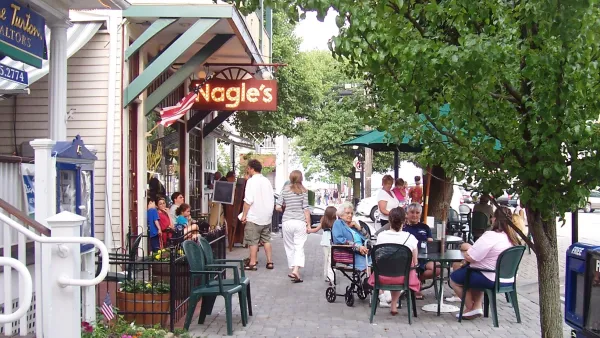
Defining the Buzzword: What's a 15-Minute City?
What does it mean to be a 15-minute city?

Planetizen Federal Action Tracker
A weekly monitor of how Trump’s orders and actions are impacting planners and planning in America.

California plans to bury El Niño’s downpour
If the state plays its cards right, it may be able to store a billion acre-feet of El Niño’s water in aquifers.

Chicago breaks ground on $3 billion megadevelopment
The new neighborhood, titled Foundry Park, will one day host 3,700 residences.

Satanic Place Names
From streams and lakes to valleys and canyons, I mapped more than 1,000 places named after the Devil.

California High-Speed Rail Authority CEO resigns after $600,000 scandal
Under Ian Choudri, the authority used taxpayer dollars to fund first class flights and trips to nightclubs.

Want to study the Missouri River? Soon, you may need unanimous approval from 10 states
Legislation would require 10 governors’ permission to study or build projects moving water outside the basin.

FREE Course: Walkable City 1: Why Walkability?
After describing his path towards focusing on walkability as the essence of good planning, Jeff Speck marches through his five principal reasons for making more walkable places.
Reinventing Malls: Planning Alchemy—Turning Gray Fields Into Gold
The course focuses on the opportunities and imperatives that shape reinvention of mall sites.

City of Rosemead
Rutgers University, Edward J. Bloustein School of Planning and Public Policy
One Hundred Miles
Hunter College, City University of New York (CUNY)
The Architects Foundation
University of Cincinnati Online
City of Cambridge
Montrose County
The Pocatello Development Authority