An underused freeway exit ramp is now an inviting linear park that connects the city to the Hudson River.


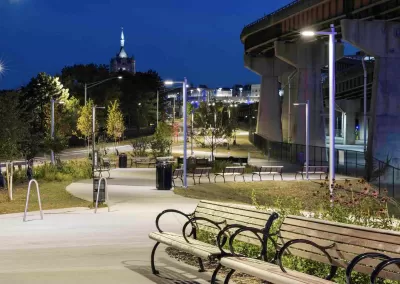
An underutilized former freeway ramp in Albany, New York was converted into a linear park, providing a model for how freeways and their surrounding infrastructure can be transformed into useful neighborhood amenities.
As Robert Steuteville explains in Congress for New Urbanism’s Public Square, “The $15 million Skyway—converting an Interstate ramp into a half-mile bike-ped corridor and park—realizes part of a long-held community vision to take back the waterfront as an accessible urban amenity,” writes Steuteville.
When first built, Interstate 787 displaced 7,000 residents and severed neighborhoods from the Hudson River. “Prior to the Skyway, reaching the waterfront from downtown required passage through public parking areas, a tangle of highway lanes, multiple signalized intersections, and unmarked and unlit walkways.”
The new park totals 3.3 acres and 2,680 feet in length from the intersection of Clinton Avenue and Broadway in downtown to US Route 9 by the river. Along the way are a 3,000 square foot outdoor art gallery, seating capacity for 600 people, 90,000 square feet of softscape park space with over 20,000 native plants and trees, and a 5,000-square-foot shaded area.
Steuteville adds, “The Skyway maximizes its limited resources by reclaiming an underutilized asset in a way that is aligned with Albany's vision for the future: an equitable and connected pedestrian and bicycle-friendly community.”
Read the full story: Freeway ramp becomes park, connecting city to its river
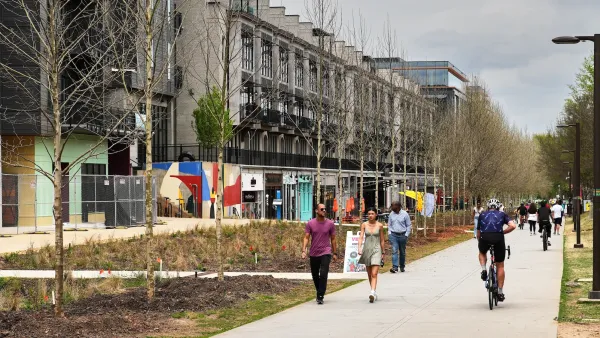
Trump has Slashed Over $750 Million From Bike and Walking Trail Projects
The Trump administration is pulling hundreds of millions allocated under the 2022 Inflation Reduction Act.
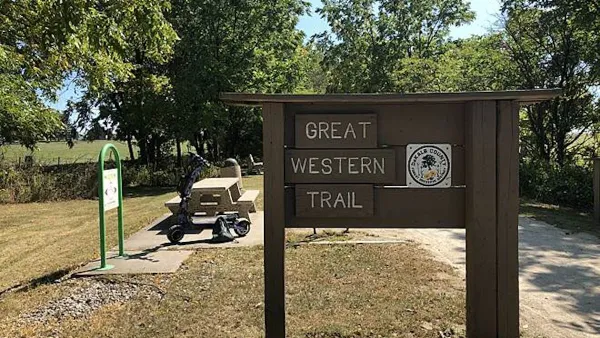
Advocates Champion the Great Western Trail
A Chicago walking and biking trail along a former railroad right-of-way has been a labor of love for local residents.
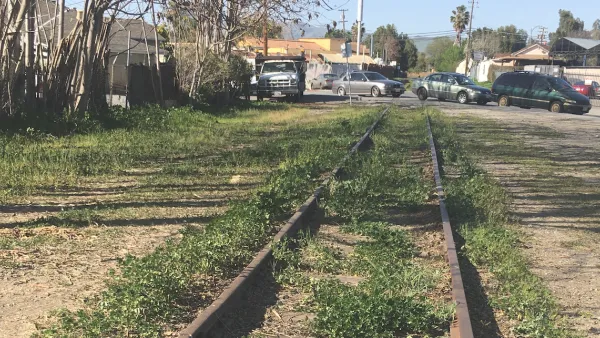
San Jose Walk/Bike Trail Moves Forward
The new trail will offer key connections to a new BART station and other local trails.

Planetizen Federal Action Tracker
A weekly monitor of how Trump’s orders and actions are impacting planners and planning in America.

California plans to bury El Niño’s downpour
If the state plays its cards right, it may be able to store a billion acre-feet of El Niño’s water in aquifers.

Desperate measures: Advocates weigh draining Lake Powell to fill Colorado River
Draining the reservoir could reduce evaporation losses by a couple hundred thousand acre-feet.

Chicago voters approve permanent festival grounds, penalty for vacant property owners
Currently, major summer and fall festivals take over public parks for weeks at a time, drawing criticism from nearby residents

NYC votes to cut outdoor dining red tape, speed up permitting
New York City also voted to allow the Department of Transportation to begin work on urgent projects before notifying elected officials.

California appears to reject Prop. 45
The proposition would have expanded the projects that qualify for a streamlined environmental review, effectively paring down the California Environmental Quality Act.

FREE Course: Walkable City 1: Why Walkability?
After describing his path towards focusing on walkability as the essence of good planning, Jeff Speck marches through his five principal reasons for making more walkable places.
Reinventing Malls: Planning Alchemy—Turning Gray Fields Into Gold
The course focuses on the opportunities and imperatives that shape reinvention of mall sites.

City of Rosemead
Rutgers University, Edward J. Bloustein School of Planning and Public Policy
One Hundred Miles
Hunter College, City University of New York (CUNY)
The Architects Foundation
University of Cincinnati Online
City of Cambridge
Montrose County
The Pocatello Development Authority