Residents and businesses are calling for a ban on trucks, which are increasingly taking up curbside parking in the city after neighboring Minneapolis instituted a similar rule.


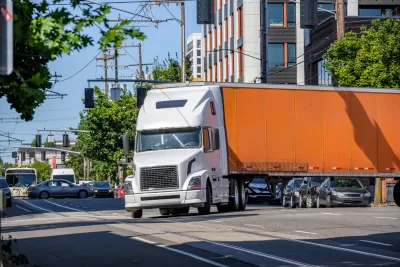
Writing in the Star Tribune, James Walsh describes a proposal to ban large trucks from parking on St. Paul streets. As Walsh notes, “Trucks are prohibited only in St. Paul's residential areas. But under a proposed amendment to city parking rules, those weighing more than 26,000 pounds would be banned from parking on any city street.”
Local businesses and residents say the rule is necessary to prevent trucks from blocking entrances and driveways and limiting visibility for pedestrians and drivers. The article quotes St. Paul public works director Sean Kershaw, who told City Council that “City streets simply weren't designed to have trucks taking up curb space.”
But truckers worry that the rule, like a similar one passed by Minneapolis in 2021, will cost them valuable work time by forcing them to park miles away from their homes. According to Walsh, “The Minneapolis ban has resulted in more trucks parking in parts of St. Paul close to the border between the two cities,” prompting the St. Paul proposal.
FULL STORY: No parking? St. Paul considers banning idle trucks from city streets

Reimagining the Curb: How Smart Curb Management is Transforming Urban Mobility
Modern demands for curbside space call for new ways to manage and allocate it.
How the Rise of Delivery Culture is Changing Urban Design
Curb management is quickly becoming a key part of urban planning as delivery vans, ride share vehicles, shared mobility devices, transit, and private cars compete for scarce curb space.

New California Law Lets Counties Seize RVs — Even if Their Owner Lives in Them
Advocates for the homeless say the law could make life harder and more unstable for people who use RVs as shelter.

Planetizen Federal Action Tracker
A weekly monitor of how Trump’s orders and actions are impacting planners and planning in America.

The state-sanctioned urbicide of Austin
People don’t kill cities. Freeways do.

US to reduce Colorado River water deliveries to Mexico
A new Colorado Treaty amendment reduces Mexico’s Colorado River water allocation by 250,000 acre feet.

5 New England states march closer to 800 megawatt wind energy project
Securing federal approval for the project may be complicated under the Trump administration, which has historically been hostile towards domestic wind power.

Baltimore to break ground on $50 million Transit Priority Project
The project will bring faster bus trips, safer streets and better bike connections to Baltimore.

Airbnb launches $250 million 'last-dollar financing' housing accelerator, makes first investment in Austin
The company will put $6.4 million towards affordable housing development in Texas’ capital.

FREE Course: Walkable City 1: Why Walkability?
After describing his path towards focusing on walkability as the essence of good planning, Jeff Speck marches through his five principal reasons for making more walkable places.
Reinventing Malls: Planning Alchemy—Turning Gray Fields Into Gold
The course focuses on the opportunities and imperatives that shape reinvention of mall sites.

Eagle County Government
Harvard University Graduate School of Design
Nashville Planning Department
The Architects Foundation
University of Cincinnati Online
The Pocatello Development Authority
The Urban Renewal Agency of the City of Pocatello
Journal of the American Planning Association