The budget proposed by the San Diego Association of Governments focuses on a new port of entry, expansion of the regional bikeway system, and mitigating coastal erosion.


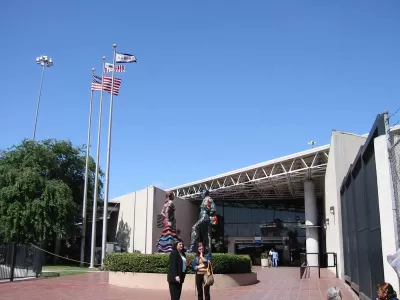
The San Diego Association of Governments (SANDAG) has released its $1.2 billion 2023-2024 budget, highlighting priorities that include bike lanes, a new port of entry at the southern border, and relocating train tracks imperiled by crumbling coastal bluffs. Joshua Emerson Smith describes the budget in the San Diego Union-Tribune.
The Otay Mesa East Port of Entry will create more capacity for border crossings for both passenger cars and freight vehicles with 10 toll lanes in both directions. The agency is funding a $51 million environmental analysis of potential options for relocating train tracks and stabilizing bluffs in Del Mar, where coastal erosion is putting close to 2 miles of rail at risk. And the region’s burgeoning 70-mile bikeway network is getting a boost with funding for the Bayshore Bikeway and new bike lanes in Imperial Beach and to the border in San Ysidro.
The budget also includes $20.4 million for the design of new and expanded commuter rail lines, most of which will go toward planning the proposed Downtown Central Mobility Hub, “a large station servicing trains, trolleys and buses, with a direct connection to the San Diego International Airport.”
FULL STORY: Borders, bikes, bluffs and rail: SANDAG's budget spells out top four priorities for 2023

San Diego Regional Transportation Plan Shifts Away From Big Projects to Focus on Improving Existing Infrastructure
SANDAG’s 2025 Regional Plan scales down plans for new rail lines in favor of expanding rapid bus service.
San Diego Region Developing Long-Range Transportation Plan
The new plan, set to take effect in 2025, accounts for changes in mobility patterns brought on by remote work.

San Diego Housing Programs Awarded $4.8 Million
The new funding will support city projects aimed at streamlining the process for building affordable housing and transit-oriented development.

Planetizen Federal Action Tracker
A weekly monitor of how Trump’s orders and actions are impacting planners and planning in America.

The state-sanctioned urbicide of Austin
People don’t kill cities. Freeways do.

US to reduce Colorado River water deliveries to Mexico
A new Colorado Treaty amendment reduces Mexico’s Colorado River water allocation by 250,000 acre feet.

Baltimore to break ground on $50 million Transit Priority Project
The project will bring faster bus trips, safer streets and better bike connections to Baltimore.

Airbnb launches $250 million 'last-dollar financing' housing accelerator, makes first investment in Austin
The company will put $6.4 million towards affordable housing development in Texas’ capital.

Guerilla urbanists are building DIY bus stop benches in Chicago
A before-and-after of one of the bus stops with a new bench. The new benches are not officially sanctioned or permitted, but the residents who placed them hope they will be the start of a network of DIY benches across the city.

FREE Course: Walkable City 1: Why Walkability?
After describing his path towards focusing on walkability as the essence of good planning, Jeff Speck marches through his five principal reasons for making more walkable places.
Reinventing Malls: Planning Alchemy—Turning Gray Fields Into Gold
The course focuses on the opportunities and imperatives that shape reinvention of mall sites.


Eagle County Government
Harvard University Graduate School of Design
Nashville Planning Department
The Architects Foundation
University of Cincinnati Online
The Pocatello Development Authority
The Urban Renewal Agency of the City of Pocatello
Journal of the American Planning Association