Amendments proposed in the state budget would also prohibit automated traffic enforcement and allow residents to travel to Canada, Mexico, and the Caribbean with Real IDs in lieu of passports.


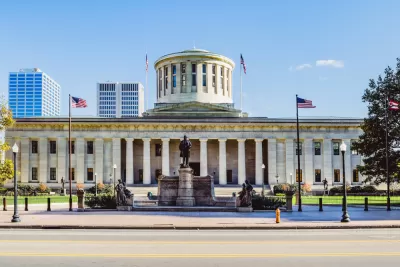
Ohio’s proposed state transportation budget calls for $1 billion in rural road funding while also banning mid-road bikeways, such as the Superior Midway planned in Cleveland. As Jeremy Pelzer reports in The Plain Dealer, the bill, HB23, “would give 80% of the $1 billion to the Ohio Department of Transportation (ODOT) for rural highway construction projects. The remaining 20% would be offered to local governments to use as matching funds for state highway money.”
The bikeway ban, which would apply to cities with populations of 300,000 or more and prohibit bikeways in the middle of roads or highways, was proposed by State Representative Tom Patton, who says “he’s heard complaints expressed by businesses along Superior Avenue that they will no longer be able to make left turns, as well as safety concerns made by the Ohio Trucking Association that the bike lane will make deliveries ‘very challenging in some places.’” The Superior Midway was approved by the Cleveland City Council last month and was scheduled to begin construction in May 2025.
The plan also proposes banning traffic cameras, which are opposed by many Republicans in the state.
Read the full story: Ohio lawmakers seek $1 billion for rural highways, propose ban on center bike lanes and county traffic-camera programs

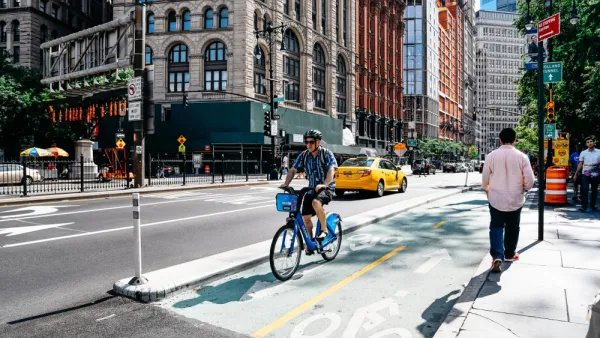
New York Could Use Cameras To Keep Drivers Out of Bike Lanes
A proposed state bill would permit New York City’s transportation department to install up to 50 cameras that would monitor bike lane violations, with drivers that block bike lanes facing a $50 fine.
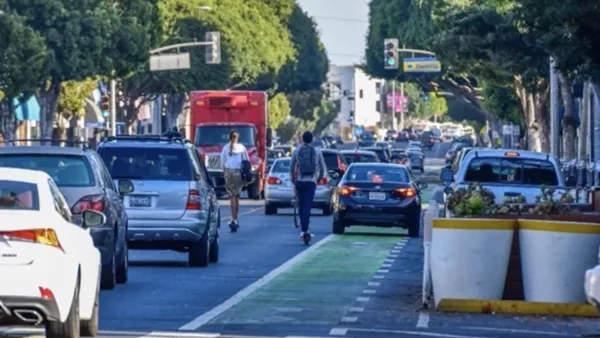
Santa Monica Puts AI Cameras on City Vehicles to Ticket Bike Lane Blockers
The city already uses bus-mounted cameras to catch violations along bus routes.

Idaho Bills Limit New Bike Lanes, Sidewalks
Cities in the county surrounding Boise will have to prove a “secondary benefit” before adding bike lanes or sidewalks to road projects.

Planetizen Federal Action Tracker
A weekly monitor of how Trump’s orders and actions are impacting planners and planning in America.

The state-sanctioned urbicide of Austin
People don’t kill cities. Freeways do.

Colorado’s Largest Data Center Could Rise Next to Homes — Without a Public Hearing
The proposed campus would consume 11 times the power of Denver International Airport; as it has across the country, opposition mounts.

Nation's most wind-powered state turns to coal as data centers increase energy demand
For the first time in decades, Iowa has increased its generation of coal power.

NYC cools commuters with city's first rain garden above a bus stop
New York City officials say the plants in the rain garden can absorb 16 gallons of rainwater during heavy storms.

Brightline West’s future may rely on $6 billion federal loan
The company has until Nov. 2 to make a $400 million equity investment into its proposed high-speed rail line.

FREE Course: Walkable City 1: Why Walkability?
After describing his path towards focusing on walkability as the essence of good planning, Jeff Speck marches through his five principal reasons for making more walkable places.
Reinventing Malls: Planning Alchemy—Turning Gray Fields Into Gold
The course focuses on the opportunities and imperatives that shape reinvention of mall sites.

Greater Baltimore Committee
Eagle County Government
Harvard University Graduate School of Design
The Architects Foundation
University of Cincinnati Online
The Pocatello Development Authority
The Urban Renewal Agency of the City of Pocatello
Journal of the American Planning Association