The city exceeded its goals for providing housing and creating new affordable housing units in 2022.


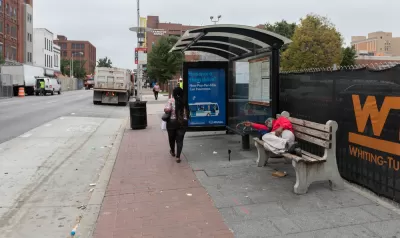
Baltimore exceeded its goals for housing unhoused residents, according to a brief by Danielle McLean in Smart Cities Dive.
The city aimed to rehouse 1,000 households and add 1,600 new affordable housing units to the development queue last year. It “found housing for 1,443 households experiencing homelessness in 2022 and added more than 2,500 affordable housing units to its development pipeline with the help of federal funds and technical support from the U.S. Department of Housing and Urban Development, the city announced on Tuesday.”
The achievement is impressive for a city with a poverty rate of roughly 20 percent, McLean points out. Using a ‘housing first’ approach, the city managed to reduce the number of unhoused people by 36 percent between 2018 and 2022 and by 63 percent in the last decade.
Kyana Underwood, public information officer for the Mayor’s Office of Homeless Services, said “All the Baltimore households rehoused in 2022 were placed in permanent housing, and many of them received wraparound supportive services such as substance abuse treatment.” The city is leveraging federal funding as part of the House America initiative.
FULL STORY: Baltimore exceeded homeless housing goals in 2022

Judge halts 'hasty' HUD changes to homelessness grants
Service providers said the sudden changes would have imperiled thousands of Americans and forced more people into homelessness.
New Book Highlights Human Side of Homelessness Crisis
A San Francisco reporter’s empathetic portrait of unhoused Bay Area residents reminds readers why supportive housing is worth fighting for.
Opinion: Unhoused People Need Housing, Not Law Enforcement
The sharp increase in the unhoused population calls for urgent action, not criminalization.

The state-sanctioned urbicide of Austin
People don’t kill cities. Freeways do.

US to reduce Colorado River water deliveries to Mexico
A new Colorado Treaty amendment reduces Mexico’s Colorado River water allocation by 250,000 acre feet.

New Jersey’s second-largest city bans standalone data centers
Jersey City will continue to allow co-location facilities, such as those meant for research institutions that store their own data.

Amtrak not solely to blame for New Jersey commuter rail's unreliability, report finds
A new study from the Garden State Initiative found that NJ Transit’s budget grew 20% across a 4 year period, but reliability declined significantly over the same period.

EPA erases limits on planet-warming pollution from power plants
Under Monday’s plan, power plants would still have some limits on how much mercury, arsenic and other contaminants they can emit.

Phoenix announces new on-demand transit service, more frequent RAPID buses
Both new services will launch in October, and are part of Phoenix's Project Effective Access Solutions for Easing Congestion.

FREE Course: Walkable City 1: Why Walkability?
After describing his path towards focusing on walkability as the essence of good planning, Jeff Speck marches through his five principal reasons for making more walkable places.
Reinventing Malls: Planning Alchemy—Turning Gray Fields Into Gold
The course focuses on the opportunities and imperatives that shape reinvention of mall sites.

Eagle County Government
Harvard University Graduate School of Design
Nashville Planning Department
The Architects Foundation
University of Cincinnati Online
The Pocatello Development Authority
The Urban Renewal Agency of the City of Pocatello
Journal of the American Planning Association